Showing posts with label digital transformation. Show all posts

Friday, February 28, 2020

Reframing consulting for the next decade

Consulting's core activities are being outmoded by the rise of digital and the demand for digital transformation.

An hypothesis: Clients need consulting to be reconfigured to prioritise and master:
  • Handling ambiguity
  • Enabling sustainability
To illustrate why I believe these are the fundamentals of successful consulting in the next 20 years, I am going to (first) reference Dave Snowden's Cynefin framework - a conceptual framework to support decision making. The following illustration is from Dave's Cognitive Edge site. 

DIGITAL HAS DRIVEN THE NEED TO MASTER COMPLEXITY

Consulting has, for the most part, operated in the ‘good practice’ area of the ‘Complicated’ upper right quadrant shown above. This is the realm of: Sense - Analyse - Respond  (in order to decide/act). The connections between cause and effect are complicated but knowable. Experience and expertise help discern those connections. And that has been the role of the consultant - the subject matter expert.

In many 'Systems Integrators', some of what also gets called consulting has has even fallen into the ‘bring the best practice’ area of the Obvious (see above). Here connections between cause and effect are well known and clearly visible. You just need to Sense-Categorize-Respond (see typical Business Analysis and vendor assessment work). The latter is commoditised, the former is outmoded by today’s digital requirements. 

Now the need is to handle the ambiguity of cause and effect experienced in Complex environments.

In complexity the connections between cause and effect are unknown. This is the realm of experiment, trying, new ways, understanding the connections by finding them. That's not analysis. No expert has a head start. The expertise required is in reading emergence (ie making sense) and in responding (ie getting on and doing as the best way of validating the emerging value. We can and should become expert in that.

Today's problem statements are far less of the 'How can I best respond to what I know?' variety and more of the 'How can I better understand what it is?' The latter can help us get to the former, but leaping straight to the former is an error in complex environments.

So consulting has to change what it does and how it does it, to:

1. Deal with the ambiguous, complex requirements of the digital world.

And that's not all...

Customer Experience has driven digital transformation to date - now there is a new dimension to CX to consider - Planet Experience (PX).

A NEW DIMENSION OF EXPERIENCE

Customer Experience drove the last 20 years of business success. Digital Transformation consulting has recognised this with the culture-change, processes and platforms to serve great CX.

Sustainable success in the next 20 years demands we add a new dimension to Experience. To great CX, (and the accompanying Employee Experience and Workplace Experience longevity demands) we must add PX - the elevation of the relationship with the planet to the level of the relationship with the customer.

I have written at length on #px in recent posts and shared initial frameworks for value generation and org maturity assessment. Core to this is the understanding that customers, employees and the culture of successful orgs over the next 20 years will demand we understand and create value for the planet just as much as we have the customer in the previous 20 years.

And just as those organisations that were built to partner the customer from the word-go ended up out-competing incumbents when they reached the scale of their older rivals, so, my hypothesis suggests, those organisations that are built to partner the planet will do so to the benefit of people and profit, too.

Example frameworks include the following:
And:
Given the PX imperative, consulting has to change what it does and how it does it, to:


Deal with the ambiguous, complex requirements of the digital world.

&

Handle the rising prioritisation of concerns for the planet.

Situational analysis (with the aid of Wardley Maps) shows us there is an increasing need to make sense at scale - revealing the task of the 21st Century consultant is to create confidence (on the certainty axis below) in complexity.
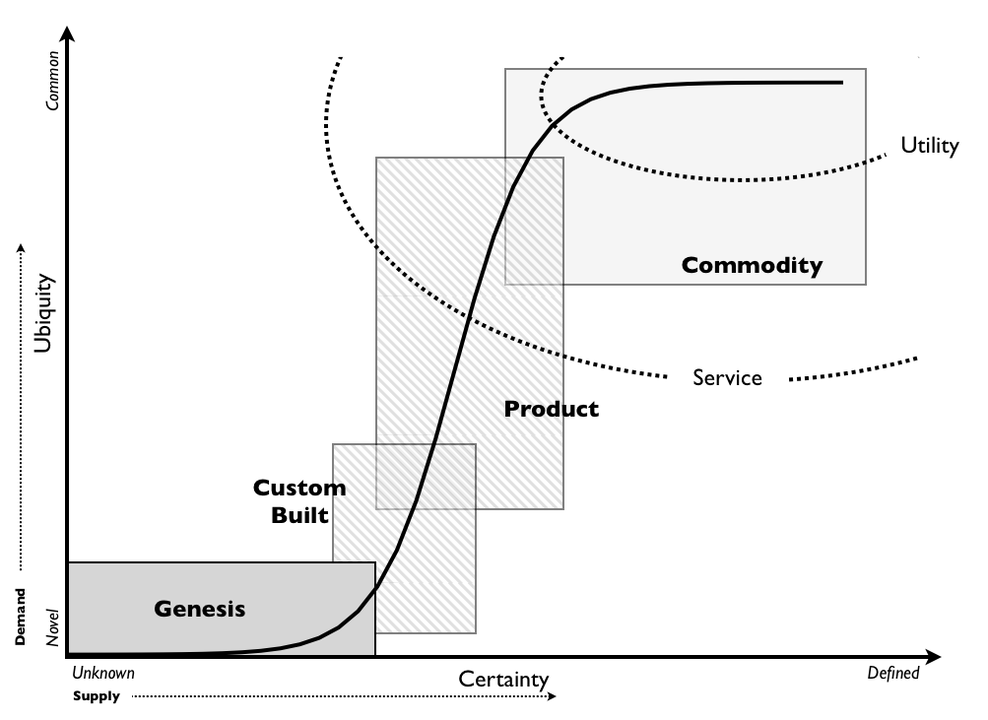

There is high demand for, but low understanding of digital transformation. This is evidenced by the high use of the term and the wide variety of meanings applied. We are far from 'Defined' (see above) yet demand is close to Common (on the Ubiquity axis). This suggests an urgent need to shift from hand-made solutions (Genesis) to take our clients toward greater certainty.

To do this we Productise as many of the capabilities that deliver emerging best practice as we can - ie we have to become expert in discovering emerging practices in complexity through repeatable and scalable ways of Probing, Sensing and Responding with end-user facing artefacts as rapidly as possible.

These ambiguity-handling activities respond to the need to move clients to greater certainty, enabling them to take advantage quickly as each practice emerges; productising the output at speed and achieving confidence (greater certainty) as each is defined.

As each new understanding of part of the complex emerges, this will drive value-building activities, creating higher-order outputs - just as productised nuts and bolts enable the building of higher order products when they replaced hand-made objects at the start of the industrial revolution.
 
The above slide illustrates some principles of action - mapping the amount of productisation vs customisation required in consulting activities across the project lifecycle.  Ambiguity is at its highest in the early steps.

Of course, how you act on the strategic imperatives I have outlined above will vary depending on your organisation's cultural, quality and profit goals. 

What is consistent is that different kinds of skills and ways of working will be a basic requirement of Consulting 2020 and beyond. For example:

PEOPLE
  • Divergent thinkers who seek to work at the speed of digital.
  • Those who have comfort with ambiguity- learned through experimentation.
  • Natural and continuous disruptors.
  • Less focused on analysis and more focused on evidence-through-testing to answer clear business questions
  • Those skilled in start-ups, experienced entrepreneurs.
WAYS OF WORKING

Processes and products focused on delivering emerging practice. eg:
  • Hypothesis generation/ideation.
  • Rapid, insight and value-led iterative prototyping of strategies as well as of products and services.
  • Tools and capabilities to prioritise and roadmap with an eye on the horizon for disruption.
  • Frameworks for PX in sustainable businesses.
  • Processes for the rapid productising (and scaling) of emergent practices.
Taken in total, this understanding and the action it requires of us, provides both the ambition and vision for Consulting for the next decade; its mission:
Create confidence in complexity for people, planet and profit by handling ambiguity and enabling sustainability.

Wednesday, February 13, 2019

Standardising innovation will deliver disruption at scale

I joined in a conversation on Linkedin triggered by one innovator positing a view on what disruption really is - and a dozen more piling in to place their version of the truth on record.
My point of view was/is this:
A technology trend has the potential to be disruptive
The response to it is a business model built on the co-evolution of practice which that trend prompts. If that response is a new model creating value in a new way, it will disrupt the existing landscape.

I felt the lack of clarity/consistency/agreement about a pivotal term like disruption revealed how far from being truly disruptive the innovation industry currently is. This comes as small surprise given that it is a core part of digital transformation (being the way-of-working How of digital transformation). And as I have previously pointed out - Digital Transformation faces its own lack of clarity on the supply side, at a time when demand is outstripping the industry's ability to supply it.

The nuts and bolts of innovation remain too often hand-wrought. We can not expect innovation to become the new way of working at a scale and regularity that the speed of digital demands, unless and until we bring a little more standardisation and certainty to it.

This was something I also referred to in: A Shared Language of Innovation recently. In that article I discuss the way in which terms such as MVP, POC, Pilot and Prototype get used in multiple ways. This speaks to the current lack of standardisation and uncertainty (when the client demand is for more standards and more certainty).

But that was just a start. Take a look at the terms I italicised in my initial POV above. We could have a lengthy debate on the meaning of all of them. Which would waste effort, time and intellect which would be better spent on creating the higher order complexity in which value actually resides.

Innovation - particularly where it relates to digital transformation - must agree and stick to making standard sized nuts and bolts. 

Until it gets close to ubiquity its impact will be limited.
There is little Disruption in making nuts and bolts - but there is next to none without them.

Monday, January 21, 2019

Creating new value - or simply keeping up?

Photo by Fancycrave on Unsplash

Demand for digital transformation is at an all time high - according to a survey of 600 leading execs for a DXC report: 2019: The year of digital decisions. It provides timely evidence that supports my mapping of the situation facing industry right now - referred to in detail here.

Referencing that article (The Job Of Digital Strategy Consulting): Companies are testing the water, feeling their way with agile here, lean there, new-tools-but-same-ways -of-working almost everywhere... There is no certain way of doing or being digital yet. Not by some distance. But we must expect that there will be movement in that direction.

What the increased demand/desire tells us is that digital transformation is headed toward ubiquity and with it standarisation and the need for interoperability. There's an increasing realisation that companies must build themselves a new future and this is at such scale that trying to do this with hand wrought nuts and bolts is too bespoke - too slow and too expensive.

What this also reminds us is that digital transformation is not the end product. It is a process of creating the nuts and bolts on which higher-order complexity - the novel stuff that creates greatest value - gets built.

When you have all the nuts and bolts, and power supplies and gears and pulleys and all those things you need to make stuff, it doesn't magically self-assemble. into things of value.

How you are able to use what you have brought together - the pile of 'what's' your grand 'why' of digital transformation may have provided you - that is where the magic happens.

The insight, the imagination, the ideation, the design, the rapid iteration, the testing and scaling - without these your digital investments are simply 'efficiency' spends. They won't even reduce your IT budgett. When we make stuff more efficiently we tend to use more of it (as Simon Wardley points out. Think how many more nuts and bolts got used as a result of standardising them.

What is needed is a way in which you can standardise and make repeatable the insight, the imagination, the ideation, the design, the rapid iteration, the testing and scaling. What is needed is a new way of working.

This is the 'How' of digital transformation and it is where the fight for market mastery gets won and lost.

In 2019 this is the most pressing challenge for creating new value vs simply keeping up.

Friday, November 16, 2018

Building in organisational adaptability

The way in which most businesses organise for value has a fundamental 20th century mass production design flaw. It constrains them from reaching both the capacity and capability to respond to the market at the speed our digital world demands.

It is specialisation.

Specialisation made a great deal of sense in a mass production world - enshrined in Adam Smith's pin factory, through Henry Ford's Model T and beyond.
But it presents a problem of friction for the modern, responsive organisation.

For example - if you have wonderful developers in one silo, and wonderful business leaders in another, you introduce a brake on responsiveness.
While you may have optimised your tech teams to develop, and your business teams to come up with ideas to value, in order to accelerate the generation of value these 'roles' should be more closely connected (as we see in Agile, Design Thinking, Lean Start-up, Holocracy and combinations thereof).
Specialisation made sense when neither party could easily access the skills of the other.

That has changed. Technology now enables business ideation. Technologies that enable one-to-one marketing, for example, can inspire businesses to ideate on the new models this supports. But the friction comes when tech delivery capacity and capability remain a bottleneck.

Those choke-points all too often force businesses back to 'as usual' when striving for new.
What is required is a way of giving business people technology skills and technology people business skills. In this way the organisation becomes more responsive to upturns and dips in  the requirement for both. It becomes built to adapt.

Pipe dream? Hardly - there are already many no-to-low code platforms and technologies which enable pretty much anyone with a laptop to develop their own applications and business process automation with nothing more than the lightest layer of additional coding*.
Business folk can be technology folk, too. At low cost. Minimum Viable Products can be crafted by the people with the vision and the insight - closing the strategy gap through direct and hands-on involvement.

And this cuts both ways. By applying managed innovation as a way of working (Agile, Design Thinking et al) Technology folk can become as enabled to access insight, set vision
and focus on value as their business colleagues.

Bringing both no-to-low code platforms and insight-led, human-centred managed innovation into your org, is a huge leap toward becoming a truly responsive organisation.

*I do not dismiss the importance of technologists. Even the best of these platforms 1. Had to be coded in the first place 2. Create their biggest bang for buck when some customisation is applied.

Monday, September 24, 2018

The strategic importance of managed innovation in digital transformation

A couple of thoughts in visual form on the strategic importance of managed innovation in digital transformation - and the behaviours required of the people involved:

First - the strategic importance:


Second - the behaviours


Friday, August 17, 2018

Crushed by scale

Photo by Mikito Tateisi on Unsplash
What if your process is simply scaling up doing the wrong thing?
What if your improved technology enables you to do that wrong thing even faster?

We often talk about the economies large organisations gain through scaling. But doing more of the wrong thing, that's the diseconomy of scale - and the crippling drag on the value of change.
So while we marvel at the new things, we must never be distracted from the need for new ways.


Digital Transformation is little more than a new thing to marvel at (an expensive tech upgrade) - unless it is accompanied by a shift to insight-led, value focused innovation as the organisation’s default way of working.
And while ideas are great, value is better. And continuous value creation is best.
To get to best requires tested frameworks, the right expertise, accelerators and approaches,. And they must be delivered in a repeatable, human-centred and transferable way.

And only once you are proving value... then you scale.


Wednesday, August 03, 2016

Digital is not a destination

I see a lot of talk about the journey to digital transformation as if its some kind of destination.
Becoming digital is not the end point. In many ways it's a launch pad to becoming a business prepared to engage in an increasingly digitized world.
There are some basic essentials with anything digital - understanding the technology requirements, the role of the data ( where you are going to get it from, store it, what it's going to inform, how you are going to draw insights from it) - the architectures required to bring business, hardware and software together, the layers of integration demanded; The people and the processes; the skills and the new ways of working, etc
But all you will achieve is the same but faster and cheaper (ideally) if becoming digital is your end game.
Becoming a different kind of business is where you should be headed; one which places customers in a different role; and one in which the business itself sees itself playing a different role. Setting this new goal, this new destination, is your first essential step. The roadmap comes second.
Digital is the way we connect ourselves; it reveals to us a connectedness which requires us to open and think differently about our role in the world. Does our presence in the life of customers offer us unique opportunities to understand behaviour; does that understanding reveal new business opportunities - does it reveal new benefits for society?
Uber is valued so high because it set out to value data first. It figured that by being a peer-supplied taxi service it would get lots of data about moving people and things. It is this data which they see as their long term business - delivering what ever you need where-ever you need it when-ever you need it.
That *may* reduce the carbon footprint of vehicle deliveries in the long run. It *may* reduce your costs or benefit your convenience. Soon they are going to have to be explicit about this every time your data is shared with them.
Be sure that businesses must  begin to think holistically about this - about having the best interests of their customers at heart and being able to demonstrate this. Without this they will not be allowed to take advantage of the new bounties data is offering.
Digital Transformation has always been a journey, not an end in itself. The end remains becoming an Open Business.


Friday, October 09, 2015

Listen Again: Antifragility and Digital Transformation

I had the pleasure and privilege of being invited to join an international panel to discuss antifragility and digital transformation on Wednesday October 7, 2015.
The panel was broadcast live at 5pm-6pm UK time but is already available to listen to at your leisure on the following link:


If you are hoping for a detailed discussion on the digital architecture required to make your business antifragile, this probably isn’t the discussion for you. But if you are interested in the human elements, the value of connectedness, openness, and the development of the truly networked, purpose-led organisation and the role these play in the sustainability of business, you’ll find plentiful riches.
Naturally, I brought my take from The 10 Principles of Open Business (which I note is suddenly scaling Amazon’s ‘Strategy’ book sales charts – perhaps no coincidence) and Anne McCrossan – founder of Visceral Business (link) spoke with passion for the humanising of the org and Todd Nilson who is director of consulting at Feverbee, the online community builders.

My sincere thanks must go to Sinan Si Alhir (Si), for his relentless sharing, connecting, openness and humanity. He brought us together and hosted the panel and never rests in his efforts to build a better future.

FasterFuture.blogspot.com

The rate of change is so rapid it's difficult for one person to keep up to speed. Let's pool our thoughts, share our reactions and, who knows, even reach some shared conclusions worth arriving at?