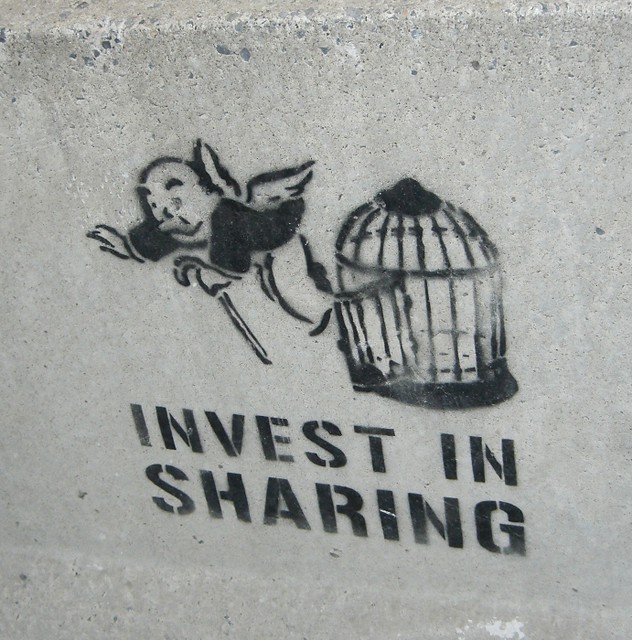
Showing posts with label sharing. Show all posts

Monday, June 10, 2013

Don't let Prism wreck the network - it belongs to you

The row over the ultimate data hoover that is Prism (catch up here with a quick guide of what it is and how legal or otherwise it may be) is, as usual, being characterised as a two-sided affair with battle lines drawn.
On one side we have our Governments - those who would protect us from whatever it is we are expected to live in terror of right now.
On the other are those who feel invaded and violated - that their data is the representation of their sovereign self - the protectors of our privacy.
Now, I'm not too concerned about the privacy thing.
I wrote in 2010:
"Privacy seeks to obscure truth. Often to an individual's personal benefit. Perhaps we are just going to have to get used to living in a state of truth - with the wider - by necessity less personal - benefits that may offer." (... the impact of an information revolution on privacy)
I've long argued that privacy is a relatively new and less-than-normal state for humankind. It's something that emerged when we started sleeping in separate rooms away from the cattle - around about the invention of the fireplace and chimney (read Bill Bryson At Home - A short History of Private Life - for more on that. It's a concept that is only some 500-600 years old. Culturally significant but in no way some kind of human need or even desire.
And I'm not big on kow-towing to terror either. Neither argument does it for me.
What I'm really concerned about in the Prism affair is that the fear of sharing it could generate could deliver a blow to the self-organising, open future we are on course for.
To self organise (the single biggest disruption to the centrally-organised status quo) we must express our meta data. That is, we must share what we think, as widely with each other, as often as possible. This is ultimately how we find each other at time of greatest need - how we find people who are seeking to solve the same problem as we are - right now.
One extra node on your network doubles its value - as I'm keen on repeating. We add each other through discovery.
So, if there's any conspiracy theory at play here that could cause us a collective problem, it's the one that's making you think twice about sharing, the one making you consider disconnecting and stopping sharing.
The centre would love that.
Stand firm. The network needs you.

Wednesday, January 25, 2012

The monkey in the machine

Here's another chance to see the marvellous Mark Earls (@herdmeister) present at the RSA on how things spread - how that social sharing thing happens (much less rational than we like to believe of ourselves).
I'm a big fan of Mark's book Herd. And no doubt I will be of the signed copy of his new book I'll Have What She's Having - when it arrives... (hint).


Enhanced by Zemanta

Thursday, November 17, 2011

Collaboration vs Competition

Competition is often touted as the powerhouse of successful growth. Beat the market or sink.
The battleground/adversarial approach has even worked successfully within companies. Successive Governments have tried unleashing it on the NHS.
There was little collaborative about the way emap operated in its fastest growing years for example. That publishing company (where I spent 20 years of my career) housed several motorcycle magazines within one building. All they shared (apart from healthy contempt for each other) was a desire to beat each other. Journalists on the same titles would fight against each other to claim the glory of the best stories.
If they had to share anything it was more likely to be with a foreign title from another company altogether.
Despite what the collaboration canon tells us, from Harvard Business Review to Wikinomics, it worked. Spectacularly. For many years emap's growth made it among the most admired companies on The FTSE.
And others have either adopted the model or arrived at it independently - promoting the cut-throat over the collaborator, the I over the team, keeping over sharing.
And they think it works.
But I wonder if they kid themselves?
Success is relative. They may be doing all right but could they do so much better by adopting a more collaborative approach - aggregating and distributing best practice rather than hoarding the tricks that allow some to win as others lose.
Could collaboration allow more to shine instead of the competitive approach which results in someone in the shade for every shining light?
I do think the no-share model has a place: where it is vital that the various parts of your company have distinct cultures and generate distinct outputs then there is potentially risk in sharing.
In our emap example, if the bike mags shared their exclusives, their contacts, their leads, their way of writing, their picture choices - well they'd have all shared the same character. And it was the differences which attracted readers, allowing them to label themselves through the choices they made.
So perhaps let that be your guide? Where you want to deliver a consistent outcome (if you are all part of one brand for example) collaborate internally. if you need to be different, compete internally.
But even then collaboration can help. It can help you shape the processes you can apply to reach very different and relevant outcomes. One best-practice process can result in very different outputs providing the inputs are different
And of course you can collaborate externally too.
Just make sure you don't end up collaborating with the same folk your competitors are...

- Posted using BlogPress from my iPad
Enhanced by Zemanta

Monday, April 18, 2011

What makes you share?


I’ve been wondering about the etymology of ‘Conversation’. The ‘con’ bit has been worrying me.
It’s been nagging at me ever since some social media auditing I was involved with (many moons ago) revealed that an online news article with positive sentiment attached (the Holy Grail for many a PR) more often than not triggered a deluge of negative sentiment in the comment stream.
This came up for me again recently when speaking with journalists at The Guardian about influence (which, for the record, I argue must always be thought of in-context and as emerging from relevance.)
It’s almost as if to generate the greatest volume of positive sentiment you should duplicitously create content which argues the contrary position to that which you want people to take (and more fundamentally, express that they take). (Image courtesy Toban Black)
Turns out the ‘Con’ part of conversation isn’t the part I should be concerned about (ahem) more the ‘versa’ bit – which is from the Latin versus and does hint at the argumentative nature of much of our dialogue.
The flip of this is that much conversation is much more of the social grooming part of our behaviour. We agree on the niceness of the weather, that policemen are looking younger and other such trivialities. By agreeing, we reveal how alike we are, bring loose ties a little closer, prepare the ground for doing stuff together should the need arise.
By taking contrary positions we are also sharing our identity – expressing where we are in conflict and through this discovering others who are in accord with us.
Now, whether or not taking a contrary position or agreeing with fellow humans is the most effective way of generating positive or negative sentiment is of marginal interest to me. Learn too much about this and seek to gain from it and I doubt you’ll end up feeling particularly clean.
What encourages others to express what they think – one way or the other? Now that does matter.
It matters because the only way we can find others who care about the same things we do is through one or other party expressing that concern. Until you share your thoughts they have no value to you or your network. They contribute nothing to making your life better or the world a better place.
But the simple act of sharing what you care about can make change. When you share you allow others to access your thoughts and to discover you. And bringing people together around things that matter to them is what changes our world.
So what drives you to share? What would make you share more?

Monday, April 26, 2010

Foursquare and the impact of an information revolution on privacy

Some time ago I decided to continue my experiment with FourSquare without hitting the 'share with Facebook' or 'share with Twitter' buttons.

I didn't want to irritate those who chose to follow my tweets, for example, but hadn't opted in to be my FourSquare friend.

I also thought there was some wisdom in limiting the people with whom I was sharing such precise, personal real-time geo-location. (image courtesy Robert Couse-Baker)

So I was a bit miffed to find that if a friend of yours is in the same location and you are both checked in, and he chooses to auto-tweet his FourSquare update, then the default is that he will share in Twitter that you are with him, too. ("Y is at X with @davidcushman).

And if his tweets aren't protected, (whose are?) then your location, who you were with and when, becomes, by default, public domain - and plenty searchable.

Whether or not the unintended sharing of my real time geolocation against my preferences matters or not doesn't sound like much of an issue - until you want to do clandestine stuff. An adhoc job interview, political deal making, affairs of the heart, etc.

Now of course in those circumstances, the wise man may choose not to geolocate themselves within or without FourSquare.

The problem though is that we may be mentioned in a tweet or status update by who ever we are with.
I don't blame FourSquare for this. I don't even seek to single them out. We are still scrabbling for the social etiquette of all this. I rarely ask, for example 'do you mind if I tweet who I'm with?'

Mostly we have the good sense to know what is right and what is wrong - when to seek permission and when to just go ahead (Antony Mayfield's excellent book, Me and My Web Shadow discusses some of this - I'll be reviewing it in detail before too long - disclosure, Antony and I sit together on the board of CitizensOnline).

But we are going through an information revolution; not just in who controls publication, distribution and user experience, but also in the volume of what has hitherto been viewed as personal, private and, to anyone other than our peers, trivial information.

In revolutions it's fair to say there's plenty of stuff that needs living in and through before we start reshaping definitions of wrong and right.

Indeed in a networked, group-forming world it's perfectly reasonable to expect niches of etiquette to emerge. One man's over-sharing may be another man's under-sharing.

If etiquette is the aggregated social conventions of a society, then 'societies' (adhoc communities of purpose) will be manifold, niche and global. One size won't fit all.

Which is all well and good when what is shared about you is shared by people you know. But that's just part of the issue.
Take a look at the picture below (that's Tory leader David Cameron at Starbucks at St Pancras).

What if either party hadn't wished to be known to be in the presence of the other, or to share that they were at x location at y time (google streetview, anyone?).

This picture was taken by someone neither of us knew and published to people that we (at least I) did.

I'm not objecting (at least not on this occasion), merely pointing out the reality of concepts of privacy about geolocation in a connected world.

Privacy seeks to obscure truth. Often to an individual's personal benefit.
Perhaps we are just going to have to get used to living in a state of truth - with the wider - by necessity less personal - benefits that may offer.
Reblog this post [with Zemanta]

Monday, March 22, 2010

Landing a man on the networked moon

Gordon Brown's plans to 'create innovation and personisation (is that customer-centric for the public sector?) in the delivery of public services will require rather more than faster broadband and a centre to understand and exploit the semantic web.
"Companies that use technology to interact with their users are positioning themselves for the future, and government must do likewise. Mygov marks the end of the one-size-fits-all, man-from-the-ministry-knows-best approach to public services.
"Mygov will constitute a radical new model for how public services will be delivered and for how citizens engage with government - making interaction with government as easy as internet banking or online shopping. This open, personalised platform will allow us to deliver universal services that are also tailored to the needs of each individual; to move from top-down, monolithic websites broadcasting public service information in the hope that the people who need help will find it - to government on demand."
Gordon Brown, PM. read full transcript

For Government,this is truly a mission on the scale of landing a man on the moon.

Not because it seems almost impossible to do, but because the scale of change, the number of barriers to overcome are so large, that essentially the UK system of government, the control from the centre model that matched the industrial age, must be utterly transformed to match the demands of the networked age.

I fear the announcement Brown made today in London is fundamentally too focused on the technology, too little on the organisational changes required to deliver the vision.

The UK Government, like every other government, like every other business, like every other organisation, must be redesigned on the principles of a networked business to deliver its purpose through a platform approach.

In this way they reduce the transaction costs of making things happen; turning a shared idea into an efficient 'fit' through the bringing together of communities of purpose.

There are no hard edges to networked organisations. There can't be. To scale and to enable they have to go beyond traditional boundaries. And they are not made by technology.

The fact that the technology enables transparency and connectedness like never before IS critical. But the desire for, and organisational design for, transparency and connectedness (for sharing; for scale through participation; for search to discover and help us organise through connecting us and our data; and for enabling the always on/not-always-available nature of the web (asychronous/synchronous) is the critical part - not the technology enabling it.

So Government - and all organisations aiming for longevity in this networked world of ours - must adapt (funny how my diagram below looks a little like rocket... perhaps it could land a man on the networked moon...):


Reblog this post [with Zemanta]

Wednesday, March 17, 2010

We don't pass on messages - we share ideas

I've often discussed why traditional advertising can't succeed in social environments.

It comes down to transmission: In social spaces the only way something gets distributed at all is because it is passed from one person who finds it useful/cool to someone else they think will think it useful/cool, too. (image courtesy furiousgeorge81)

So you have to provide messages that can be adapted. Jokes that can be retold in the form people wish to retell them. Unfinished articles. Messy kitchens.

The message you send out isn't how it'll be passed on. It never was anyway. There is more on that in this deck:


But of course what people pass on isn't a message.
"Hey Joe! Come on over here. I've got this great message to tell you!"
That is advertising. That is broadcast. It lacks the human touch.

No, what we actually do is pass on ideas, not messages.

So, what's the idea you want to share, that others can adapt, embrace, contribute to, share?
"Hey Joe! Come on over here. I've got a great idea I want to share!"
That is human. And being human is a bit of a bonus when you want to communicate with other humans.

Thursday, September 10, 2009

Your mother was right

A short video from Red Hat (via Chris Brogan) which makes some well worn points in an elegant way. You may find it helpful if you are one of the many working hard to convince others of the need to adapt to the networked world.

It explains how a billion dollar company became what it is, by giving things away. That is - by contributing to and participating in communities.

Red Hat lived a line I like to use: "The people who can make the biggest difference to your business don't work for it."


Reblog this post [with Zemanta]

FasterFuture.blogspot.com

The rate of change is so rapid it's difficult for one person to keep up to speed. Let's pool our thoughts, share our reactions and, who knows, even reach some shared conclusions worth arriving at?