Showing posts with label complexity. Show all posts

Thursday, May 28, 2020

Being Change: A Responsive Organisation Needs Responsive People

Over the last series of posts I have illustrated the need to become, and the benefits of, The Responsive Organisation.
I have drilled into how to identify and how to respond to the Context Shocks from which a Responsive Organisation can benefit. I have provided a guide to developing and scaling its capability to benefit.

But, of course, a responsive organisation needs to be populated by Responsive People.
Indeed, from the lessons we learn from feedback loops, the responsiveness of the people who are the organisation will prove either dampener or accelerator to the responsiveness of the organisation.
I referred to the responsiveness in the individual as 'learned personal antifragility' in a previous post and recommended that those of us who had learned this, may hold some responsibility to share how, with others.

That is the intention of this post.

Engaging people in their personal journey of change is, in the reality of the complexity of organisations, entangled with the change of the organisation.

In the chaotic moments of Context Shock, of the kind we are experiencing through Covid19, the need to 'see what we do not see' is essential - and reliant upon the 'wisdom of crowds' that engaging everyone in the organisation can give you. Dave Snowden's Cynefin framework and its application to leadership through crisis provide ample evidence of the value of this.

A fine example of 'what we do not see' - and one shared by Dave - is this widely published image (below). 83% of radiologists miss the anomaly so don't feel bad if you do. Taken individually there's a very large chance it gets missed. But if you ask 100 radiologists it gets found (17 times being enough for you to take a closer look... at the Gorilla in the dark, top, right side of the lungs.

However, in the context of today's post I want to emphasise the purpose of 'asking the crowd' for its additional value in engaging people in change they can embrace.
Very simply the process for this is:
1. Identify and reach out to your crowd
2. Set the constraints of their observations
3. Capture their response as close to real-time as possible
4. Conduct your quantitative analysis
5. Spot the Gorilla and tell the crowd.

Now we have their attention (as well as useful emergence from weak signals to shape responses to the Context Shock).

The next step is to help them learn their personal antifragility. Your responsive organisation is reliant on people seeking learning experiences in change vs responding with fear. The more people you can take on the journey, the more you can amplify the positive benefits of the responsive organisation.

When Rory Yates and I reflected on what had given us some form of personal antifragility, the themes reflected in the slide above became clear (follow previous link for our validations).

With my 4-steps of Making Responsive People (above slide) I am seeking to replicate some of what we have learned from 20+ years in digital innovation and change.

1. Play: If you aren't a gamer and never have been, you missed out on some foundational stuff. We learned trial and error in a very 'safe to fail' environment. Let's close that gap in your psychological armour.
2. Feedback Loops: Properties on the web were so much more instantly measurable than anything that had come before. We learned to try stuff and saw, very quickly, what happened as and when we did. We saw rewards fast and that improved our responsiveness. So find what measures directly what you do, and measures it fast. Then, crucially, we must encourage and reward you to respond to what happens.
3. Positive Psychology: Recognise that most people fear change. They don't seek learning opportunities. They see threat in movement. It's natural. But it can be overcome. Programs which help people identify their 'Fixed Mindset' blindspots (see Carol Dweck's Mindset) can and do help us to change our approach to change. Building happiness through low-effort, high impact activities such as Yale University's (free and online) Science of Wellbeing Course gives us the tools of positive psychology to help.
4. Learn Through Doing: This is the essence of Being Change. But simply thrusting people at anything, from back to normal, to new normal, to no normal, without making them change ready, is a recipe for fear, unhappiness and dampened organisational responsiveness. You may identify some teams are ready to go straight to this step. Game-on for them . But they are in the minority. So for the rest, ensure steps 1-3 are conducted, then start your newly responsive-ready people on small, relatively low risk, test-and-learn projects with very small teams (5 works well).

Applied at scale you have tools to make your people, and with them the organisation, much more responsive.

Monday, May 25, 2020

Is furlough a glimpse of a bot-powered economy?

The Context Shock of Covid-19 is forcing underlying trends to the surface at unprecedented rates. We aren't experiencing anything that wasn't going to happen anyway - we are experiencing it faster.

Political economist Orit Gal points out: "complexity theory teaches us that major events are the manifestation of maturing and converging underlying trends: they reflect change that has already occurred within the system."

This means going 'back to normal' is a mistake. As is failing to become more responsive.

I have detailed two of these trends in distributed working, and the responsive organisation (and it can be argued distributed working is nested in and part of the trend towards the responsive organisation).

I have also documented the trend towards treating our planet as a partner, in the way we have become good at treating our customers with respect - in the concept of Planet Experience.

There are, naturally, others. The trend towards a cashless society, for example, away from traditional education (by subject and as a mass production model), for another.

I want to raise some questions about the acceleration of a significant and immediate additional trend today, because its second and third order consequences will have extreme impact on our economic model: Automation. 

As companies survey the challenges facing them over the next 12-18 months they will seek to cut costs both by scaling back on their office needs (distributed working) but also by automating everything they can. If any aspect of your job can be automated and the business you are working for is looking to survive, what it will spend on, is in ways of saving money. And it's undeniable that bots usually look like a short term win in this respect.

We can argue about the harm caused by the loss of smarts from carving people out of a business. The brighter organisations will use bots to lift and shift the bits of people's working lives that don't require creativity and imagination - so that that the people are free to create value by being more creative and imaginative. But that's looking on the bright side.

We are in a darkened world of raised drawbridges, of panic and protectionism. Fear will drive many, many struggling businesses to simply take the savings and worry about the consequences later.

Those consequences will include large scale unemployment. And for many people, pivoting to being an RPA expert (for example) will, realistically, be out of reach.

What this leads us to is the acceleration of a further underlying trend - perhaps towards some version of the Universal Basic Income. Covid-19 has given us an accelerated glimpse of that future through schemes such as the UK Government's Furlough policy. Touted as a job retention scheme on the assumption things get better again fast, coupled with the lock-down experience, it may prove a leading indicator of life after large scale automation. A taste of things to come.

There is nothing intrinsically wrong with bots taking peoples jobs. The challenges are in how we judge what constitutes a positive contribution to the society we live in and the ecosystem on which we rely.

If you enjoy time in the sun, exercising, learning, baking, creating art, music, craft, and in time, spending time with friends and family - doing the things you 'enjoy' more of the time than the things that are recognised as making an economic contribution (ie working), then perhaps we should formally value the enjoyable stuff as highly as we do the 'economically valuable' stuff.

But how? How do we get paid if the bots are doing our jobs? 

Stephen Hawkins last message on the web gave us a clue. He said the problem wasn't the bots, it was capitalism - at least the form of market-first capitalism dominant today. Bots are bad if they mean the economic value they create /displace comes back to fewer and fewer owners of this new means of production. Bots are fine if the value they create is more equally distributed to the benefit of both society and planet.

Taxing bots has been suggested to tackle this in the short term, with the tax raised being available to spend on positive interventions for society. Which could include a Universal Basic Income and investment in a happier, healthier society and planet.

This trend demands something important of us - our understanding of our own value, and of what we call success. We will need to start prioritising happiness over stores of wealth.

Is that all bad?


Photo by Robert Collins on Unsplash


Friday, February 28, 2020

Reframing consulting for the next decade

Consulting's core activities are being outmoded by the rise of digital and the demand for digital transformation.

An hypothesis: Clients need consulting to be reconfigured to prioritise and master:
  • Handling ambiguity
  • Enabling sustainability
To illustrate why I believe these are the fundamentals of successful consulting in the next 20 years, I am going to (first) reference Dave Snowden's Cynefin framework - a conceptual framework to support decision making. The following illustration is from Dave's Cognitive Edge site. 

DIGITAL HAS DRIVEN THE NEED TO MASTER COMPLEXITY

Consulting has, for the most part, operated in the ‘good practice’ area of the ‘Complicated’ upper right quadrant shown above. This is the realm of: Sense - Analyse - Respond  (in order to decide/act). The connections between cause and effect are complicated but knowable. Experience and expertise help discern those connections. And that has been the role of the consultant - the subject matter expert.

In many 'Systems Integrators', some of what also gets called consulting has has even fallen into the ‘bring the best practice’ area of the Obvious (see above). Here connections between cause and effect are well known and clearly visible. You just need to Sense-Categorize-Respond (see typical Business Analysis and vendor assessment work). The latter is commoditised, the former is outmoded by today’s digital requirements. 

Now the need is to handle the ambiguity of cause and effect experienced in Complex environments.

In complexity the connections between cause and effect are unknown. This is the realm of experiment, trying, new ways, understanding the connections by finding them. That's not analysis. No expert has a head start. The expertise required is in reading emergence (ie making sense) and in responding (ie getting on and doing as the best way of validating the emerging value. We can and should become expert in that.

Today's problem statements are far less of the 'How can I best respond to what I know?' variety and more of the 'How can I better understand what it is?' The latter can help us get to the former, but leaping straight to the former is an error in complex environments.

So consulting has to change what it does and how it does it, to:

1. Deal with the ambiguous, complex requirements of the digital world.

And that's not all...

Customer Experience has driven digital transformation to date - now there is a new dimension to CX to consider - Planet Experience (PX).

A NEW DIMENSION OF EXPERIENCE

Customer Experience drove the last 20 years of business success. Digital Transformation consulting has recognised this with the culture-change, processes and platforms to serve great CX.

Sustainable success in the next 20 years demands we add a new dimension to Experience. To great CX, (and the accompanying Employee Experience and Workplace Experience longevity demands) we must add PX - the elevation of the relationship with the planet to the level of the relationship with the customer.

I have written at length on #px in recent posts and shared initial frameworks for value generation and org maturity assessment. Core to this is the understanding that customers, employees and the culture of successful orgs over the next 20 years will demand we understand and create value for the planet just as much as we have the customer in the previous 20 years.

And just as those organisations that were built to partner the customer from the word-go ended up out-competing incumbents when they reached the scale of their older rivals, so, my hypothesis suggests, those organisations that are built to partner the planet will do so to the benefit of people and profit, too.

Example frameworks include the following:
And:
Given the PX imperative, consulting has to change what it does and how it does it, to:


Deal with the ambiguous, complex requirements of the digital world.

&

Handle the rising prioritisation of concerns for the planet.

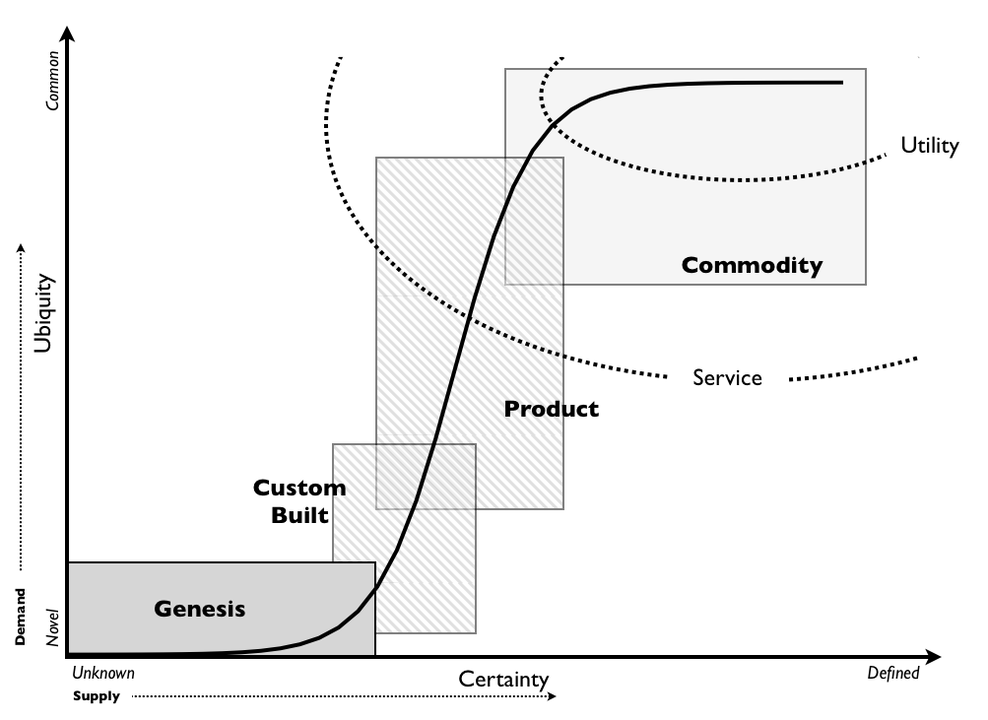
Situational analysis (with the aid of Wardley Maps) shows us there is an increasing need to make sense at scale - revealing the task of the 21st Century consultant is to create confidence (on the certainty axis below) in complexity.


There is high demand for, but low understanding of digital transformation. This is evidenced by the high use of the term and the wide variety of meanings applied. We are far from 'Defined' (see above) yet demand is close to Common (on the Ubiquity axis). This suggests an urgent need to shift from hand-made solutions (Genesis) to take our clients toward greater certainty.

To do this we Productise as many of the capabilities that deliver emerging best practice as we can - ie we have to become expert in discovering emerging practices in complexity through repeatable and scalable ways of Probing, Sensing and Responding with end-user facing artefacts as rapidly as possible.

These ambiguity-handling activities respond to the need to move clients to greater certainty, enabling them to take advantage quickly as each practice emerges; productising the output at speed and achieving confidence (greater certainty) as each is defined.

As each new understanding of part of the complex emerges, this will drive value-building activities, creating higher-order outputs - just as productised nuts and bolts enable the building of higher order products when they replaced hand-made objects at the start of the industrial revolution.
 
The above slide illustrates some principles of action - mapping the amount of productisation vs customisation required in consulting activities across the project lifecycle.  Ambiguity is at its highest in the early steps.

Of course, how you act on the strategic imperatives I have outlined above will vary depending on your organisation's cultural, quality and profit goals. 

What is consistent is that different kinds of skills and ways of working will be a basic requirement of Consulting 2020 and beyond. For example:

PEOPLE
  • Divergent thinkers who seek to work at the speed of digital.
  • Those who have comfort with ambiguity- learned through experimentation.
  • Natural and continuous disruptors.
  • Less focused on analysis and more focused on evidence-through-testing to answer clear business questions
  • Those skilled in start-ups, experienced entrepreneurs.
WAYS OF WORKING

Processes and products focused on delivering emerging practice. eg:
  • Hypothesis generation/ideation.
  • Rapid, insight and value-led iterative prototyping of strategies as well as of products and services.
  • Tools and capabilities to prioritise and roadmap with an eye on the horizon for disruption.
  • Frameworks for PX in sustainable businesses.
  • Processes for the rapid productising (and scaling) of emergent practices.
Taken in total, this understanding and the action it requires of us, provides both the ambition and vision for Consulting for the next decade; its mission:
Create confidence in complexity for people, planet and profit by handling ambiguity and enabling sustainability.

Monday, January 07, 2013

The dash from convergence and how the web can save us if we choose


I wonder if the proliferation of devices we are experiencing give us a hint about what will happen to the web?
A few years back – when the first smart phones were making inroads, when the first all-you-can-eat mobile data deals were laid before a hungry audience, then it seemed to make perfect sense that convergence would arrive via the device.

Hell, I have a phone that can take picture, tell the time, calculate, run my diary... open documents, access my email, access the internet, play games and music, play video, show broadcast tv etc etc. Why wouldn’t we think one device could do it all?

And here I am packing a few items for some days away on business and finding it essential that I load up with a laptop, ipad, kindle fire AND iphone (4S)...
Little sign of convergence here. And I’ve never given up on wearing a watch either.

But platforms? Despite the vast variety of opportunity, there are only ever a handful of giants. Facebook, Twitter, Linkedin, for example

All start off with relatively focused aims. But over time they bloat – copying the ideas of others, assuming that the battle is on for the one social home we will become and remain loyal to.

But the more they bloat, the more we see the value in the specific, the more we spill out into those with greater focus on specific needs – the Pinterests, Instagrams, 4Squares of this world – and the thousands more behind them in the long tail.

I wonder if, given just a little more bloating from the big boys, we may rediscover the self-forming-group value of the web – that we need less direction and guidelines from those who would be our internet, and more purpose from ourselves to make our connectedness count.

The dash from convergence in devices may be yet another indicator that we are more comfortable with complexity than the reductionists would have us believe, that we value niche over lowest common denominator in a very powerful way.

And that’s a good thing – because it’s a much better match with the infinite variety of adhoc self-forming groups the web is built to enable.

The web is our salvation from the bland, from the mass, from the uniform. If we want it to be.

FasterFuture.blogspot.com

The rate of change is so rapid it's difficult for one person to keep up to speed. Let's pool our thoughts, share our reactions and, who knows, even reach some shared conclusions worth arriving at?