Showing posts with label complex adaptive systems. Show all posts

Monday, May 25, 2020

Is furlough a glimpse of a bot-powered economy?

The Context Shock of Covid-19 is forcing underlying trends to the surface at unprecedented rates. We aren't experiencing anything that wasn't going to happen anyway - we are experiencing it faster.

Political economist Orit Gal points out: "complexity theory teaches us that major events are the manifestation of maturing and converging underlying trends: they reflect change that has already occurred within the system."

This means going 'back to normal' is a mistake. As is failing to become more responsive.

I have detailed two of these trends in distributed working, and the responsive organisation (and it can be argued distributed working is nested in and part of the trend towards the responsive organisation).

I have also documented the trend towards treating our planet as a partner, in the way we have become good at treating our customers with respect - in the concept of Planet Experience.

There are, naturally, others. The trend towards a cashless society, for example, away from traditional education (by subject and as a mass production model), for another.

I want to raise some questions about the acceleration of a significant and immediate additional trend today, because its second and third order consequences will have extreme impact on our economic model: Automation. 

As companies survey the challenges facing them over the next 12-18 months they will seek to cut costs both by scaling back on their office needs (distributed working) but also by automating everything they can. If any aspect of your job can be automated and the business you are working for is looking to survive, what it will spend on, is in ways of saving money. And it's undeniable that bots usually look like a short term win in this respect.

We can argue about the harm caused by the loss of smarts from carving people out of a business. The brighter organisations will use bots to lift and shift the bits of people's working lives that don't require creativity and imagination - so that that the people are free to create value by being more creative and imaginative. But that's looking on the bright side.

We are in a darkened world of raised drawbridges, of panic and protectionism. Fear will drive many, many struggling businesses to simply take the savings and worry about the consequences later.

Those consequences will include large scale unemployment. And for many people, pivoting to being an RPA expert (for example) will, realistically, be out of reach.

What this leads us to is the acceleration of a further underlying trend - perhaps towards some version of the Universal Basic Income. Covid-19 has given us an accelerated glimpse of that future through schemes such as the UK Government's Furlough policy. Touted as a job retention scheme on the assumption things get better again fast, coupled with the lock-down experience, it may prove a leading indicator of life after large scale automation. A taste of things to come.

There is nothing intrinsically wrong with bots taking peoples jobs. The challenges are in how we judge what constitutes a positive contribution to the society we live in and the ecosystem on which we rely.

If you enjoy time in the sun, exercising, learning, baking, creating art, music, craft, and in time, spending time with friends and family - doing the things you 'enjoy' more of the time than the things that are recognised as making an economic contribution (ie working), then perhaps we should formally value the enjoyable stuff as highly as we do the 'economically valuable' stuff.

But how? How do we get paid if the bots are doing our jobs? 

Stephen Hawkins last message on the web gave us a clue. He said the problem wasn't the bots, it was capitalism - at least the form of market-first capitalism dominant today. Bots are bad if they mean the economic value they create /displace comes back to fewer and fewer owners of this new means of production. Bots are fine if the value they create is more equally distributed to the benefit of both society and planet.

Taxing bots has been suggested to tackle this in the short term, with the tax raised being available to spend on positive interventions for society. Which could include a Universal Basic Income and investment in a happier, healthier society and planet.

This trend demands something important of us - our understanding of our own value, and of what we call success. We will need to start prioritising happiness over stores of wealth.

Is that all bad?


Photo by Robert Collins on Unsplash


Friday, February 28, 2020

Reframing consulting for the next decade

Consulting's core activities are being outmoded by the rise of digital and the demand for digital transformation.

An hypothesis: Clients need consulting to be reconfigured to prioritise and master:
  • Handling ambiguity
  • Enabling sustainability
To illustrate why I believe these are the fundamentals of successful consulting in the next 20 years, I am going to (first) reference Dave Snowden's Cynefin framework - a conceptual framework to support decision making. The following illustration is from Dave's Cognitive Edge site. 

DIGITAL HAS DRIVEN THE NEED TO MASTER COMPLEXITY

Consulting has, for the most part, operated in the ‘good practice’ area of the ‘Complicated’ upper right quadrant shown above. This is the realm of: Sense - Analyse - Respond  (in order to decide/act). The connections between cause and effect are complicated but knowable. Experience and expertise help discern those connections. And that has been the role of the consultant - the subject matter expert.

In many 'Systems Integrators', some of what also gets called consulting has has even fallen into the ‘bring the best practice’ area of the Obvious (see above). Here connections between cause and effect are well known and clearly visible. You just need to Sense-Categorize-Respond (see typical Business Analysis and vendor assessment work). The latter is commoditised, the former is outmoded by today’s digital requirements. 

Now the need is to handle the ambiguity of cause and effect experienced in Complex environments.

In complexity the connections between cause and effect are unknown. This is the realm of experiment, trying, new ways, understanding the connections by finding them. That's not analysis. No expert has a head start. The expertise required is in reading emergence (ie making sense) and in responding (ie getting on and doing as the best way of validating the emerging value. We can and should become expert in that.

Today's problem statements are far less of the 'How can I best respond to what I know?' variety and more of the 'How can I better understand what it is?' The latter can help us get to the former, but leaping straight to the former is an error in complex environments.

So consulting has to change what it does and how it does it, to:

1. Deal with the ambiguous, complex requirements of the digital world.

And that's not all...

Customer Experience has driven digital transformation to date - now there is a new dimension to CX to consider - Planet Experience (PX).

A NEW DIMENSION OF EXPERIENCE

Customer Experience drove the last 20 years of business success. Digital Transformation consulting has recognised this with the culture-change, processes and platforms to serve great CX.

Sustainable success in the next 20 years demands we add a new dimension to Experience. To great CX, (and the accompanying Employee Experience and Workplace Experience longevity demands) we must add PX - the elevation of the relationship with the planet to the level of the relationship with the customer.

I have written at length on #px in recent posts and shared initial frameworks for value generation and org maturity assessment. Core to this is the understanding that customers, employees and the culture of successful orgs over the next 20 years will demand we understand and create value for the planet just as much as we have the customer in the previous 20 years.

And just as those organisations that were built to partner the customer from the word-go ended up out-competing incumbents when they reached the scale of their older rivals, so, my hypothesis suggests, those organisations that are built to partner the planet will do so to the benefit of people and profit, too.

Example frameworks include the following:
And:
Given the PX imperative, consulting has to change what it does and how it does it, to:


Deal with the ambiguous, complex requirements of the digital world.

&

Handle the rising prioritisation of concerns for the planet.

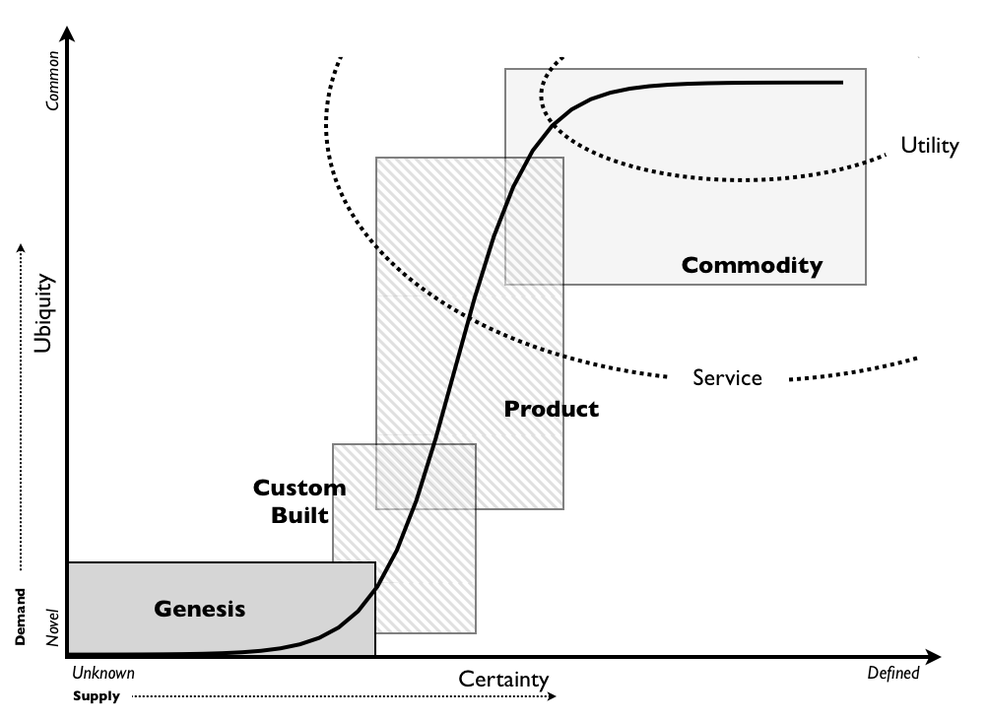
Situational analysis (with the aid of Wardley Maps) shows us there is an increasing need to make sense at scale - revealing the task of the 21st Century consultant is to create confidence (on the certainty axis below) in complexity.


There is high demand for, but low understanding of digital transformation. This is evidenced by the high use of the term and the wide variety of meanings applied. We are far from 'Defined' (see above) yet demand is close to Common (on the Ubiquity axis). This suggests an urgent need to shift from hand-made solutions (Genesis) to take our clients toward greater certainty.

To do this we Productise as many of the capabilities that deliver emerging best practice as we can - ie we have to become expert in discovering emerging practices in complexity through repeatable and scalable ways of Probing, Sensing and Responding with end-user facing artefacts as rapidly as possible.

These ambiguity-handling activities respond to the need to move clients to greater certainty, enabling them to take advantage quickly as each practice emerges; productising the output at speed and achieving confidence (greater certainty) as each is defined.

As each new understanding of part of the complex emerges, this will drive value-building activities, creating higher-order outputs - just as productised nuts and bolts enable the building of higher order products when they replaced hand-made objects at the start of the industrial revolution.
 
The above slide illustrates some principles of action - mapping the amount of productisation vs customisation required in consulting activities across the project lifecycle.  Ambiguity is at its highest in the early steps.

Of course, how you act on the strategic imperatives I have outlined above will vary depending on your organisation's cultural, quality and profit goals. 

What is consistent is that different kinds of skills and ways of working will be a basic requirement of Consulting 2020 and beyond. For example:

PEOPLE
  • Divergent thinkers who seek to work at the speed of digital.
  • Those who have comfort with ambiguity- learned through experimentation.
  • Natural and continuous disruptors.
  • Less focused on analysis and more focused on evidence-through-testing to answer clear business questions
  • Those skilled in start-ups, experienced entrepreneurs.
WAYS OF WORKING

Processes and products focused on delivering emerging practice. eg:
  • Hypothesis generation/ideation.
  • Rapid, insight and value-led iterative prototyping of strategies as well as of products and services.
  • Tools and capabilities to prioritise and roadmap with an eye on the horizon for disruption.
  • Frameworks for PX in sustainable businesses.
  • Processes for the rapid productising (and scaling) of emergent practices.
Taken in total, this understanding and the action it requires of us, provides both the ambition and vision for Consulting for the next decade; its mission:
Create confidence in complexity for people, planet and profit by handling ambiguity and enabling sustainability.

Wednesday, October 31, 2018

Coding the economy to cut the high price of low cost

Photo by Ray Hennessey on Unsplash

The allocation of resources - and the cost of optimising that allocation - has always been humanity's most profound challenge. Artificial Intelligence may offer our best solution - but only if we are prepared to think globally.

Capital and the market model it sustains has been held up as our best bet for resource allocation for centutres. Yet capitalism and its governance are not necessary states by any means. They are emergent properties of the complex adaptive system we describe as the economy.

One transaction allocating value does not capitalism make. Multiple ones at scale can. Just as a molecule of water is not a wave, let alone a tidal force. These are emergent properties of complex adaptive systems.

The interactions within the system are what creates those emerging properties. Change those interactions and the properties change.

The best modifier we have had to date has been Government intervention - taxes, laws, welfare etc. But complex aqdaptive systems are notoriously difficult to tinker with. Think of the butterfly effect as applied to weather (another complex adaptive system).

So a Trump here or a Brexit there is going to have some impacts, but predicting exactly who, where and what feels the chill wind is a somewhat more exacting science than knowing that change will come.

As our economy has become more connected (and decentralised) it is becoming more anti-fragile. Make no mistake the economy will keep on functioning no matter what governments do. The question is can it be controlled somehow to ensure the emergent properties are desirable for humanity?

As we head towards quantum computing and ever more intelligent automation the point looms at which decisions to allocate resource will patently be better handled by machines.

Our machines will be better able to calculate the global economic costs of each transaction. They will factor for the environment as much as for human need. If we code that in.

But this is going to be a greater race for power than military applications of AI. Those who choose not to take part will be at significant compertitive disadvantage to rivals.

So the pressures to allocate to meet immediate human gratification will be huge. Only through global agreement on total costs will we give our children a chance.

Monday, September 20, 2010

Scaling relevance: Delivering bespoke utility at low cost

The networked world will overturn many traditional business models which focus on low cost - often driven by the desire to feed on the economies of scale of mass production.

In a networked world we have the potential to scale relevance and should focus on that first.

Relevance - or fit with our specific needs - is reduced by the focus on economies of scale that mass production delivers. Relevance = Utility; in that the more relevant it is to me, the more useful it is to me.

We all have a preference for the thing we find most useful - and place most value upon it. Mass production can't deliver relevance - at least it can't beyond meeting lowest common denominator requirements. The bargain we enter into, when accepting mass produced approximations of fit with our specific needs, is low cost.
There is a balance point between utility and cost - which varies for each of us dependant on circumstances.
I believe our ability to connect with those people like us seeking solutions to the same problems we do, which the web enables, swings the balance strongly in favour of relevance, fit, utility.

And as it does so, so we must start considering, and delivering, new business models which seek to serve the network and not the world of broad mass production; models that make delivering relevance (highest utility) their key driver.
An example; we'd all prefer a made-to-measure, bespoke suit. Not only can we specify it to our taste, it will also be optimised for relevance. In other words it'll fit not just our taste, but our specific shape. To service our bespoke requirement in this regard is costly - particularly when compared with the price of an off-the-peg solution.

Granted suits on pegs are not sold quite at the level of one-size-fits-all, but they are certainly sold against a series of broad 'fitness' points. Very rarely, a buyer's specific taste and shape requirements will be matched by an off-the-peg suit. And on that rare occasion no doubt the rare buyer will rave about the quality of the fit of the suit to all his pals (who no doubt will find buying the same off-the-peg-suit far from satisfactory).

Consider how the networked world could make suits. Let's assume that people are able to accurately measure themselves in all the dimensions a quality bespoke tailor would (and yes, that is quite an assumption, but play along for the thought experiment, please).

Imagine a platform which could gather the meta data of these measurements, associated with their owners (a website, if you like, where people enter the relevant data) where those with excellent matches are introduced to one another - on a global scale.

Now these customers are formed into a group via the meta data of their shared dimensions and taste. Assume thousands of them (remember, we are operating on the global scale of billions of internet users) are a match - and they can all buy together. Now they can get the same order of utility (hand stitching aside, if that is indeed an advantage) as the individual bespoke suit buyer - at the same order of cost as anyone buying a mass-produced off the peg suit.

Imagine the relevance-first model applied to your industry.

The network has the ability to scale fit (relevance) in a way traditional mass production can not. In the complex adaptive system of the economy, those best adapted to the actual fitness landscape are best equipped to survive.

It's another example of how the web reveals the true role of the organisation as a platform - and the web as a place where orgs make things with (others) rather than take things from.
Enhanced by Zemanta

Thursday, November 12, 2009

How to make more pegs, more round, more often

Providing things that people need/want is at the core of any business. If there are round holes, you provide round pegs. That's the plan.

Trouble is, life is a little more complex.

The holes are rarely consistent in size or roundness. The pegs become best approximations.

So we take the hammer of advertising and marketing, mass media lowest common denominator comms of all forms, and bludgeon away. (image courtesy)

Sometimes some of the pegs even appear to fit. Hit enough, hard enough and long enough and - hey presto! Demand met.

Ahem.

Ok, more like supply supplied, then. All very wasteful. And noisy.

The fitness landscape of any complex adaptive system (from evolution to the economy) requires something, well, more adaptable.

It requires something more maleable - more open to change - to make a better fit.

If the pegs can be reshaped to fit the holes, they just drop in. No mass media hammering required. No energy wasted.

Businesses have always used the tools available to them to make the best approximation of those round pegs - market research, focus groups, the black-sweatered CEO's gut feel.
Those whose approximations are closest to round, find they need less hammering.

Now we have access to better tools - the social technologies that enable groups to form. That is, better access to people.

Now groups can form to wikifix a problem they share - such as your peg not fitting their hole.

Now you can let them, together, reshape your peg so it drops beautifully into place.

But it will only happen if you accept that the best people to shape a product or service to any fitness landscape you encounter are those who make up that landscape.

Advertising isn't (just) the tax you pay for being unremarkable (some products inspire such excited human interaction that the fitness landscape changes to accommodate them) it is also the tax you pay for trying to fit square pegs in round holes.

Hang up your hammers. Start opening your doors.


Reblog this post [with Zemanta]

Monday, January 19, 2009

The Crunch and your personal experiments

An unhealthy dose of risk aversion has swept through the financial world since it got taken somewhat by surprise by the crunch.

It's extending its hope-corroding fingers into the world of social media start-ups.

Less of Google's - 'you can't milk a calf' - more of - 'show me the money'!

Don't let this eat at you, too. Don't be part of a downturn in personal experimentation. (image courtesy)

For example. When you hear Google is closing services, does it make you think twice before uploading content to any new-comer? Does the risk averse monkey on your back whisper: "you'll lose it forever if they go belly-up"?

Are you sticking with the devils you know? The brands you already have a taste for?

Who you trust for cloud services is built around assumptions of long term reliability.

To win in this space cloud competitors will have to offer guarantees to customers - and evidence of a personal content migration or retrieval plan should the worst happen.

Which takes you back to needing to prove a value for these relationships to funders.

And it's all adding up to creating a credit crunch of experimentation.

Experimentation - our essential playfulness - is vital for the health of our web and for increasing innovation, innovation which brings efficiency and wealth for all. The more experiments, the more successfully we find good fits for the evolutionary fitness landscapes that can converge and amplify through the two complex adaptive systems of the web and the economy.

The less we experiment, the less chance of finding all the right fits for all possible niches and needs.

Your willingness to experiment is the equivalent of the banking system's willingness to lend.

There is no government bail-out scheme on offer for this.

Only you can keep the flame of experimentation and innovation alive.

And you must.

Lend yourself - your time, your playfulness, your innovative spirit - so that the evolution of the web may continue.

Try the new guys. Take a risk. Extend them some of your credit.

Show the bankers how it's done!

Show your intent with a comment below! Encourage your friends to do it too, blog and tweet it, email and text it.

You are the driving force of the web.

Go play!
Reblog this post [with Zemanta]

Wednesday, September 10, 2008

How to avoid extinction in an evolving world

I saw Rory Brown tweet about journalist Hugo Dixon talking about the death spiral of newspapers today. It's a subject dear to my heart. Newspapers were where I started my career 21 years ago. I was trained for print.
But we've logged their decline on this blog and many others. Microsoft, for example, predicts their extinction within 20 years.

The newspaper industry made, in my view, two key errors.
1. It missed the quality opportunity.
2. It spurned the R&D advantage it had

Now these are very grave errors. But if you're not in the newspaper industry I'd advise against form of smugness. For there, but for the grace of etc etc... (image by colin purrington via flickr)

Newspapers had (perhaps still have) an opportunity to do what the gift economy of the net couldn't: Invest in quality.

Churning out the same press releases anyone can find repeated 1000+ times on the internet may be cheap but it's also self-destructive. If you can't beat the web on price, you can't beat it on relevance and you can't beat it on speed (and you can't) you'd better find something else to beat it on. Quality seems the only game left in town. The creation of the point-worthy.

The R&D advantage was spurned too. When the print barons had piles more cash than the gift economists of the likes of wikipedia, google, youtube et al, they could have invested to make the kind of structural change required to match the networked world.

Now, ever more fearful, they are reduced to picking through the wreckage and looking for further efficiencies.

They chose not to invest in survival strategies for a world of complex adaptive systems (such as the net, such as evolution) and instead persisted with the linear mass-efficiencies models which worked so well in a mass industrial age.

Ok, so newspapers are having it hard. What's that got to do with you (if you aren't a print journalist, for example)?

Well, I don't think all of the troubles newspapers are facing are caused by the medium.

Anything which seeks to mediate in a networked world faces the challenge of being worked around, that's for sure. That is the impact of group forming network theory in practice.

But perhaps of even more impact is the way traditional companies and corporations are responding to, or are able to respond to, the huge changes being wrought by the networked world.

The death spiral Hugo Dixon describes is that of a company managing efficiencies. This is the mass industrial response - the fnal phase of the S-curve seen in many businesses (as referred to by Professor Malcolm Mcdonald among others).

When you have run out of innovations you turn to the accountants. More and more effort is focused on saving, less and less on growth.

You save until you can no longer spend.

This applies to newspapers.

It may also apply to a business near you.

Monday, August 18, 2008

The networked world can make brands more relevant than ever

Brands risk losing relevance in a networked world - if they continue to apply broadcast, one-size-fits-all thinking to it.
But, by listening, responding and adapting to its group-forming nature, brands can become more relevant than ever.

Chuffed to say the following slidedeck was selected to be featured on the slideshare homepage on Aug 19.


What the network (the internet) is for:
The internet is for forming groups.
The fact that people can use it to organise themselves around shared interests, passions and aims (communities of purpose) at next-to-no-cost, disrupts everything.
People can organise themselves to achieve what they want on a niched global scale.
This has world-changing implications for all forms of mediation - branding and brand messages included.

Three key disruptions:
  1. Who gets to create content (control messages)? Any and everyone.
  2. Who gets to distribute content (share messages)? Any and everyone
  3. Who gets to control the user experience? The user is the destination now. They control their own A-where-ever journey.
You can't target every community of purpose. They can.

This 10-slide deck explains how allowing messages to evolve is the most efficient way of transmission in the networked world - and the only way of reaching into the increasingly long tail. It is the right response to life in a complex adaptive system.

Without this reach your ability to achieve scale in the networked world relies wholly on one-size-fits-all quality. That's fine in broadcast mediums. But the network is not a broadcast medium. In networks, where communities of purpose form, relevance wins every time.


The timescale:
The great disruption of the internet has only just begun.
It is only with the arrival of social networks that the majority of users have been offered an easy-to-use interface for accessing the power of the network; group forming (with purpose) on a global scale. When an interface becomes ubiquitous, then significant change occurs. Cite: The telephone.

It is only three years since myspace first clocked more page impressions than google. It is only three years since YouTube started changing the way we think about television.
The great disruption of the internet started just three years ago. You ain't seen nothing yet!

Key Lessons


1. Listen:

Brands are what their users say they are.
Noah Brier's Brand Tags illustrates this in a so-funny-it-hurts (and not in a good) way. Check out your brand now at brandtags.net. There is a UK version too, but data is currently a little patchy. Make it richer, here.

Users tweet about coke, british airways, o2, macdonalds, or anything else you care to name. Search using your own terms at summize.com (twitter search)

Their conversations tell you not only what they think about your brands, but also how, where and when they use them and who they are using them with. They use them as the content that sparks their conversations.

The conversations are happening with or without your consent, on or off your own mediated forums, branded social networks and chat rooms, in every connection between every node. Where people are, they talk. And where they talk, they talk about you.

Some brands are making great use of the new social mediums. Zappos (an online shoe retailer in the US), for example. And David Armano at Logic + Emotion offers a useful reminder of how brands should approach social media (using twitter as his example).

You can't build communities or control the conversation. You can enable. Join them around their campfires. Be prepared to listen, then serve them with things that are useful - things they they will think are cool enough to pass on to others, who they think will think its cool, too. They are best placed to judge this. Not you.

You've got to be joking?
Look on the funny side. Think how jokes are adapted to be passed on. How do you select which gag to tell which person or gathering. How do you adapt it to suit. That adaption = adoption by the next community of purpose.

The business case
Since approximately 70% of purchase decisions are made based on friend's recommendations (according to Forrester) - you have to seriously consider focusing more of your spend on connecting where the conversations are happening and placing higher value on the conversations and the results of those conversations.

Radian6 among other sentiment trackers, can reveal how your brands are being talked about. That's the information gathering phase... But there is a tangible connection between trust and responsiveness, as Jeff Sonstein says.

2. Respond
In the networked world marketing isn't done to them, it's done by them. Think less about where the eyeballs are and more where the mouths and ears are. And think about joining their conversations in real time.

Real time captures the moment of inspiration. "I want to buy X". It is the essence of two of my more simple concepts, the Intention Economy. and Lean-To-Marketing.

Responses that work:

Widgets with personal outcomes.
Widgets that allow users to adapt them to better suit them to the community with whom they choose to share them next, are a brilliant fit with the networked world.

There are numerous examples. One of my favourites was Pampers US campaign last Christmas. It lowered technical barriers to allow any and everyone to mash up pictures of their own kids with a beautiful video and Silent Night message of Christmas peace. And that made it a widget with a personal outcome. Anyone who did it would want to share it with their close relatives, at least. And each of the receipients may like the idea sufficiently to adapt it to include their own children, and pass it on to the next adhoc community... and on it goes. Unfortunately it is no longer available here.

Others include the Simpsonizeme.com (can you see what they'd done there?) which turns your mugshot into a Simpsons version of yourself, to coincide with the movie release. That does live on, in association with BurgerKing.

In each case we create a version for ourselves to take on our journey with us. And in the process it becomes our message to share with our communities.

Mark Earls (author of Herd) suggests "give them something to do together".

The Cadbury's Gorilla's manifold reinterpretations on YouTube illustrate the power of this idea. And here's an important lesson, whether or not Cadbury wanted the network to take its idea and play with it and share it or not, that's exactly what happened. (hint, they aren't in control of the message. They never were).

You can tap into this.
There are three conditions required for a successful widget.
1. A willingness to relinquish control.
2. Toolkits users can play with.
3. Creative users.

We've clearly got creative users. We can make their lives easier by lowering the technical barriers (as Pampers did) and providing tool-kits to make co-creation easier (just as NiN have by providing tools on their website to allow fans to easily remix their work and share the results).

And since that which we create, we embrace, we're more likely to take on the role of marketer on behalf of what we have created, selecting the right communities of purpose to share the outcomes with.

2 & 3 are relatively easy. It's number 1 many struggle with. But without it you're left trying to control a message - trying to dictate where and when and how it will be delivered. And you're not very good at that - at least you're nowhere near as good as the people living in those communities.

This post How We Are Made Great discusses how individually we cannot hope to be in control of turning the flock, how important it is to take a human social approach to changing opinion or behaviour.

In this world even the role of links is challenged (as I discussed in Portability is the new Linkworthy)
They did a great job at discovering people through content.
But we're entering a world in which content is discovered through people.
Here being pointed at is less important than being taken with. Widgets are consumate taken-with enablers.

Going on the journey all brands must make if they are to adapt to survive in the networked world goes more than skin deep. It requires cultural shift, a cultural shift that makes the brand itself a better fit with the networked world. We are in transition - so broadcast models still have great value - but the speed of the transition becomes faster by the day.


Great examples of brands listening to and adapting to the networked world:
Zappos understand that customer service (human interaction) is everyone's responsibility.
Pampers makes your kids the stars Christmas campaign.
NiN make mash-ups easy and shareable.
Where are the Joneses takes Ford to new places.
The Simpsons/Burger King
Itsmy.com (their user-chooses-the-ad model leverages the social graph in a brilliantly simple way).
Spinvox for listening and responding. (and that reminds me of qik's lean-too marketing)
Carphone Warehouse listens... (example of inevitable two-speed culture in a giant?)

Your further examples welcome. Post links in the comments below and I'll add them to the list as they come in.

Tuesday, August 05, 2008

How to adapt to survive the 21st century

I believe in evolution. That is, I believe in complex adaptive systems which use relatively simple rules to create immensely complex outcomes - such as the weather, the economy, ideas, messages, the internet, ourselves, and life on Earth. They do this by a process of iteration, selection and amplification.

I have discussed (The Perfect Storm: A Fourth Element) how I believe it is no coincidence that the fastest growing company in history (google) exists at the same time as the internet: two complex adaptive systems are coming together (the economy and the internet) to fan the flames.
We are looking ahead into a golden age. And you will be part of it; If you adapt to survive.

One outcome of evolution is that there are always casualties - things that get dampened out of existence rather than amplified to success. Don't be a diplodocus. (image shared via flickr by cpurrin1)

I have a handful of simple rules for success for individuals driven by the idea that in order to adapt to survive in any given environment the first and primary requisite is that you are living in that environment (told you these rules were simple...)

So I always suggest:

Write a blog: Discover how easy it is to be a publisher, how easy it is to create and share content, how easy it is to form groups of shared purpose in networks of trust, how easy it is to find relevant content and for relevant people to find you. More.

Build a widget: You have to start by trying to guess who might choose to share your widget or be enthused or impressed enough to pass it on - which raises a whole bag of questions. More. Discover not only that we are all publishers now, we all distributors, too - and all of us are advertisers.

To which I'll add:
Join a social network: Discover the easy-to-use tools that are making group-forming ubiquitous (more on why this is so critical here).

What tips do you have? What other advice for individuals and groups do you have to help them adapt to survive in the networked world as it comes to dominate the 21st century?

Thursday, April 17, 2008

Communities of purpose are the business units of the 21st century

Communities of purpose are the business units of the 21st century.

This notion, should you accept it, has profound and far-reaching implications not only the future of publishing but also for advertising, marketing, production and the very process of the creation of value.

It has implications too for how companies should organise to benefit from the new way value is created. Yes, it is disruptive, isn’t it?

This paper seeks to explain why these communities of purpose are of such value and why enabling their rapid, real-time evolution unlocks the key to value creation.

It will consider why this has the potential to be the greatest explosion in value ever created.

And it will propose solutions in which content, conversation and communities of purpose provide the cornerstones. With them I believe we can unlock value now and into the mid-to-long term.

It seeks to answer the question “How do we monetise hosting the conversation?”

Translation: How does media make money in the future?

You can read it in full or download and/or share it below. Hope you'll share your comments below.


Tuesday, March 25, 2008

World 1.0 vs World 2.0: Thinking out loud!

This from David Gurteen:
"This thinking can be applied in business, in education and learning, to adults and to children and to government and to society. Its not just about technology!"

Amen David. It's certainly about more than simply who gets to create and distribute content.

World 1.0
World 2.0
Knowledge sharing and learning is imposed additional work Knowledge sharing and social learning is a welcome natural part of people's everyday work
Work takes places behind closed doors Work takes place transparently where everyone can see it
IT Tools are imposed on people People select the tools that work best for them
People are controlled out of fear they will do wrong People are given freedom in return for accepting responsibility
Information is centralized, protected and controlled Information is distributed freely and uncontrolled
Publishing is centrally controlled Anyone can publish what they want
Context is stripped from information Context is retained in the form of stories
People think quietly alone People think out loud together
People tend to write in the third person, in a professional voice People write in the first person in their own voice
People especially those in authority are closed to new ideas and new ways of working Everyone is open to new ideas
Information is pushed to people whether they have asked for it or not People decide the information they need and subscribe to it
The world is seen through a Newtonian cause and effect model The world is recognized to be complex and that different approaches are needed

Monday, March 17, 2008

Does your face fit? Business plans and the fitness landscape

The idea of the economy as a complex adaptive system (as popularised by The Origin of Wealth) can be, well, complex.
One of the key learnings, for me at least, is the idea that business plans more often than not fail before they even get to be tested for fitness by the place they are intended for: the market.

In a networked world, you can substitute the term community for market (at least a fully empowered co-creating community, you can).

If the economy is evolutionary then it finds the 'most fit' by a process of selecion, amplification and repetition.
In evolution this happens in the environment. In the economy the environment isn't the boardroom - it is the fitness landscape of the market/community.

It's just another important reason we should find ways to make the silo walls of the company permeable - particularly when it comes to your business plans. Yes, I think that does mean reaching out to the community the plan is meant to serve when it comes to creating it. And letting that community make the selections. You can help with the amplification and repetition.

Actors as business plans.
The adaptability of the plan is also critical. Imagine you're a jobbing actor going from audition to audition. The fitness landscape (the selection process) is the director and his honchos.
If you look right for the part, you get the gig, if you don't, you don't.
The more adaptable you are (the better an actor you are, I guess) the more often you will be able to change your performance to meet the needs of the role. You can shape how well you fit. You learn from the feedback you get, and do more of what got you the gig next time (or less, or try another strategy next time, if you failed).
Selection, amplification and repetition.

If you sit alone talking into the mirror and try to decide for yourself how good you are, all alone, it's unlikely you'll improve. And when you go to that audition the market is more likely to say no.

Has your boardroom got mirrors or open doors?

Monday, February 25, 2008

From fear of the random to joy of complexity

Thanks to a free download over at MobHappy I've been discussing the Black Swan with colleagues.
If you haven't read the Black Swan - go get a free summary download now.
There are similar ideas also to be found in The Origin of Wealth. Simply, big changes are caused by unusual events that no one saw coming.
Confused of Calcutta makes the point in another way today, quoting Howard Schneiderman:

When you turn down a request for funding an R&D project, you are right 90% of the time. That’s a far higher rate of decision accuracy than you get anywhere else, so you do it.

And that’s fine. Except for the 10% of the time you’re wrong. When you’re wrong, you lose the company.

The 'frozen accidents' thesis described in the Origin of Wealth references Annie Oakley. At the end of her sharp-shooting show she would ask for a volunteer from the audience brave enough to let her shoot a cigarette from his (or her, I guess) lips.
Because few would ever be foolhardly enough to risk this, her husband would pose as an audience member, step forward and allow the show-stopping finale to take place.
However, on one occasion Crown Prince Willhelm of Germany confounded the usual routine and stepped forward when a volunteer was called for.
Annie had been on the sauce the night before. Now imagine if her trigger finger had been just a little shaky that day. Potentially world war 1 would never have happened... Germany wouldn't have been defeated, Hitler wouldn't have had a platform to prosper etc etc.

One frozen moment in time, one seemingly random chance, could have gigantic impact.
The difficulty for those of us trying to predict the future, trying to strategise... is that this kind of cause and effect can only be seen when you look backwards.

Derren Brown pulled off a great illustration on his Channel 4 TV series recently. He convinced a group of people he had a fool-proof system for backing the horses. His evidence - the results of his tips so far. The show focused on one woman who had used his system to back six winners on the trot. He now convinced her to gather all the cash she could borrow to back winner number seven.

Only once the bet was placed did he reveal to her how his system worked.

Imagine the speed with which her jaw hit the floor when he revealed that she was simply one of thousands of people who had been recruited for this TV programme. That each time he chose a race with six horses in. He gave one sixth of the group a different horse to back each time. Only 1/6th of the group could be right. The other 5/6ths were thanked for taking part and the remaining 1/6th divided by six once more, and given another tip (each 1/6th getting a different tip) and so on. Only the losers knew the system was flawed. The winners in each round were convinced it was a sure fire hit - and by the time race seven came round there were just a handful of excited punters left.

The fact was they had just got lucky in a random series - and now this last lady was putting her shirt (almost literally) on what amounted to no more than faith in a completely random outcome (in which she had a 5/6 chance of failing).

The Confused of Calcutta example could be seen as applying this to the backing (or otherwise) of R&D projects.

The Black Swan leads us to understand that those who have been stunningly successful in business (Bill Gates for example) do not have a secret we should all follow, instead they were in the right place at the right time to benefit from a series of random events (in Gates case it was the happenstance that IBM wanted an operating system, the people they wanted to work with preferred to go ballooning than meet with them and so Gates and Microsoft got asked as a second choice. Gates didn't even have experience of OS. He licensed someone else's. And in the end his company was worth more than IBM.

This sounds depressing for those trying to predict. And it is if you want certainty in the long run. But the case made by the Origin of Wealth suggests that the best solution is to make your company more able to cope with evolution, more able to evolve.

Rather than random events, The Origin of Wealth suggests that business plans are selected for fitness by the market. This is far from random. But it does involve trying things to see how well they fit the market, and changing them in response to the market. Bill Gates was the right individual to take advantage of the fitness landscape (the market) presented to him.

I would, as you might expect, substitute the word 'community' instead of market.

The Origin of Wealth argues the economy is a complex adaptive system - just as evolution is (it is the daddy of all selective processes). I suggest the web is a complex adaptive system too.
Which is why (as I've said before) we live in an age of the fastest growing company in history (Google). It is the arrival of a system of distribution and value creation (the web) which matches the evolutionary performance of the economy which has enabled this.

The problem for most of us is that company hierarchies and silos stand between our business plans and the community. The fitness of a plan is more often than not judged by the guys saying no 90% of the time (as in the Confused of Calcutta example), rather than the community of people for whom it is intended.

The challenge is to find a way to allow the community/market to make its own selections more of the time. In short, we must find ways to act more like complex adaptive systems ourselves - to enable evolutionary practices and processes.

Do your current processes and systems get in the way, or do they assist in this process?

An example:

A company measured its absence rate. Its overall absence rate had risen. It decided to impose a draconian regime of withdrawl of sickness pay across the board (just to be clear, we're not talking about anyone I work for).

Often our first response is to supply a one-size-fits-all solution. We seem to think it's fairest. Evolution doesn't.

The reality in our example was that the rise in abscence rate was accounted for by a pocket of localised lead-swinging (with most likely a viral effect... some people started taking time off, others locally perceived that as granting permission for them to do likewise). Dealing with the local issue slashed the whole company's over all rate. A fit solution for the particular environment.

Evolution isn't interested in what is fair - it doesn't share out a little bit of death across all organisms, or even across all species in hard times. And it doesn't do half pregnant.

Monday, January 28, 2008

Ready, fire, steer

Twitter is a goldmine sometimes. Luke Razzell of Blogfriends twittered 'Ready, fire, steer' as a strategic metaphor, not 'ready, aim, fire'.
I didn't need the context. It's a model for how non-linear, evolutionary business models have to function - that is - the ones that are the best fit for those two key complex adaptive systems - the web and the economy. Neat metaphor. Thanks Luke.

FasterFuture.blogspot.com

The rate of change is so rapid it's difficult for one person to keep up to speed. Let's pool our thoughts, share our reactions and, who knows, even reach some shared conclusions worth arriving at?