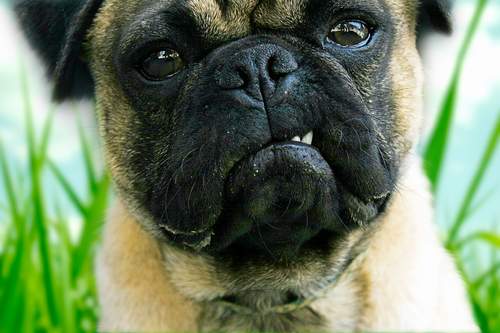
I started wondering why I hadn't heard or read about a dog attacking someone for what seems at least a good while now (apologies for the scientific language...)
And then I recalled something called the 'issue attention cycle' we used to talk about in newspapers back when I was in that industry.
Essentially it was the length of time people would still be bothered about a particular issue.
The first dog attack may get a 'brief' on page 7. The second a lead story on page 5. By the third there's a campaign on page 1. But as the attention wanes further attacks warrant less and less attention until they are no longer covered at all.
The issue - one assumes - remains, it's the attention that has gone.
Newspapers likely had a viral impact on each other. Neighbouring local papers having their agendas set, their attention focused, by those nearby.
I imagine (and if you have a relevant example, please do share) if you mapped the reporting of dog attacks over time you would see classic viral dispersion across the nation. Bubbling up, bubbling down again.
Let's assume that dog behaviour isn't viral - that there isn't the equivalent of doggy newspapers to spread the news. The behaviour of the dogs hasn't changed. The reporting of it has.
That's worth remembering when you read any story selected for you by lowest-common-denominator publication.
But it's also important we remind ourselves of this in social media: where the issue attention cycle remains. Through our selection of trusted sources (ie rss readers or peer-to-peer recommendation focused by our selection of Twitter or Facebook friends) we are active participants in the generation of these cycles.
And through the speed of publication, the cycles are hugely truncated.
The saving grace of the web in this regard is the universal ability to publish that it grants.
We don't have to wait for the centre to pay something attention; ourselves and our peers create our only cycles. We choose when to start them, how long to sustain them and when their job is done.
No one can tell us where our interest starts and finishes any more.
And for that we should be eternally grateful. The media chose what to surface. Now we do.
Showing posts with label edge. Show all posts
Friday, September 24, 2010
Monday, March 08, 2010
We police ourselves better than the Advertising Standards Agency ever could
The uk's advertising standards authority wants to apply the same rules to brand-run Twitter accounts and Facebook pages as it does to TV ads and billboards: (via The Guardian) http://bit.ly/darbhbOn the face of it the drive to enforce legality, honesty and truthfulness seems wise.
They (the Advertising Association) even say they are advocating this primarily to protect children; Always a good tactic to deploy to deflect those who would oppose.
You have to ask how they expect the Advertising Standards Authority (ASA) to police this?
And more importantly, why they think they are better placed to police this than those they seek to protect?
It's another example of the advertising world attempting to place a broadcast, centre-out solution on a peer-to-peer space. You ain't in Kansas anymore, Dorothy.
They make the assumption that the act of setting up a page or account and filling it with dishonesty is equal to broadcasting that dishonesty to unsuspecting audiences. Which is to fundamentally misunderstand how distribution happens in social media.
We ONLY pass on that which we think is useful to those we think will also find it useful.
If we get that wrong our followers stop being our followers, our friends stop being our friends. It is in our interest only to share what we judge to be the honest and truthful (we make our own judgements about the legal - file sharing etc).
We are best placed to make these judgements in the context of OUR communities of purpose (yes, and kids too - by the power of the wisdom of their crowds).
We make those judgements fast, and, since the crowd offers self-correcting mechanics, we make them accurate and relevant.
We at the edge, not them at the centre - and certainly not the ASA.
Sorry but your rules - quite literally - do not apply here.
Thursday, December 18, 2008
2009: The Year Realisation Dawns
2009 is the year the realisation dawns that social media is already bigger than all other media put together, because more people spend more time participating in it than is spent consuming any and all other kinds.I mean that the stats which, for the past and present, are already staggering, will start to reflect the truth that many of our daily lives bear witness to - less TV, less print, less broadcast; more social media, more networks more of our time. More of ourselves, personally invested.
It is the year when even those sat plumb in the centre will be unable to deny that our mass migration to and participation in social media is much more than simply where and how we are entertained and informed.
It is how we come together around things we care about. And in doing so, we create change. We can create everything we care about.
It is the year that many will realise that our increasingly ubiquitous use of social media is not a fad, trend or bubble - it is a new reality and the key to unlocking a new era in cooperation, a new world of collaboration. (image courtesy)
For those with their eyes open wide enough, 2009 will reveal that we are only at the start of the great disruption of the Internet.
2009 will be a great year for those who ditch the idea of the web as a distribution channel and instead embrace the web as a place where communities of purpose come together to collaborate.
The more we engage with social media the more we understand this and the deep reaching disintermediation that follows from this as sure as night follows day.
It will be a year in which those wedded to broadcast will have their notions of reality challenged at every turn.
I saw James Gardner, head of innovation at Lloyds TSB (the UK bank, of which I am a customer), write that:
"social media is a channel optimised for the insignificant." (context here)I think that rather neatly sums up how and where the misunderstanding is occuring.
This is not a channel for use. This is a web of many-to-many flows for participation.
It is optimised for everyone to share with anyone they care to, any and everything that matters to them right now.
Significance, whether you describe the nodes or the content, is relative - no longer to be judged from the centre. The value is between the people doing the sharing.
Those stuck in the centre must prepare for the new reality. And you, my friends, must help them.
It's not Us versus Them. It is We.
Subscribe to:
Posts (Atom)
FasterFuture.blogspot.com
The rate of change is so rapid it's difficult for one person to keep up to speed. Let's pool our thoughts, share our reactions and, who knows, even reach some shared conclusions worth arriving at?


![Reblog this post [with Zemanta]](http://img.zemanta.com/reblog_e.png?x-id=ffe1c545-6b28-47bf-b532-2a2e067e13aa)