Facebook's announcement that it is to enable a 'subscribe' button so you can follow interesting things and people (provided they are sharing publicly) is the latest shot in the battle for hearts and minds among the big players. 'Subscribe' is essentially Twitter's follow (or Google +'s for that matter).
So it's yet another case of Facebook being late to the party.
The extra it adds is enabling you to select how much of someone's stream you want to subscribe to - giving a little control to the follower (though frankly this has varying value depending on your personal experience of the volume of content - which has always been controlled by who and what you friend or follow in any event).
But it got me thinking: Subscribe takes us back to our online social roots: You just have to love blogs and blogrolls, RSS and hypertext linking. A glorious place of freely forming communities of purpose.
All the rest; Facebook, Twitter, Google +, etc etc, all the rest are at best filters of simplicity or, at their worst, silos of data. Some sit further along to the left of that scale, some to the right. But sit on it they do, in a way that blogs and rss well, don't.
The social platforms have taken down some serious technical barriers to entry - itself a silo of some significance. My wife would never have written a blog. But she's at home and connected with facebook. This is a good thing.
But ultimately we will call time on the nannying. The tech difficulties the platforms solve for us will become problems no longer. A level of what we now call technical know-how will simply become common sense. Like being able to cross a road, most folk will grow up knowing how. They'll call it common sense rather than know-how because it will, of course, be common.
At that point we no longer need the platforms. We'll need and will have the common sense to publish, to discover those who share our needs, problems or desires. And the ability to connect in self-forming groups.
And guess what Facebook et al? We won't be doing this to be marketed to.
I've long been baffled by those that think the future is digital. Those who believe this seem fixated on the idea that it is the technology that makes change, rather than what people do with it.
When the technology of the printing press arrived, the end of the story wasn't the development of the book. It was what people did with books that counted - how they spread ideas.
And in the printing press model, the changes to the way society organised echoed the mass production centralised way of doing things that the printing press - and later more forms or mass production - represented.
No, the future now isn't digital, it is self-organised (as I have suggested before). The web's role is to enable adhoc self-forming groups of purpose to form more effectively than at any time in history. And since communities of this kind reduce the cost of action - they cut the cost of achieving what more of us want, more effectively, than at any time past. The future that delivers is emerging and accelerating towards us now.
So what does that mean for the world we know? For your business? For your political party? Your form of government?
Well perhaps it's wise to reflect on what survived from the feudal world to the capitalist one? How many of the richest families in Britain were among the richest in Britain on both sides of the divide? And if there are any that survived, were they among the first to adopt capitalist principles of organisation - of both capital and labour?
What of our God and King? In Feudal times the Church sat alongside the King - in terms of power; and always well ahead in terms of wealth. Both saw their places tumble in the age of capital. Today they are at the peripherary: Pomp and splendour - about as relevant as the role of hand illluminator of Bibles.
God and King were superceded by Parliament (democratic legislatures) and the Law.
The question facing all who would mediate, all who would organise from the centre, all who would impose one size-fits-all-solutions on a fragmented fitness landscape, is: are you prepared to adapt to the looming self-organised future, to survive?
Are you prepared to start listening, start adapting to real time need, start opening up, start thinking like a platform to make change with the people who want the same as you (both inside and outside your org)...
If you aren't, then expect the rest of us to be self-organising to answer the question of what replaces you any day now.
Gordon Brown's plans to 'create innovation and personisation (is that customer-centric for the public sector?) in the delivery of public services will require rather more than faster broadband and a centre to understand and exploit the semantic web.
"Companies that use technology to interact with their users are positioning themselves for the future, and government must do likewise. Mygov marks the end of the one-size-fits-all, man-from-the-ministry-knows-best approach to public services. "Mygov will constitute a radical new model for how public services will be delivered and for how citizens engage with government - making interaction with government as easy as internet banking or online shopping.This open, personalised platform will allow us to deliver universal services that are also tailored to the needs of each individual; to move from top-down, monolithic websites broadcasting public service information in the hope that the people who need help will find it - to government on demand."
For Government,this is truly a mission on the scale of landing a man on the moon.
Not because it seems almost impossible to do, but because the scale of change, the number of barriers to overcome are so large, that essentially the UK system of government, the control from the centre model that matched the industrial age, must be utterly transformed to match the demands of the networked age.
I fear the announcement Brown made today in London is fundamentally too focused on the technology, too little on the organisational changes required to deliver the vision.
In this way they reduce the transaction costs of making things happen; turning a shared idea into an efficient 'fit' through the bringing together of communities of purpose.
There are no hard edges to networked organisations. There can't be. To scale and to enable they have to go beyond traditional boundaries. And they are not made by technology.
The fact that the technology enables transparency and connectedness like never before IS critical. But the desire for, and organisational design for, transparency and connectedness (for sharing; for scale through participation; for search to discover and help us organise through connecting us and our data; and for enabling the always on/not-always-available nature of the web (asychronous/synchronous) is the critical part - not the technology enabling it.
So Government - and all organisations aiming for longevity in this networked world of ours - must adapt (funny how my diagram below looks a little like rocket... perhaps it could land a man on the networked moon...):
Wow. Twitter made an announcement at SXSW (I'm not there, for the record) which, according to reports, got overshadowed by other events.
I don't want to go into that. I do want to make sure you don't miss the real story here. Something that is potentially beyond game-changing - it is life changing. And it is called @anywhere.
From Twitter's blog:
"When we designed Twitter, we took a different approach—we didn’t require a relationship model like that of a social network. Keeping things open meant you could browse our site to read tweets from friends, celebrities, companies, media outlets, fictional characters, and more. You could follow any account and be followed by any account. As a result, companies started interacting with customers, celebrities connected with fans, governments became more transparent, and people started discovering and sharing information in a new, participatory manner.
"We’ve developed a new set of frameworks for adding this Twitter experience anywhere on the web. Soon, sites... will be able to recreate these open, engaging interactions providing a new layer of value for visitors without sending them to Twitter.com. Our open technology platform is well known and Twitter APIs are already widely implemented but this is a different approach because we’ve created something incredibly simple. Rather than implementing APIs, site owners need only drop in a few lines of javascript. This new set of frameworks is called @anywhere."
It took hypertext to create the open, unsilo'd web of documents we see today.
We are waiting for something similar to do for the web of people what hypertext does for the web of documents. (image courtesy Erica Marshall)
And @anywhere sounds like it could be a judicious punt in the right direction.
Imagine if @anywhere could become a standard protocol for people's real-time meta data in the way hypertext has proved to be for documents?
That's potentially web changing - and therefore life changing. For all of us.
In its present iteration the @anywhere platform twitterises sites. Launch partners include eBay and The New York Times, Amazon and (watch out Google) Yahoo!
But surely the end game isn't about serving individual sites? Just as hypertext isn't about better internal navigation within a website. No, @anywhere is all about connecting people through the real-time expression of their meta data. So @anywhere is the building blocks of the twitterisation of the web - taking the real-time adhoc fuzzy-edged community-of-purpose forming that Twitter delivers beyond the silo of Twitter itself - and across the entire internet..
Imagine if all sites used it. And it all connected us from site to site. Beyond the silos.
Forget the 140character thing, that's just clever interaction design. It's the framework and standardising of a protocol emerging here which excites me.
Facebook Connect connects. But to me the way it connects people is in a hypertext, node-to-node way. The potential for @anywhere is to connect via interaction between nodes. And that's a much richer space with far greater opportunities to connect with people who share your real-time expression of need, a much greater opportunity to find each other when you need each other.
And the great thing about value in interactions is that it is value in which we can all share. An even better way to find those who care about the same issue we do right now, come together and act to fix it.
Efficiency beyond the dreams of the broadcast world.
I had lunch with Gregory Lent today. We have known each other digitally for some time. He is the artist responsible for the work on the cover of my book. This was the first time we had met in person.
Greg is a truly fascinating, very warm and very wise man. His twitter profile tells us: 'Emptiness consultant, transformation ecologist, artist, economist ... pro-intelligence'. Not average.
Our conversation, our interaction, resulted in a phrase which Greg seized upon. And on reflection it is one you may also feel is worthy of further consideration.
"The internet simply shows us the way the world actually is,"
...is what I came out with. Or at least something very similar to that.
That could be a very interesting stub. The internet reveals to us how connected we are, how connected we could be, how connected we should be.
It reveals to us our interdependency. It demands we collaborate. You can't participate without others, you can't distribute without others. You can't publish to yourself. You can't be a disconnected individual node when you are part of the web. On the internet you can't achieve without others, without one another.
Think how an idea is distributed and evolves online: If it is not passed on from one human to another it goes nowhere. You can't blast it out, it has to be handed one to another. It may go global. It may reach us all. But it has done so at a very human, hand-to-hand scale. From one person who cared enough about it to pass it on to another human they cared about.
The internet makes those connected to it part of a whole. And it makes it a real, tangible thing, in a way we could only believe in or conceive of in the past (the Buddha, as Greg points out, tells us nothing exists in isolation, more recent philosophies introduce ideas such as 'without context there is no meaning').
In so doing, the internet (perhaps more specifically the web of humanity woven upon it) makes real what was once the realm of the transcendental philopsopher.
It makes this truth of our collective self accessible to anyone who chooses to connect. It can be accessed not only through philosophy, but also through action - by learning from connecting.
It makes real what we instinctively know. It provides the evidence.
Imagine the next generation: in which almost everyone understands humanity as a collective, not a series of national, political, language, religious or other silos.
How will that change politics, the law, education, the structure of business... us?
The uk's advertising standards authority wants to apply the same rules to brand-run Twitter accounts and Facebook pages as it does to TV ads and billboards: (via The Guardian) http://bit.ly/darbhb
On the face of it the drive to enforce legality, honesty and truthfulness seems wise.
They (the Advertising Association) even say they are advocating this primarily to protect children; Always a good tactic to deploy to deflect those who would oppose.
You have to ask how they expect the Advertising Standards Authority (ASA) to police this?
And more importantly, why they think they are better placed to police this than those they seek to protect?
It's another example of the advertising world attempting to place a broadcast, centre-out solution on a peer-to-peer space. You ain't in Kansas anymore, Dorothy.
They make the assumption that the act of setting up a page or account and filling it with dishonesty is equal to broadcasting that dishonesty to unsuspecting audiences. Which is to fundamentally misunderstand how distribution happens in social media.
We ONLY pass on that which we think is useful to those we think will also find it useful.
If we get that wrong our followers stop being our followers, our friends stop being our friends. It is in our interest only to share what we judge to be the honest and truthful (we make our own judgements about the legal - file sharing etc).
We are best placed to make these judgements in the context of OUR communities of purpose (yes, and kids too - by the power of the wisdom of their crowds). We make those judgements fast, and, since the crowd offers self-correcting mechanics, we make them accurate and relevant.
We at the edge, not them at the centre - and certainly not the ASA.
Sorry but your rules - quite literally - do not apply here.
There's a rule about new technologies - bleeding edge tech doesn't equal bleeding edge demand. I'm old enough to remember Betamax. Electronics companies have a track record in this kind of failure. Famously (and quoted in Blue Ocean Strategy) Phillips CD-i was a commercial flop because it tried to do too many things - and customers weren't sure what value it could add to their lives.
That and the fact the games were rubbish.
Phillips added and added technical functions and spec. With all this 'special stuff' - the execs were convinced the market would lap it up. But they forgot to ask what the user would find useful.
Innovation is only any good if it's useful to people. The more people it is useful to, the better the outcome.
Often the focus of innovation is on ourselves - how can we make things better for us. Or it's on showing off how technically clever we are (our spec's bigger than your spec).
And isn't that what a huge chunk of digital marketing has been all about? Sharper and sharper focus on tracking and responding to online behaviour - cleverer and cleverer tech, more and more spec?
All the better to serve the right ad at the right time with.
All the innovation focused on building a better advert.
What we're talking about here is a technological arms race in pursuit of incremental improvements in quality or relevance of messages.
Which is the answer you'd come up with if you asked advertising and marketing teams what they wanted from digital innovation.
But is it what all elements of the route to market actually WANT from the best-ever ability to connect with people that digital technologies enable?
Is a better advert what the manufacturers and service providers want from digital technology? Is it the best they can expect from our growing ability to form communities of purpose at the drop of a hat?
And is a better advert what 'consumers' want?
Oh, I know, the right information at the right time becomes really 'useful' so you could argue the more effective you are at this the more effective your 'adverts' for all parties. There is some truth in this. Ads that take this approach attain much higher click-thru rates (but all those that don't get clicked must still be counted as spam).
More importantly, this is defaulting to the belief that what we all want is better messaging.
What if that isn't true? What if what we all actually want (manufacturers and service providers - customers, too) is improvement in quality or relevance of products and services?
More potential 'customers' for advertising would find that useful.
So the role of advertising and marketing may just be in deploying your skills and relationships to improve the quality and relevance of products and services.
Expect references to the best set of tools to bring us together (the social technologies which form the web) being wasted on gathering eyeballs - and how platform thinking can put them to their best use: innovating better and more relevant products and services.
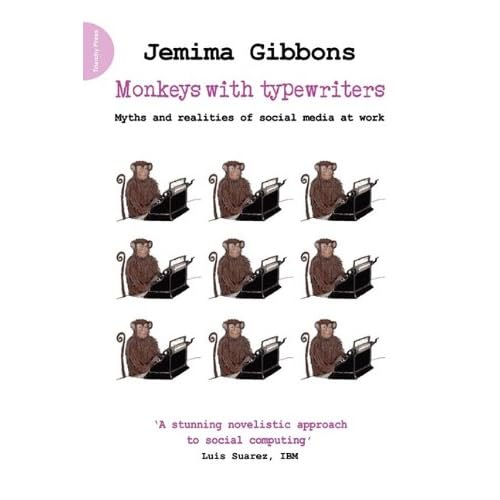
I went to Essex University with Jemima Gibbons. In fact, we were both elected to serve on the same small editorial committee of Vulture, the student union rag. I’d tell you what year that was. But I'm too much of a gentleman…
We found each other again less than a year ago. Via Twitter, naturally. She came along to a hastily arranged tweet-up in Camden Town – which was where she told me about the book she was completing. Had we stumbled upon each other earlier Jemmia says I'd likely have played a cameo in Monkeys With Typewriters myself (insert your own gags here).
Jemima’s book is “a novelistic approach to social computing” according to Luis Suarez. It certainly has a story-telling quality – scenes described, images evoked.
I’ll admit it wasn’t an approach I was comfortable with at first, but it grew on me – and I found myself drawn in attracted by the page-turning storyness of it.
It’s a story in which I happen to know a great many of the characters. ‘Social’ is a relatively small world – particularly in London where the majority of the plot unfolds. Perhaps that added to the fascination… I kept reading on looking out for the next friend to get a mention…
Sometimes there is more story-telling description than actual insight – but that’s not altogether a bad thing.
Many, when faced with creating a mass media portrayal of the interwebs (book, magazine article, latest BBC4 TV series…) default to a way of describing aA Big Thing that it is out to do and who is out to do this big thing and to whom – very centre-out notions and essentially a broadcast approach.
The reality is the web is what it is. It is all of us. It is what each of us makes it. It is what emerges from our interactions. There is no grand plan, there is no editorial committee…
Jemima’s approach (and the clue is in the title, Monkeys With Typewriters… brave when your surname is Gibbons) is much closer to the latter ‘reality’.
It’s a guide book for those in organisations coming to terms with the shifting sands beneath their feet (as hierarchy and central control are swept away and improved upon by adhoc self-forming communities of purpose).
And it’s a guide book that is more practical than most, coming complete with buzzword demystification and a 30-step guide to ‘getting social’ thrown in.
If you’ve spent a lot of time thinking about the impact of group forming network theory then this is probably not the book for you. But if you’re just starting to understand that everything the network touches it will disrupt, then Monkey’s With Typewriters will set you on the right path without making your brain bleed. And we all know someone who could do with that.
To summarise; influence is derived from how close you are to other influencers in a network - how low and short the number of links from you to how many other influencers (not the number of your connections, as often assumed).
Which validates why network analysis is such a crucial element when trying to 'identify influencers'. (image via Beth Harte)
Stowe concludes:
The subtle, dark-matter mystery of social networks is that influence is oblique, and not easily determined by the sorts of tools we have today. It is not your follower count, or who you follow, per se. But, instead, do you have short paths into other social scenes, both incoming and outgoing? That is the deep structure of being truly connected: bridging over different social scenes, acting as a conduit, a vector, a filter and amplifier for ideas good and bad, the best insights, and deadly viruses.
Influence is fluid. It resides less in the node and more in the interactions between the nodes. It is the interactions which change the state of the group, not a change in the condition of the nodes (think water H2O molecules and ice, water, steam - an example Mark Earls (another 90:10 collaborator) refers to in his book Herd. (Update, Mark has now posted his own response)
This means that giving interesting things to people to do together - bringing them together around things they care about (through shared purpose), to act on those things, has more value than spotting the influencer and giving them some sort of message you expect them to go off and influence others with.
Influence has a certain value: in crisis management, identifying those with the likelihood of having their voice heard by a greater number and in giving likely start points for the real job of peer to peer distribution. If you're going to try to turn the flock, you're bound to think it best to start off by working with the big birds.
And to Stowe's point about the tools, influence is complex, but not complicated. It can be deconstructed nuance by nuance; function by function.
One day - and perhaps quite soon - we will have the tools to fully understand it in real time. And that concerns me. Because at the point we can truly understand influence we're but a tiny step from using that power for ill. Manipulation, springs to mind. It could all become very 'broadcast'.
People influence each other. They change the state they are in. Help them find each other, support their conversation, help them act on it. That will always generate more value (for ALL parties) than an influential voice.
One of the organisations I advise asked for my thoughts on setting up (let's say enabling) a Facebook community this morning.
The success or failure of any groups that form, via pretty much any tools, comes down to the same thing - how well are you enabling those involved to achieve the three things they join groups to do?(image courtesy Kbaird.)
Three Reasons People Join Groups:
1. Express themselves: Usually this is support for or antipathy toward something. It's how people know that group X is one that cares about the same stuff they do.
2. Discuss what needs fixing about it.
3. Fix it
Facebook has the tools for peer-to-peer comms - but pages and groups veer towards broadcasting at an audience without extreme caution. Success depends on what the community is given and in how much they talk to each other. Communities talk to each other, audiences are broadcast at.
One way 'founders' of groups can encourage more interaction is by appointing interested folk to roles in which they can take more ownership of the group. Obviously ongoing support for the group through tools, content and interaction is critical , too.
Few groups get past point 1.
To point 3, make clear in the group how people joining can help and what they can actually do to manifest that.
Peer-to-peer interaction is always less about the viral marketing of a message, more about bringing people together who care, to talk - and then act.
I know. I'm meant to review the last decade or predict what'll happen in the next year around this time.
Thing is, I'm not going to follow the rules, because for the years following 2009 it simply wouldn't be appropriate to follow rules which may have applied up to this point.
We're in for a big change: Where the noughties were a decade of discovery, the teens will be a decade of realisation. And not discovery of new tech. The future isn't digital; it is self-organised.
The noughties were when we discovered our self-organising power - little by little. And new models started to emerge.
But we are embarking on 10 years in which people all over the globe will realise the self-organising power now at their fingertips - and start turning that realisation into the world they want; niche by niche.
Which means everything you know is up for grabs. Everything.
Everything that is organised or mediated can and will be disrupted by this.
That's pretty much every aspect of society, then. (image courtesy Life Archive on google)
As the realisation dawns, you can be certain no one will be talking about 'social media' anymore. They will just get on with using the best ever set of tools and platforms to communicate: With each other, find each other, form groups, act.
They won't wait to be directed. They will simply come together and debug their world. Niche by niche. The edge in action.
Which is bad news for those who would organise and those who would mediate.
It's not just traditional media, advertising, marketing etc that's going to be replaced. Even the 'new media' stuff that relies on central organisation is threatened. Traditional search (for example) is already being replaced for many by collaborative filtering.
Ubiquitous, always-on computing will arrive as the enabler. Digital social tools which allow us to express meta data beyond silos (including language) will emerge to enable all of us to find all of us when we need each other most. Those tools and platforms which fulfil those roles most successfully will be those with the best chance of commercial success.
And by 2020 we will have the tech and the will to make communities of purpose the primary form of organisation: adhoc self-forming groups brought together to collaborate - driven by common purpose.
The self-organised future will begin taking shape, new structures for education, law, government - all the aparatus of the state - will emerge. And as they do the state itself, as a formalised centrally-controlled collective based on geography, will submerge.
Lowest common denominator models will disappear wherever communities of purpose can self-organise (which is pretty much everywhere and anytime).
One example? Mass party politics will decline. New democracy will formulate in open systems - with collaboration delivering a better fit, niche by niche,
In repeatedly failing to understand the cross-border collaboration of 'their' people, our national leaders remind us of the failure of lowest common denominator politics and broad and assumed national interests.
The issue of global warming may prove a key catalyst. We gave our leaders the chance to sort things out with their big, broad, one-size fits all policies (they found that none did).
In a decade of realisation we move beyond being passive consumers in all aspects of our lives - government policy included.
We won't sit back and wait for the centre's solution. Instead we quietly and determinedly get on with wikifixing our world - collaborating across borders, ignoring the fictional silos the nation state has imagined and attempted to impose.
The impact of the edge on the centre has the potential to be cataclysmic. If change from without happens faster than change from within, something will tear. Fundamental organisational change is hard to imagine as a gentle process.
Judging when to cede control will be a key skill for leaders of all organisations in the coming years. Protecting the vulnerable, another.
My daughter has just finished her first term of traditional schooling. I have to wonder if she will complete her education (what a curious pre-network phrase...) within a similar lowest-common-denominator structure. And if she doesn't - then how does the morph from old to new happen? With a meeting of a parents collective and nods of assent - or with teachers manning the barricades?
There is much to consider; much I (and we) could strive to predict.
The role of the 21st century organisation will be to become a platform: A platform to enable people to find each other, talk together, act together and change the world together, niche by niche.
Now, you could argue that we have this in the form of the internet. It's one hugely effective collaboration engine (and a complex adaptive system too, which is all good for marrying up with the very fitness landscape that demands our niche by niche approach).
But for all the connecting, group forming brilliance of the internet, we still need firestarters. We still need people (those 'human resources' who make up orgs) to start the flames - to light the way and draw the rest of us together.
And if you aren't in the business of starting fires, then pretty soon you aren't going to be a 21st century organisation.
Repeat, niche by niche, matching products, services and behaviours to the fitness landscape - making the most efficient use of available resources, ending waste.
Nothing gets to be produced without 'the markets' (that's us folks) consent.
Stumbled on the latest update to Technorati today (the site that ranks blogs and their authority) and was somewhat shocked to discover FasterFuture's 'authority' had jumped by around 1000% to 423.
Its rank in the blogosphere has leaped by a similar order (13,896 of all blogs - where I recall it languishing around where you could pretty much could add a zero to that.
I had put a slow decline (the authority was once 120 and the ranking 70K ish) over the last year or so down to me blogging less and tweeting more.
The big change now is that Technorati is only gathering its data over the last couple of weeks or so - not the last six months as was it's methodology.
Which means if you've got a decent rank and authority - and want to maintain it - you'd best blog often as much as you blog well. It's helpful to those of us seeking individuals with particular interests AND authority, too - because the results are much closer to real time (as Stowe points out on /Message)
Technorati needed to cut its costs, this method not only does that (less intensive number crunching to do) but it also encourages a reverse in the decline in blogging - something very much inline with Technorati's needs, too.
And since blogs remain the single least silo'd way in which we express metadata and connect one to another in communities of purpose (the only silos in blogging are being online - or not - and language) I'd have to give that my blessing.
Well, that and the nice high ranking FasterFuture has acquired.
UPDATE: Oct 19, 2009 I'm going to keep track of this: Since time of first writing the rise has continued. And then some.
Today's stats show fasterfuture as 8312 highest rank blog on't planet (though I note this is of 825,402 indexed, as opposed to the 300m thought to exist). Guess these are those worthy of indexing in the past few weeks, as opposed to those created ever), Authority has risen to 464 (for context it would need an authority of 760-odd to make the top 100).
Update: Oct 27, 2009:
Today the authority is 485 and the rank is ???,??? - honestly, couldn't find a way to get that number today. I notice though that a little green badge has been apended: 'Top 100 (small business)'. It is of course nice to be in the top 100 of anything - but I'm a little baffled as to why the Technorati algorithm selected this blog for that category?
Update: Oct 29, 2009.
Today we have an authority of 506 and a ranking in the top 5000 (4965) - and that's after a fall! Gulp. The small business Top 100 badge still lives on some views on Technorati, too.
Update November 3, 2009:
Despite the red down arrow (which indicates we've been even higher since I last checked) FasterFuture is now has a ranking of 4214 and an authority of 522.
But it will also open a door on the 'social' side of the label - how the formation of groups, communities of purpose, has the potential to disrupt and reconfigure everything we do - from processes within organisations to politics, education, economics and beyond.
Really quite chuffed to say it's all-but a sell out with people attending from my local authority, business organisations, retail, training, a local engineering firm, marketing and pr teams, seo specialists and a global mobile tech company.
There are those in print media - newspapers/mags etc - who cling to the idea that they can 'do a cinema'.
When TV arrived as the latest mass media many predicted the demise of cinema.
They didn't count on its:
Ability to adapt with experience-enhancing technology (colour, stereo, Dolby, 3d etc)
The power of that experience being shared.
If I was in a media company right now I'd be looking at how what cinema did could translate to shore up my properties. To start with. (image courtesy rivalee)
And then there's the elements that kept radio in the game when first cinema and then radio rocked up:
Convenience
Portability
Currency.
Print shares convenience and portability - but scores zip for currency against anything post radio. It's ability to enhance shared experience ain't the greatest, either (though this can be enhanced through events and digital communities, of course)..
Media properties need to adapt. And the obsession with print has to be questioned long and hard.
Those cinematic and radio survivors of the mass media wars give a guide.
Cinema uses technology to enhance shared experiences, radio is convenient, portable and current.
Combine all these and you have a proposition to take you into the age of the eighth mass media - us.
I don't just mean that we create the content in a UGC vs Professional Content Creators kind of way. I mean WE are the distribution, the content, the 'user journey', how messages are transmitted... WE are the medium and the media carried within it.
We are the connections. We are also how the connections are made.
In the age of the eighth mass media, organisations must understand that serving multiple and ever increasing numbers of niches is the route to sustainable scale.
Those who wish to remain part of our lives must provide value to the adhoc self-forming communities of purpose our digital selves can't help but participate in.
We have already adapted. We are creating a new landscape. Are you fit for it? Are you prepared to become so? I wonder how this 'Twitter: The newspaper of tomorrow? matches up.
As I commented on Dave Armano's blog (Dave is part of the Dachis revolution), I'm delighted to see social business design (and all other descriptions of making business more efficient through crowd-sourced solutions) being legitimised. (Image courtesy)
This is true for all forms of organisation - from businesses to institutions.
And I have a growing sense that this is what the money has been waiting to follow.
Because this adaptation of business to the networked world shows direct return on investment - it streamlines businesses, creates new orders of efficiency in everything from product development, to marketing, to recruitment, to you name it...
It delivers business models (and businesses) adapted to the networked world. It enables businesses to exist in a rapidly transforming world.
One small example: The people who can make the biggest difference to your company don't work for it. Adapting to the network means they can. If there is a part of your business that can't be disrupted by adhoc communities of purpose (forming online to improve on what you currently do) you are in an extremely enviable position.
The social business design thang (and I'm not sure that'll be how we end up describing efficiency through social technologies, but it's a neat short-form for now) is a cost-effective launch model, too.
To deliver you don't need millions of users on 'your' platform , a gazzillion servers and more bandwidth than Twitter when a celeb dies, before some fantasised micro-payment model starts paying back the millions sunk by scale-fixated VCs.
That's why I think investors will find this 'use' of (we really mean participation in) social technologies so much more exciting and potentially rewarding than throwing cash at the next Facebook or Twitter.
So that just leaves one question for me... who is going to pay for the tools and platforms which deliver the real-time, beyond-silo, connections on which social business design relies (the next Facebook or Twitter)?
So why don't I have Adsense on my blog? Google keeps pushing it at me. Why don't I take this free money?
The first reason is simple and mercenary. The payment I may receive via Adsense is too low to tempt me. The return on my time not sufficiently rewarding. ( I know, I've tried in the past).
That may be because there are insufficient advertisers for the Adwords related to the stuff I blog about. And that means the ads served seem rather less like the helpful content that Adsense promises and more like the spam it seeks to avoid. (image courtesy)
And I don't want to put you off, dear reader. I value our relationship more than I value a few cents from Google.
A lot more actually, which is where RoI comes in. Or perhaps we should call it RoR - return on reputation and/or relationship?
By allowing advertising which could sell you something I have not tried myself, I can't give it my endorsement.
I can't recommend it to you. In fact an ad may pop up for a product or service I will actively recommend you do not use. Each time this happens our relationship is damaged and my reputation with you is diminished.
Adsense takes no account of the value we both place on this.
I'd like to think the niche nature of this community is such that should I recommend a product, service, event etc you will give it quite serious consideration.
Our conversations can be – and regularly are – one to one. And this is the reality of the future online as more and more we become The Eighth Mass Media - the publishers, advertisers, marketers, distributors, connectors.
You'll give me the time of day because over time you have come to learn from experience that we share the same thirst for knowledge about certain things, have similar problems to solve etc. We are one of my favourite things - a community of purpose.
In short, we have a relationship in which we exchange trust to build reputation.
I described a simple model previously which could value reputation using something like Adsense. It may be worth reviewing again.
I think if a model could be devised and implemented which raised the valuation of reputation and therefore of our recommendations, one to another, it would kill the incumbents.
Who would stick with the few cents of Adsense if instead you had a way of being rewarded for the recommendations you give freely to those you know will value them?
It’s a micro-relationships model, but not a micro-payment one. Car manufacturers have been know to pay up to £300 to large media outfits for a lead which results in a test drive. We as individuals will come to expect equal returns in our niches.
That’s mostly because our recommendations come with our reputations and micro-relationships tightly bundled to them.
We don’t give our recommendations lightly. False recommendations are taken personally. We lose friends. Your recommendations would become ultimately worthless. And we understand that recommendation is in the eye of the perceiver – and we don’t want to lose face by giving friends something they perceive as ill conceived. (Yes, I do think my recommendation to you is more valuable than a recommendation from some form of mass media broadcasting at the lowest common denominator of its audience.)
We know our friends (our communities of purpose) in ways advertisers – even Google – can’t touch.
The future is not in-context, related, targeted. It is in conversational flow (with all the real-time that suggests), peer-to-peer recommendation and consistently and constantly validated reputation - otherwise known as human relationships.
Via Silicon Valley insider comes this marvellous chart which reveals people do more sharing of links via Facebook than they do via email. Just ignore the headline on the graph.
What's particularly interesting to me is the volume generated by Twitter - which has approximately (and likely less than) one fifth as many active users as Facebook right now (roughly 45m to roughly 250m).
Which means the adhoc fuzzy-edged communities of purpose who populate twitter are around twice as likely to share as those of us (often the same people) restrained by the private-data-heavy silos of friends on Facebook. Nutshell: You're potentially twice as likely to learn something new on Twitter as you are on Facebook.
Open beats closed when it comes to learning and sharing new stuff. Case, ah hem, closed.
Listening always beats asking. Asking questions demands and shapes response.
And people, good, kind, back-scratching people, will often tell you what you want to hear.
Taken to extremes you get your LinkedIn recommendations. (Compare that to what your colleagues may say if you're out of the room...)
Less dramatically, ask people and you guide their thoughts.
Market Research companies are painfully aware of this skew. No question is entirely without motive. None comes without an agenda - an agenda proposed by the questioner.
But listening, passive listening, can teach you much.
Wise orgs and brands are doing more of this. It's often a bit of a revelation for them that they can do it relatively easily online.
But anything I publish on any open forum, blog, tweet, is recorded, is searchable, is discoverable. As is anything you say. Or your friends. And their friends ad infinitum.
Right now and for the mid-term (I'm assuming) we feel what we hear is pure, unsullied, honest, unskewed people saying what they really mean to their peers. With caveats around axe grinders and power relationships, of course.
But could it be we will begin to change what we say on the assumption that brands are listening? Will it lead to a layer of artifice?
I guess it's a little like CCTV surveillance. Britains 'know' they are the most filmed people on Earth. The emergence of hoodie culture - hiding your face from the prying eyes - is the most visible change to behaviour.
For the most part we act as if the cameras aren't there. (image courtesy)
But perhaps this is because the implications haven't sunk in yet?
And with the notion that brands and orgs can pick up on our every digital utterance still very new, who knows how this fact will end up modifying our online behaviour as we become more familiar with it.
Will we update our notions of privacy and private space as we embrace the digital?
Will we find greater value in expressing ourselves freely because that expression can connect us with others trying to solve the same problems we are (communities of purpose)?
Or will silos around our private lives remain strictly maintained?
Will we feel the need for them in a world in which you can be overheard by anyone else.
And what happens when those doing the surveillance speak back - in real time. I recall the experiment in which CCTV operators added a speaker to their cameras and started berating people they spotted dropping litter. Out loud and in public. That shocked.
So if a representative of a brand responds to your complaint in real time on Twitter (for example) are you shocked? Angered? Or pleased?
I'm guessing pleased? You aren't being told off. You are being helped at just the point at which you expressed the need for help.
Does knowing they are there (lurking/ready to help depending on your pov) make a difference? Do we change if they start openly responding?
Are we thinking outloud to impress the infinite unknown audience?
What I publish is not only shared right now with those who directly choose to receive it, it is here for all time, for all people. Ever.
Dr Mike Wesch talks about the moment of context collapse we face when staring into a webcam to share on the web - that we know not to whom we are speaking.
The same must be true of any kind of utterance which can for ever be discoverable.
When you realise just how long and loud your voice may echo through the ages does it make you want to shout a little louder. Or clam up?
The dilemma is one that has always faced publishers. We're all publishers now - with greater reach than ever before - it faces us all.
It has the potential to change the meaning and value of everything we share online.
Here's a monumental post from change management consultant Si Alhir synthesising many great and powerful concepts including Seth's Tribes and my own Communities of Purpose, among others.
The Purposeful Enterprise also includes links to a great deal of valuable background reading.
The diagram here gives you a taste. It's from si's original post. Click to enlarge it.
Worth a read for anyone contemplating the role, form and function of organisations in the networked world.
The rate of change is so rapid it's difficult for one person to keep up to speed. Let's pool our thoughts, share our reactions and, who knows, even reach some shared conclusions worth arriving at?




![Reblog this post [with Zemanta]](http://img.zemanta.com/reblog_e.png?x-id=96b7e785-1a93-419b-9cc0-528f810b0e67)

![Reblog this post [with Zemanta]](http://img.zemanta.com/reblog_e.png?x-id=2873bed3-477e-442a-a5bd-d68c4c158b15)

![Reblog this post [with Zemanta]](http://img.zemanta.com/reblog_e.png?x-id=fff3032c-05f7-4fe1-80ef-c92ae2d5e7fa)


![Reblog this post [with Zemanta]](http://img.zemanta.com/reblog_e.png?x-id=db5fcefe-1fb9-4521-981e-d45d6c7a8a3b)
![Reblog this post [with Zemanta]](http://img.zemanta.com/reblog_e.png?x-id=f81060ec-e7d4-4d3a-84c6-69863b404a16)

![Reblog this post [with Zemanta]](http://img.zemanta.com/reblog_e.png?x-id=f9edf5c7-ec70-409c-8d28-3c6cdd78f8af)
![Reblog this post [with Zemanta]](http://img.zemanta.com/reblog_e.png?x-id=531c073c-8601-4d1e-b203-6168c868a994)
![Reblog this post [with Zemanta]](http://img.zemanta.com/reblog_e.png?x-id=100bf378-c93c-479e-bdda-640d4b2fd6ba)
![Reblog this post [with Zemanta]](http://img.zemanta.com/reblog_e.png?x-id=8a0802c6-861d-47bd-a74e-01d2cd91e268)


![Reblog this post [with Zemanta]](http://img.zemanta.com/reblog_e.png?x-id=3fb29cf6-da7d-4690-b556-4b7d241f78ce)

![Reblog this post [with Zemanta]](http://img.zemanta.com/reblog_e.png?x-id=4745c7a3-4075-43df-93d5-031a4b3b3a46)

![Reblog this post [with Zemanta]](http://img.zemanta.com/reblog_e.png?x-id=5fa9ed28-e27e-40fa-b317-b9c77e417c34)
![Reblog this post [with Zemanta]](http://img.zemanta.com/reblog_e.png?x-id=0c33f989-8e3d-476f-8df7-db95a914b812)

![Reblog this post [with Zemanta]](http://img.zemanta.com/reblog_e.png?x-id=397b911a-d5c5-422b-b57d-ffbe59e8f4b3)

![Reblog this post [with Zemanta]](http://img.zemanta.com/reblog_e.png?x-id=57bf5d82-8b52-48e4-bf52-e2cabe5bfad2)

![Reblog this post [with Zemanta]](http://img.zemanta.com/reblog_e.png?x-id=5bbdfc99-8f08-42e4-9c04-64c4fe1bc743)

![Reblog this post [with Zemanta]](http://img.zemanta.com/reblog_e.png?x-id=aa2b5b93-7c24-41b5-9b92-5eadaab894c5)