
 |
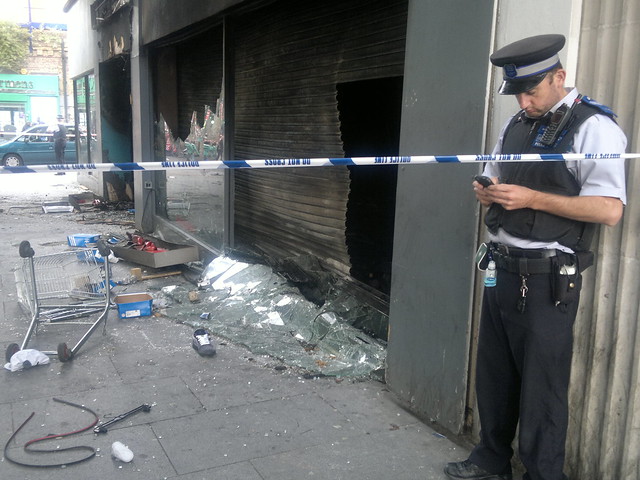
| Brixton Footlocker - the morning after (via linniekin, Flickr) |
The first is how they have been reported; by citizen witnesses; by journalist witnesses and finally as edited by news orgs.
Citizens have delivered a tapestry of fear, anger, concern... reality; Journalists a cooller detachment which lacks the white heat emotion of engagement; News orgs a filtered, cooled, emaciated version of 'the validated truth'.
Always ask whose truth you gaze upon. I may not be able to check or validate every citizen expression of the reality as they see it - but there must be at least as much truth in what they are sharing as in the cold, dispassionate glance of the edited news org version.
Heady, fast moving times. They require of us that we take responsibility - with crap filters on - for what we choose to pass on.
But enough of the messages, what of the behaviour?
Why have these riots happened now? How could the new tools of coordination and cooperation lead to a truly landscape-shifting revelation for those taking part?
I should say right off I'm not a fan of theft, violence, arson or even of keeping folk from a good night's sleep.
However, the group dynamics and peer-to-peer permissions and mimicry that the human behaviour of rioting demonstrate, do hold a grim fascination for me.
So, why now? Those dismissing the London Riots as one long acquisition spree by thieves fail to answer that simple question.
If greed were the key, why this summer, not last? The answer may lay in a longer term period of joblessness and hopelessness - yes the result of policy decisions.
But it also took:
- A crowd
- A state of agitated excitement,
- The ability to organise.
- Permission to act out of line (in a co-ordinated way)
These factors came together on Saturday night in Tottenham.
But they could have come together in another crowd with another cause to be excited.
What of our flock turner? Someone has to start a riot. Someone has to grant the permission to act out of line. And in so doing they grant permission to those around them to act, entirely irrationally, in a way they wouldn't ordinarily behave. It may be one person at first - and then another - then a clump join - and then the crowd joins...
This video goes some way to illustrating that - through the medium of dance...
Once permission to behave differently (and badly) was granted (we're back to the riots now) off it spread.
We do what the monkey next to us does - we are Homo Mimicus rather than Homo Sapien as Mark Earls (@herdmeister on twitter) author of Herd, puts it.
We copy - Oh so readily. Particularly if someone has prepared the ground as effectively as the economy and The Government have contrived to do. The conditions are right.
If a Government unit on behavioural economics had planned this nudge themselves, they couldn't have hoped for greater success:
Agitate folk through economic and policy means - give agitated folk a reason to gather - and then all you need is the 'dancing man' to give them a nudge.
Monkey business spread rapidly across London.
Tonight? More parts of London? More Uk cities? (Unfortunately while drafting this post I heard of outbreaks of violence in Leeds and Birmingham to add to London's third night of troubles.
Next: More European cities? MoreUS Cities?
Riotous behaviour is Herd behaviour like any other human behaviour: As hard to identify how to stop as it is to start.
Mark's book has a chapter on riots - and some tips for cops. They focus on breaking the channels of communication (in this case blackberry messenger and twitter), moving swiftly to break up crowds the moment they asssemble, and arresting anyone for even the slightest infringements (removing any hint of permission to act out of line).
And when equilibrium is restored - of course - go looking for the root causes and act on them.
In short, take away the ability to organise, the gathering of agitated folk, the permission to act out of line and once all those are dealt with, the reasons for the agitation.
In 1981 when conditions were similar it took broadcast media to spread the news.And there was no tool of on-the-go coordination - not even mobile phones.
Now everyone taking part carries with them a way of coordinating on the fly. No wonder the authorities are concerned. Trouble can now be organised, directed and refocused in a decentralised way making it exceptionally hard to deploy against for the police.
They've learned from the Arab Spring. Monkey see, monkey do. That's as much of an answer to 'why now' as anything I've seen.
The decentralised 'bad guys' are able to dissipate and reassemble too fast and in too great numbers for the police to act. There are tales this evening of shop keepers boarding themselves inside their shops, having reported mobs outside to the police, only to be told the police don't have the bodies to act.
My guess is that if we don't get a night or two of heavy rain to break the cycle the army will be on the streets by the end of week. And at that point we in the UK may feel a bit glib pointing at 'heavy-handed' responses in Arab lands.
Those at the helm in this and other countries should be less concerned about acts of theft and vandalism and rather more about what the participants are learning.
IF those intent on riotous assembly are indeed coordinating through the social tools now at our disposal, what happens after they are done with expressing anger and frustration through fire and theft?
IF those intent on riotous assembly are indeed coordinating through the social tools now at our disposal, what happens after they are done with expressing anger and frustration through fire and theft?
What if they realise the true power they wield?
What if they do to The Government what they did to The News of The World?
I'd stick a cork in the chianti and get the next flight home if I were on Her Majesty's front bench.


