Showing posts with label human behaviour. Show all posts

Tuesday, February 06, 2018

Imagination beyond experience - the leap to Super-Human

Image from the movie Superman
Humanising AI is a worthy and common dream. And it is where and how we should focus to create value in the near term. But a greater challenge looms.

While we always seem to want to make AI 'think like a human', we know that when it doesn't, it can outperform us (in narrow fields, where ambiguity is constrained, at least) for example in the games of Chess and Go!

While we always seem to want to make bots look like humans, we know that there are many more efficient designs to meet specific needs. The human body is a bit of a jack of all trades, master of none (compare us with the highest performers in any particular parameter from the animal kingdom.)

And while we always seem to want to make AI behave like humans, we know humans behave irrationally and often against our best interests.

Imagining super-human (ie outside of human) thinking, design and behaviours will be our next great challenge. And for that we are going to have to truly partner the machines because this will take us beyond our own experience.

Wednesday, January 25, 2012

The monkey in the machine

Here's another chance to see the marvellous Mark Earls (@herdmeister) present at the RSA on how things spread - how that social sharing thing happens (much less rational than we like to believe of ourselves).
I'm a big fan of Mark's book Herd. And no doubt I will be of the signed copy of his new book I'll Have What She's Having - when it arrives... (hint).


Enhanced by Zemanta

Tuesday, January 10, 2012

Why no one wants to be in your club

I used to belong to a fund-raising organisation which always seemed to struggle for members.
Every now and again there would be much gnashing of teeth as members wailed and failed to comprehend why so few others would join us.

We'd always end up blaming society ("no one wants to join organisations these days", "people are more selfish than they used to be", "there's no sense of community" etc etc.)

No. Sorry. These are excuses.

There's nothing broken about our desire to join with one another. The web shows given the right conditions groups will form. And scale. Even today.

Those conditions:
1. Give people something interesting to do together.
That's straight out of the Herdmeister playbook. If your group isn't gathering numbers it's either not offering interesting enough stuff, or good enough ways for those who would wish to, to join in.
2. Discover and invite people to whom the group will matter.
If you aren't doing this - if you've just built it and expect them to come - you're going to end up disappointed.

Of course when one of the right folk finds your group, they will invite others of like mind. But you must also think about ways in which newbies can arrive together. Walking into a pub with a group of mates is a much nicer experience than walking in alone.
Enhanced by Zemanta

Monday, October 03, 2011

5 ways to make better marketing, better companies

Five quick tips with which to assess your strategies in the light of the connected world: Tick the boxes and you won't go far wrong in making your marketing, innovation, engagement, and ulitmately your organisation, a better fit with the 21st Century.

1.    Have something to believe in. What else have you got?
2.    Don’t do stuff to people. Make stuff with people. That way it’ll be a better fit and matter more.
3.    We don’t connect to be marketed to. No one forms groups or resides in communities to be marketed to. Ask yourself why groups DO form.
4.    We do what the other monkeys around us do. Then post rationalise. This matters.
5.    There are powerful connections between circumstances and behaviour. Do not ignore them.

Saturday, September 03, 2011

The tyranny of the authority of signs vs the mimicry of monkeys

When on holiday in Barcelona recently I watched an amusing example of human behaviour which illustrates our irrational reliance on authority – following its dictacts even when the evidence of our own eyes compels us to do otherwise.

In this case travellers at Barcelona Sants station were confronted with both an up and a down escalator to choose from to go down to the platform. 

An easy choice you’d think. An easy rational choice, yes.

But introduce a confusingly placed sign and it seems we will often switch off our rational thought, ignore the evidence of our own eyes, and follow the authority of the sign.

In some cases this was true even when people were coming up the ‘up’ escalator right in front of the person planning to use the same escalator to go down – leading to results that kept me amused for many moments.

I was lucky enough to have a flipcam in my pocket so recorded what unfolded. 

Perhaps what follows below also illustrates that we are more likely to be convinced by authority (represented by the sign) when we are in an agitated state (ie the folk in a hurry seem most likely to follow the orders of the signs over and above the herd instinct of following those folk who are going the right way.

This perhaps has implications for channelling behaviour in riot situations of the kind discussed on this blog in recent weeks.

I was particularly amused by the behaviour emerging towards the end of this 3min video in which it appears our herd instinct has us copying some very irrational behaviour – ie you have to try to go down the wrong escalator first before returning to try the right one. It’s what all the rest of us monkeys are doing...


Enhanced by Zemanta

Monday, August 15, 2011

Cameron, circumstances and priests

The Parable of the Good Samaritan by Jan Wijna...Image via WikipediaOne of the points of my previous post on how riots spread is Monkey See, Monkey Do.

Or to put it less simply, we are less rational than we would like to think - we act like those around us and as allowed, persuaded, nudged or otherwise cajoled to do by the circumstances in which we find ourselves (the behaviour of other folk being a very key part of those circumstances).

Now, even our nice Mr Cameron (remember the one, when he first became Tory leader, when he seemed more interested in what is right rather than what is Right), knew that.

As HM Opposition are all of a dither to point out, Cameron himself proclaimed "there are connections between circumstances and behaviour" five years ago...

Damn right. Primed with the right conditions, given the right circumstances - you too are at great risk of behaving in a very irrational way. Once again, I point you at Mark Earl's excellent Herd for more on this.

This is really important because once we understand this is what drives behaviour, then we can start on the business of ascribing blame for that behaviour and (rather more importantly) doing something about it.

It's why I am getting increasingly annoyed at the misdirection the Government PR machine is employed in. First every talking head spouted 'criminality' to focus our attention on the outcome. Now that is being replaced by 'moral collapse'. Both make us focus on the outcome. Which is convenient because it's hard to pin the blame on the Government for outcomes. Circumstances and conditions? Now there some Governmental blame can be laid.

So, I had best demonstrate what can turn even good people bad - to act irrationally - if the conditions are set for them. I best show how it's more the context and circumstances to blame and less the moral fibre of the people concerned...

Take for example the study at Princeton Theological Seminary quoted in Malcolm Gladwell's often-bought-but-rarely-looted Tipping Point.

In the story he tells, each student priest is asked "to prepare a short talk on a given Biblical theme, then walk over to a nearby building to present it."
Along the way to the presentation each student comes across a man slumped head down, eyes closed, and clearly in some distress.
Obviously being good God-fearing folk (with no doubt all the parental support our dear leader would desire) they stop and help, don't they?

Wouldn't you?

Well. The researchers included three variables: background of the subject - whether they had entered seminary as a way of helping people or not, (2) which parable they were to prepare - several were given the Good Samaritan... and (3) a time context, saying either that they were running several minutes late and should hurry up, or that they were early and had some time to spare.

Guess what?

The only thing that impacted how likely our trainee priests were to stop and help our hapless fallen guy was how late they thought they were running.

In other words whether you were planning to help folk as a vocation, and whether or not you had just been hard at it thinking about the Good Samaritan, mattered little. Their attitudes and feelings were instantly  over-ridden by subtle clues in the environment - in this case being told whether they were running late or not.

 I can't claim to be any better than any of those flawed priests-to-be. I can't claim to be able to resist temptation to act irrationally if the conditions are right - if the circumstances so nudged me. You see, I'm human too. So is David Cameron if the stories of the Bullingdon Club are to be believed.

The good news is I do think there is something your rational selves can do to avoid those contexts.

My guess is many of us would loot in the right (wrong) circumstances. But I'm also pretty sure most of us would employ our rational moments to guide us away from those circumstances.

And that's where the Government - and others bent on behaviour modifying must focus, too.
We can rationally decide to join together with good things in mind - and we can support each other - be good monkeys to be seen and copied, too.

That's how the brooms came out - en masse - for the twitter clean up. We can use social media to find folk thinking positively, too and coordinate and cooperate with them.

Call it rational if you like...
Enhanced by Zemanta

Monday, August 08, 2011

How riots spread - expressed through the medium of dance

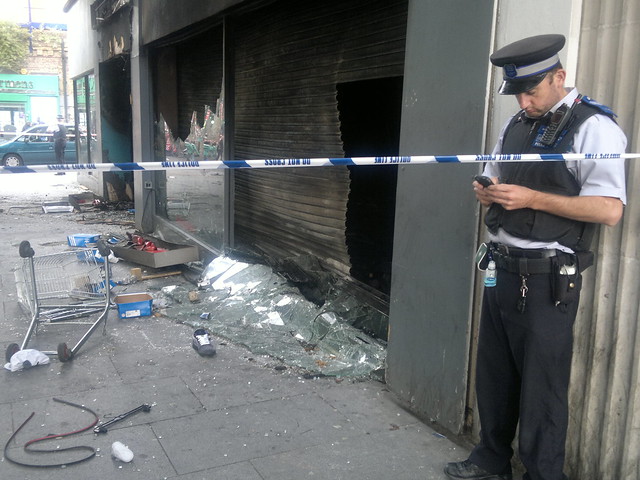
Brixton Footlocker - the morning after (via linniekin, Flickr)
There are two things of significance for me about the London Riots of the last couple of nights (and as I write I hear they have extended to a third night).
The first is how they have been reported; by citizen witnesses; by journalist witnesses and finally as edited by news orgs.

Citizens have delivered a tapestry of fear, anger, concern... reality; Journalists a cooller detachment which lacks the white heat emotion of engagement; News orgs a filtered, cooled, emaciated version of 'the validated truth'.

Always ask whose truth you gaze upon. I may not be able to check or validate every citizen expression of the reality as they see it - but there must be at least as much truth in what they are sharing as in the cold, dispassionate glance of the edited news org version.

Heady, fast moving times. They require of us that we take responsibility - with crap filters on - for what we choose to pass on.

But enough of the messages, what of the behaviour?

Why have these riots happened now? How could the new tools of coordination and cooperation lead to a truly landscape-shifting revelation for those taking part?

I should say right off I'm not a fan of theft, violence, arson or even of keeping folk from a good night's sleep.

However, the group dynamics and peer-to-peer permissions and mimicry that the human behaviour of rioting demonstrate, do hold a grim fascination for me.

So, why now? Those dismissing the London Riots as one long acquisition spree by thieves fail to answer that simple question.

If greed were the key, why this summer, not last? The answer may lay in a longer term period of joblessness and hopelessness - yes the result of policy decisions.
But it also took:
  • A crowd
  • A state of agitated excitement,
  • The ability to organise.
  • Permission to act out of line (in a co-ordinated way)
These factors came together on Saturday night in Tottenham.

But they could have come together in another crowd with another cause to be excited.

What of our flock turner? Someone has to start a riot. Someone has to grant the permission to act out of line. And in so doing they grant permission to those around them to act, entirely irrationally, in a way they wouldn't ordinarily behave. It may be one person at first - and then another - then a clump join - and then the crowd joins...

This video goes some way to illustrating that - through the medium of dance...


Once permission to behave differently (and badly) was granted (we're back to the riots now) off it spread.
We do what the monkey next to us does - we are Homo Mimicus rather than Homo Sapien as Mark Earls (@herdmeister on twitter) author of Herd, puts it.

We copy - Oh so readily. Particularly if someone has prepared the ground as effectively as the economy and The Government have contrived to do. The conditions are right.

If a Government unit on behavioural economics had planned this nudge themselves, they couldn't have hoped for greater success:
Agitate folk through economic and policy means - give agitated folk a reason to gather - and then all you need is the 'dancing man' to give them a nudge.

Monkey business spread rapidly across London.
Tonight? More parts of London? More Uk cities? (Unfortunately while drafting this post I heard of outbreaks of violence in Leeds and Birmingham to add to London's third night of troubles.

Next: More European cities? MoreUS Cities?
Riotous behaviour is Herd behaviour like any other human behaviour: As hard to identify how to stop as it is to start.

Mark's book has a chapter on riots - and some tips for cops. They focus on breaking the channels of communication (in this case blackberry messenger and twitter), moving swiftly to break up crowds the moment they asssemble, and arresting anyone for even the slightest infringements (removing any hint of permission to act out of line).
And when equilibrium is restored - of course - go looking for the root causes and act on them.
In short, take away the ability to organise, the gathering of agitated folk, the permission to act out of line and once all those are dealt with, the reasons for the agitation.

In 1981 when conditions were similar it took broadcast media to spread the news.And there was no tool of on-the-go coordination - not even mobile phones.

Now everyone taking part carries with them a way of coordinating on the fly. No wonder the authorities are concerned. Trouble can now be organised, directed and refocused in a decentralised way making it exceptionally hard to deploy against for the police.

They've learned from the Arab Spring. Monkey see, monkey do. That's as much of an answer to 'why now' as anything I've seen.

The decentralised 'bad guys' are able to dissipate and reassemble too fast and in too great numbers for the police to act. There are tales this evening of shop keepers boarding themselves inside their shops, having reported mobs outside to the police, only to be told the police don't have the bodies to act.

My guess is that if we don't get a night or two of heavy rain to break the cycle the army will be on the streets by the end of week. And at that point we in the UK may feel a bit glib pointing at 'heavy-handed' responses in Arab lands.

Those at the helm in this and other countries should be less concerned about acts of theft and vandalism and rather more about what the participants are learning.

IF those intent on riotous assembly are indeed coordinating through the social tools now at our disposal, what happens after they are done with expressing anger and frustration through fire and theft?

What if they realise the true power they wield?

What if they do to The Government what they did to The News of The World?

I'd stick a cork in the chianti and get the next flight home if I were on Her Majesty's front bench.

Enhanced by Zemanta

Tuesday, August 18, 2009

Five things I'm really fed up of

Five things I'm really fed up of:

1. Businesses insisting on massaging (messaging?) the humanity out of their best efforts to communicate with humans. There's a kind of insanity in that which is beyond grotesque.
2. The desparation for certainty. The world has always been adhoc, hard to measure and unwilling to yield to your command and control simplicity. Learn to love the opportunity within the cloud of 'vague'.
3. The allure 'mass' still has despite our niche know-how and why. Twitter trends; 'ooh I'm on the tele', 'I've got more friends/followers than you' - you know it doesn't make sense. Just let go.
4. Those who think they can 'use' us (that's me and you, kid) as a channel. 
5. Anyone who thinks the conversation is trivial. They belittle what it is to be human and the value we place on relationships. Their loss.

and... breathe. (image courtesy)

Oh go on then, tell me what you're fed up of.


Reblog this post [with Zemanta]

Tuesday, November 04, 2008

Human interaction requires human intervention

Too many people see social media as just another channel - another way of deploying the high-impact weaponry of creative content with the intent of leading the largest number of horses to water.

This is a mistake.

Social media is about human interaction. About the interactions humans have with one another. About humans sharing stuff between themselves, doing things together. Doing their things together. Stuff that they find useful to each other.

If you want to involve yourself with each of their interactions, then yes, it's going to be hugely labour intensive - human labour intensive.

You can automate the collating of what you should be listening to. But you can't automate how what you hear should be perceived or CRUCIALLY how you can, should, must respond.

Instead of seeing social media as a place to deploy, think of 'it' (and I think we're talking about the network here...) as a place to learn - to learn how humans share things. To learn how, in the context of the group you are seeking to change behaviour in, behaviours are communicated - and copied.

Focus your human effort, YOUR human interaction, here.

Then you might, just might, learn the right kind of useful and interesting thing to share with that group - something they will think worthy of sharing with one another.

Remember: It's not what you do to them, it's what they do to each other.

Thursday, September 25, 2008

MySpace Music. Sharing the broadcast?

While the real lesson of the networked world for music is that (as Herdmeister would say) music is something we do together, MySpace is taking advantage of the monkey-see monkey-do (in this case monkey-hear, monkey-do) reality of the flocking activity of real human behaviour.

(Thanks to Jamie Burke for sharing this link).

MySpace has launched MySpace Music which effectively turns audio files of your favourite music into a Facebook newsfeed-style shared experience with your social graph (your MySpace friends, at least). (image by antikris via flickr)

It's integrating the functionality of the likes of last.fm and blip.fm inside the fully-formed social network of MySpace. And, of course, it's an excellent fit - because MySpace always was all about the music.

One of its biggest advantages over other apps is that it offers unlimited streaming of the music your friends are listening to from the news feed.

Now, if only the record companies allowed users to mash-up, remix and redistribute the results (that is adapt in order to adopt)... then we'd have a model that really fits the networked world.

This slidedeck (used previously on this blog, granted) reveals why I think that's important. Essentially, because it takes into account the importance of individual human intervention and relationships (in adhoc self-forming communities of purpose) in the spreading of messages today.

If you don't enable the co-creation side of the equation what you are effectively doing is using people as a funky new broadcast channel. It can work. I just don't think it's likely to work as well as the evolving network of two-way relationships that ceding control and sharing outcomes allows.

Lots to think about for MIDEM in January.

FasterFuture.blogspot.com

The rate of change is so rapid it's difficult for one person to keep up to speed. Let's pool our thoughts, share our reactions and, who knows, even reach some shared conclusions worth arriving at?