Thursday, February 06, 2014

High Streets as celebrations of the self

Image via: http://www.huntingdon-town.info/
I found out my local art gallery is closing down when I strolled in to get a couple of pictures framed.
Just another victim of the recession? Well yes and no. More a victim of a structural change in how we shop.

High Streets are becoming the home to those things which require our presence to benefit. And mostly to benefit means those things which give us some corporeal satisfaction or improvement: restaurants, coffee shops, beauty salons, hairdressers, nail bars and tatoo parlours. Even the estate agents are thinning out.
There are more places in my High Street (and I bet in yours if you live in any small town in the UK) where I could get a massage, than places I could buy groceries.

The supermarkets have supersized and stalk the edges of towns.

What's left in our town centres is a celebration of the self, where we go to make pilgrimages to pampering.
Oh - and what else? Banks and mobile phone shops.

My guess is that unless your business is serving physical need/improvement and you are surviving in the High Street, your business model just hasn't been disrupted hard enough yet. Yes, banks and mobile phone operators... your time will come.

What time is that? Well let's stroll back to that art gallery. The owner told me artists have used the web to disintermediate the middle man - the galleries. Today people wander into his gallery, see an original they like then go look up the artist and find they can buy something very similar for a few pounds cheaper direct.
And since the gallery has its High Street overheads, it can't compete.

So next time you are thinking about your next mobile phone contract - go online and see if you can't find something a bit like it (or a lot better actually, like giffgaff which features in my book) for less money and you'll be hastening the process those inside the large mobile phone retailers are already preparing for - the decline and relatively rapid removal of the High Street mobile phone store.
Now, what's next for banking I wonder?

Saturday, February 01, 2014

Kindle version of The 10 Principles of Open Business arrives - and you can try before you buy

The Kindle version of my book went live today - and with it comes the opportunity to 'try before you buy' with Amazon's Look Inside feature.
The sampling allows you to read the first two and bit intro chapters, which I hope will be enough to hook you!
The good news for Kindle fans is that the book is considerably cheaper in e-form than in print.
Amazon's pricing model never ceases to surprise me - it seems to have little to do with the authors or the publishers. In the pre-order phase pricing varied from around £15 to around £18.
After one day on sale (Jan 28), which appeared to go quite well, the price for the print version has gone up to £19.99 - zero discount.
So if you are looking for a bargain and can forgo the new book smell and feel... the Kindle version is £13.73 - more than a third off.
That is, it appears, subject to change. I'll be watching closely.
Choose from either option here.
In the meantime a big thank you to those of you who have already bought one - I'm really looking forward to your thoughts and the space remains for the first review on Amazon.

Tuesday, January 28, 2014

A special day in the life of this blog

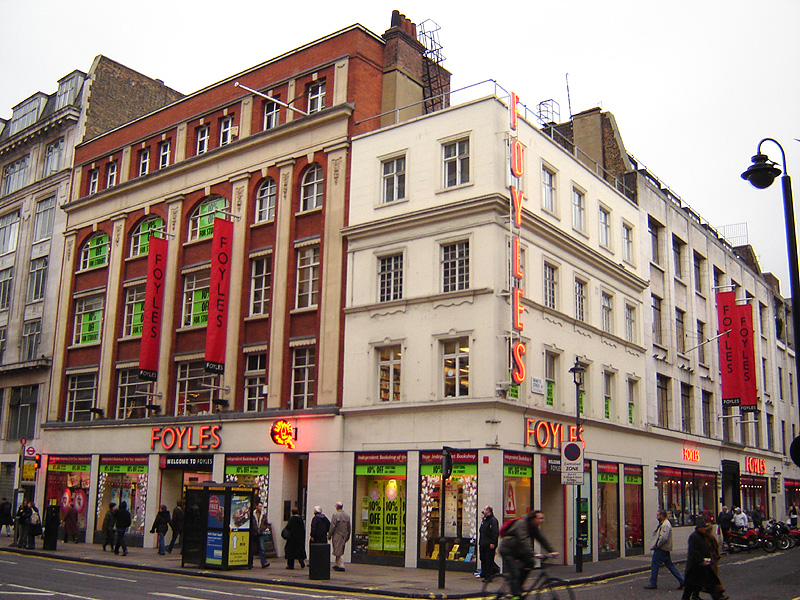
Spot the book: Foyles in Charing Cross - via Wikipedia
Today is a big day for this blog - and for me. Today sees the launch (UK at least) of my book The 10 Principles of Open Business.

The book is the culmination of a journey in thought and in practice that dates back to the beginning of this blog - in September 2006.

During that time (primarily driven by my blogging and curiosity) I've been lucky enough to connect with many brilliant minds; from Alan Moore & Tomi Ahonen, through Clay Shirky and Seth Godin, JP Rangaswami and Doc Searls, Mark Earls and Hugh MacLeod, Alan Rusbridger and Tom Watson - the list continues in the acknowledgements and those interviewed or quoted in the book.

But I've had more than just thought experiments to perform. I've been faced with plenty of real world challenges - from creating change at Bauer Media (formerly emap plc) through to working with a very diverse range of clients in my senior roles at Brando Social, 90:10 Group, The Social Partners and as a freelance consultant.

During these past six years (since going agency and consultancy side) I've been working with, often brave, sometimes fearful representatives of organisations ranging from Sony Mobile, The Edge, City & Guilds, The Guardian, Tesco, Honda Europe, SEAT, First Capital Connect, Bupa, Avis-Budget Group (EMEA), Microsoft, Citrix, 3M, Gatwick Airport, Carlsson Wagonlit, The Co-operative, The UK Borders Authority, Department of Transport, Cabinet Office, Expedia, Tate Modern, to name just a handful.

It was the process of putting theory into practice with paying customers that helped Jamie Burke and I shape the 10 Principles and make them the blueprint for success in today's networked economy that they have become. The result is the book that launches today.

A word about Jamie at this point. He is very much the co-author of the principles - but could contribute very little to the writing of the book itself due to business commitments; hence the book is credited to myself as author with Jamie.

I hope many of you who have found value from this blog over the many years may want to pick up a copy for in many ways your contributions have helped to shape this outcome.

Click here to add it to your amazon shopping cart right now. Thank you.

Oh - and if you spot one on a shelf in a book store anywhere, please do send me a pic (email address is at the top of the dekstop- version of the blog. If you share that pic on twitter too (with the hashtag #openbusiness) I'll send the first three to do so a signed copy in return. (Hint, Foyles in Charing Cross, London, should have them by the end of the week.)


Friday, January 24, 2014

Win a copy of the 10 Principles of Open Business

To mark the UK launch date of the 10 Principles of Open Business I have another batch of copies to give away.
Here's how you can get your hands on one:

1. Two will go at random to anyone who has retweeted the following by 1am GMT on January 28, 2014:

"RT this for a chance to win The 10 Principles of #OpenBusiness - http://amzn.to/1eyDweN"

Two winners will be selected at random and sent physical copies of the book - worth £19.99 each. To qualify the amazon link must be included in the tweet, and the user of the twitter handle must be demonstrably human (bots need not apply). Qualifying tweets must be shared by 1 am GMT on January 28, 2014.

2. One copy will go to the person who gives the best reason for getting a freebie by commenting on this post, below.
The catch here is that you have to commit to writing a review (creating a video one if you prefer) for your own social channels AND add a review to amazon. Naturally you are free to publish what ever you like, you just have to commit to doing a review, good, bad or indifferent.

3. The final copy in this batch will go to someone who is prepared to read it, then hand it on to someone else who they think will get value from it. 
Ideally you'll make that a condition of giving it to the person you pass it on to (as will they, and so on). Just drop me your details and postal address to the gmail address you'll find at the top of the desktop version of this blog.

The deadline for 2 and 3 is February 24, 2014.

Tuesday, January 21, 2014

My bit for Davos: Rethinking IP in the Digital Age

I'm linking to this from  the WEF site. Principle 6?
Over the past six to nine months I've been one of "100 experts from media and technology industry, government, civil society and thought leaders, including innovators and artists" gathered from all around the world to contribute to the World Economic Forum's Seven Principles for Adapting to the New Digital World.

Today the principles are being launched at the WEF's 2014 meeting in Davos.

As is inevitable with so many voices to consider, the outputs are broad.

What they aren't is a How-To guide. How they are implemented by organisations and businesses raises a whole world of new questions and challenges.

The principles do at least provide a framework to ask the right questions within. For example -
" inform users about ownership and rights. "
This in itself can trigger a wide-ranging debate including new definitions of ownership and new measures of return on contribution. The Co-Ip model, considered in my chapter on Open Innovation in The 10 Principles of Open Business springs to mind.

The seven principles - in the words of the WEF

“The way we create, consume and share content and information has changed dramatically in the digital era,” said Diana El-Azar, Senior Director of Media, Entertainment and Information Industries at the World Economic Forum. “The principles lay out a vision for the way we want our online culture to evolve.”

Developed by over 100 experts in workshops and interviews in 2013, the Principles for the Creative and Information Economy in the Digital Age encourage governments, policy-makers, the private sector, civil society groups and individuals to:
  • Foster and reward creativity
  • Build an ecosystem for innovation
  • Expand access to content
  • Inform users about ownership and rights
  • Give creators and rights owners control and choice
  • Enable people to be creators
  • Strengthen global collaboration
The Norms and Values in Digital Media: Rethinking Intellectual Property in the Digital Age present a shared set of goals to help adapt business practices and policy-making to changing norms and values in a hyperconnected world. The principles are part of a World Economic Forum initiative which examines digital issues related to privacy, freedom of expression and intellectual property.

 Full release and supporting information,

FasterFuture.blogspot.com

The rate of change is so rapid it's difficult for one person to keep up to speed. Let's pool our thoughts, share our reactions and, who knows, even reach some shared conclusions worth arriving at?