Monday, December 08, 2014

Give to receive

The 10Principles of Open Business provide a framework for rebuilding the trust so many brands and organisations have thrown away in the over-zealous pursuit of profit/cost.
What we know is when they destroyed the trust they had (through exploited suppliers, one-size-fits-all marketing and anti-customer service) they also destroyed the shareholder value they thought they were creating.
Today’s businesses are waking to the advantages of treating their customers better – of becoming customer-led Open Businesses. They do this because they know without trust their brands have little value.
Those that are most successful at this have recognised something you will find defined in the chapter on Trust in The 10 Principles – that trust is a reciprocal thing. We don’t want trust of the ‘you can trust us to be the cheapest’ kind. We want trust of the ‘we have your best interest at heart’ kind.
To be trusted you have to trust.
Amazon and John Lewis – about the most trusted names in retail these days in the UK – both provide a similar case study when it comes to refunds (an ever more critical part of the retail mix in an increasingly online environment in which distance selling regulations apply to everything bought online in the UK).
Both companies give you your money back. Take John Lewis. I took a six month old leather bag back. The zip had broken and the strap had all but snapped. I had no receipt. But I knew it was a John Lewis bag. I took it back and had the current list price of the bag (£145) zapped straight back on to my credit card.
Trust.
Which I immediately reciprocated. I went straight to the bag department and bought another bag. I know that if I have a similar problem, I’ll get similar treatment in future.
Amazon: Got a problem? They will refund you and THEN ask you to return the item. They trust you. So you trust them.
Both have thought about the problem not from an ‘efficiency’ perspective – but from a customer effectiveness one.
Today you must either offer wow or easy. If you are really good you wow by being easy (Amazon, John Lewis).
You can wow through really low price, or really high quality. Do this and you may get away with not being the easiest in the market to trade with. But if you can’t differentiate yourself significantly through price or quality then easy is where you have to aim – and where you have to win.
I wonder how many high street retailers can really argue they are as easy to trade with as Amazon? They don’t offer higher quality. They rarely offer lower price.
How can they restore the trust and make themselves easier – the first step may be to start trusting their customers more. For many that will require them to know their customers better.
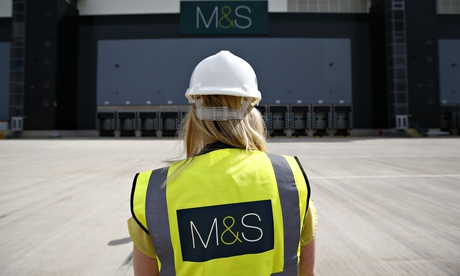
I’ve had a few run-ins with one famous High Street retailer in the last few months. It’s becoming a bit of a running joke in our house. Mrs C laughed after I recounted my latest call with The M&S executive office and said: “They must hate it when they know it’s you,”
I only wish they had the customer systems in place to know my past record when I do contact them. I’d love it if they hated to see me coming. They’d know how much in debit with me they already are and might make an effort not to make things worse.

Sadly, every new issue I have with them is like starting from scratch. 

For M&S watchers - here's my latest complaint. I bought some trousers online. Colour wasn't quite what I was expecting (Less 'neutral' more, pensioner beige). So I returned them to a store. Thinking M&S was the bastion of easy exchange, I took nothing more than my order number with me. That should access everything they have on record about the transaction, I figured.
Nope, in store they can't check your online order number against anything, it seems. Now, instead of trusting their customer and just giving me the money back (as they would have done had they had the receipt) they could only give me a credit voucher. There was nothing in store that day that caught my eye so I took the voucher home to use at my leisure online.
When I did go to buy something online with it I discovered it could ONLY be used in store. In other words a purchase I had made online had been converted into a voucher I could not use online.
I rang and asked for it to be converted to an e-voucher. Computer said no. Even though I have all the reference numbers this could only happen if I sent the voucher back to them first. Funnily enough, if they don't trust me, I'm disinclined to trust them.
So I was left with a useless voucher (as least until the next time I went into one of their stores) instead of the goods I had paid for online.
That is how not to wow, how not to be easy - and how to illustrate the decline of a once great customer service brand...

Thursday, November 20, 2014

Creating a new brand? Start with what it stands for

Open Business: File under business strategy...
Brands are what people say they are. The classic example here is Kelloggs CornFlakes; developed and conceived as a sexual suppresent, the way people used it (as a breakfast cereal) changed how they talked about it and, after that initial hic-cup, how it was branded.

If you want them to agree with what you think your brand is about you have to behave in a way consistent with that position - and that is driven by purpose. Know your purpose and the rest becomes easy. (Chapter One of The 10 Principles of Open Business is dedicated to exactly this).

This sometimes gets lost in the life of a brand. But when one is starting out it has to be the very start point. And that's what last night's broadcast of BBC1's The Apprentice entirely missed.

To create a brand from scratch FIRST you must decide what it is for; what is its purpose - what does it stand for?

Neither of the teams last night started there - and that's why they struggled to align a name, a label, a billboard and a TV ad in any kind of coherent way. This was something Lord Sugar didn't bother pointing out (banging on about product first as if had one of the teams  created something that tasted really nice it would have done its own branding and sold itself to the room of ad execs).

It's simple really:
1. Choose purpose: (eg Helps you tackle life's adventures head on)
2. Come up with a name to reflect that: (eg Red Bull)
3. Give it a taste and colour to reflect that (Caffeine boosted, natural zingy stuff, you get the idea)
4. Do things that reflect the message (jump from balloons in space)
5. Now story board that TV ad...

There are lessons in this for anyone tackling something new - whether it be products and services or developing a brand. I only wish 'business TV' like The Apprentice would do a better job of keeping up.

Tuesday, November 18, 2014

Communication: The art of sharing with others

Communication. The act of communion with another soul. Isn't it?

Yes, I know there are other definitions. But this is the oldest. It precedes the broadcast age.

Interesting too that the term communication comes from the Latin "Communicare" which literally means, To Share. (I'd be fascinated to learn the root in other languages via your comments, please)

I'm interested because I'm wondering if communication in business needs calling out as the 'sharing with others' it actually is rather than the 'broadcasting a pov to others' it regularly defaults to.

Communication as a term has been so misused and abused by an industry bent on getting its message into your brain (doing something to you, rather than with you) that the true meaning has been lost to the point where we have to use terms such as  'collaboration' to define what we mean by genuine communication.

When we connect, we lower the cost of action. This is because we talk to each other and talking to each other enables us to share in the act of making new things.

Those things are new products, new services, new ideas or new processes. Each is an output of what we call collaboration. But perhaps once we get over and out of our broadcast habits we'll be able to call it plain and simple communication once again.

Saturday, October 18, 2014

To the head of customer experience, Marks & Spencer

There's work to be done on Customer Experience here...
Marks & Spencer were once known as the no quibble returns people. Got a problem, you could take it back. In the land of physical stores that was just fine.
But the game changed. And Marks & Spencer didn't.
They left their customer experience back in the 20th century while the rest of us (their customers included) came to expect more. They came to expect customer-led experiences - those that seek to resolve a customer's issue, that understand the value of that customer, that know who that customer is at each touch point.
I hadn't had a good run with M&S. Three successive fails across different parts of their business (poor flowers, dodgy suit, terrible food) had led me to making a make or break call with their executive office. It was very difficult to raise a complaint in the first place because I tried to do it on an iPad. Their model is still PC first. oh dear.
But I don't want to bang on about that. When I told them this was their last chance to retain me (after multiple calls and channel switches) they sent me a £50 gift voucher.
It worked.
I went back to shopping in my nearest store for food on a Saturday.
And then I made the mistake of ordering some clothes online.
The first package came. On time. Trouble was a pair of jeans among the items had the security tag still attached - you know, the sort that covers your world in dye if you try to remove it with the wrong equipment.
So I fired off a complaint (via a pc, lesson learned) and pointed out that the reason I shopped online is that I don't have time to visit the nearest clothes store (30 miles from my home) so can you please try to resolve this without me having to attend? Maybe you could send someone round when doing deliveries with a security tag remover, I reasoned?
The computer said no. They offered me (seriously) a £5 gift token. I told them this is not about money, this is about serving customer need. By not bothering to check that they had removed the security tag, no doubt their deliveries were a tiny bit more efficient. The cost of that 'improvement' had been passed on to me. The cost of fixing their failing (my time and travel) was entirely to be borne by the customer (sans £5 gift voucher).
I'm lucky enough to be paid a tad more than £5 an hour (which is the minimum my resolving the issue would cost) so I didn't think this a good trade off.
Scarily, I had also ordered a new suit from M&S (yes I know...) and said in my last comms to M&S customer service that I was seriously worried about how the suit may turn up now...
You know what I'm going to say next, right? The suit arrived the next day, complete with... you've guessed it... security tag on the jacket!
I started the inevitable and painful complaint process again... They were sorry. This time a £10 gift voucher.

It really isn't about the money. I just want the product I have paid for in a fit-for-purpose-state without the need for me to expend any additional time and money of my own in resolving what is properly the company's issue to fix, not mine!

Isn't that how we all feel now? Isn't that what we all expect?
A series of further exchanges have followed with offers of next day delivery but a continued insistence that I must send the items back before they will send replacements. Well (I have pointed out) I'm sorry but I need the suit for a wedding next Saturday. If I keep hold of it I can (as a last resort) drive to my nearest store and get them to remove the tag). If I send it back I have absolutely zero evidence that M&S is capable of sending me the item in time - and crucially - without a bloody security tag attached. In fact, all my personal experience points to the fact that at least one item per package will have a security tag attached.
The bottom line here is that M&S is using cash to pay off annoyed customers rather than investing in building a customer-centric and device agnostic approach to customer experience.
Now - let me go seek out the head of customer experience and point them this way...

UPDATE October 23, 2014: Tracked down the relevant person on Linkedin who responded swiftly to tell me they'd be picking this up at work.

Given how short I was on time now, I drove 30 miles to my nearest clothing store on Sunday to get the tags removed. This I felt compelled to do despite it being the day of my daughter's birthday party. Parents will understand how little time I had to spare - but thanks to M&S fails I had to spend 90 minutes of the little I had fixing their screw up.
The people in the store were kind and listened. They couldn't understand how the items came to be tagged. Indeed in the case of the jeans, they don't tag them in store, let alone in distribution warehouses.
They wanted to offer me something (yes, vouchers) but I declined because I have now raised this with someone at HQ...
However, I have still not heard anything further from M&S, three business days on.

I will keep you all posted.

BTW - a general rule I think customer experience should apply - Resolution at the point of transaction should always be offered. If it was delivered to my home, you should resolve the issue at my home.

UPDATE October 24, 2014. A letter arrives from M&S Head of Customer Services. It is detailed and lengthy. It accepts there were failings that should not have happened and which were inexcusable. It promises better inter-departmental communications and to consider enabling the online team to send out replacements in advance of receiving unfit for purpose products back. The letter thanks me for bringing all this to their attention.

All in all a very reasonable response. If only it had actually included a resolution of my issue...

I'm left feeling like I've done M&S a number of favours - from resolving the issue myself to giving them big clues about how to improve their offering and reduce their fail rate.

I am left assuming that karma will provide my reward...


Tuesday, October 14, 2014

Antifragile: my contribution to a networkshop

Antifragility consultant and long term supporter of Open Business Sinar Si Alhir was asked to host a workshop at the Center for Technology Innovation at the University of Wisconsin at Milwaukee.
Rather than go it alone, he turned to his network to create a more antifragile response.
I was among those he chose to reach out to and you can see the output of the whole here: (Demystifying Antifragility).
The concept, if you aren't aware, comes from Nassim Nicholas Taleb's book Antifragile - Things That Gain From Disorder (which I thoroughly recommend).

Here's the full text of what I shared with the networkshop:

For me antifragility is about networks (and as is my interest) primarily about the relationships in those networks.

Networked organisations are antifragile. The Mob, Al Queda, these are difficult to destroy because the idea resides not in a boss at the top but in everyone everywhere.

Facebook is fragile. It's fixed networks can be severely damaged by the removal of prime nodes - or superconnectors. Twitter is antifragile - made of nodes where the ability to organise and re-organise around interest in adhoc ways means the loss of one node has less impact on the whole.


The internet is antifragile. Indeed if the web historians are to be believed it emerged as a military application designed to outlive more formally structured communications channels.


Hierarchical companies are fragile. Take out Steve Jobs and...

Familes outlive the oldest companies and will continue to do so; they are networks of connections with both close and weak ties creating a fluidity and adaptability that is essential to be antifragile. They are tied by something which connects them all to each other, not each node to a leader.


The key test of the antifragile is that it has stood the test of time; the weather is antifragile, evolution is antifragile (hence life in aggregate rather than in particular).


Designing for antifragility requires us to think about the survival and continued flourishing of the whole, of the web, rather than of the individual, or the node.


FasterFuture.blogspot.com

The rate of change is so rapid it's difficult for one person to keep up to speed. Let's pool our thoughts, share our reactions and, who knows, even reach some shared conclusions worth arriving at?