Showing posts with label relevance. Show all posts

Tuesday, November 09, 2010

The end of the age of significance - how we'll create our own cultures

The Mona Lisa (or La Joconde, La Gioconda).Image via WikipediaI was just listening to a quite marvellous piece of music by Brian Eno. I won't tell you what - it's likely not relevant.

(Just because you place a little trust in my musings about social (etc) doesn't mean you trust my musical judgement - and unless we are connected on a music sharing service, why should you?)

Whatever the case, most commentators on popular music would acknowledge Brian Eno has contributed works 'of significance'.

In a similar though perhaps clearer way, Leonardo's Mona Lisa is - whether you like or loathe it - acknowledged as a work of significance.

There is something uplifting and unifying in the idea that a piece of music, art, work of literature or person is of such significance that it is afforded near universal value by the majority of humanity.

But this is challenged by this networked age of ours - an age equipped with the tools to surface and scale relevance.

To understand the shifting sands of 'Significance' we must take a step back and explore how Significance has been acquired.

The Mona Lisa has been surfaced as significant by the machines of mass media and production.
Centrally contrived notions of what makes good art, who is a fine artist etc have been codified in the universities and art colleges. Those agreed notions are broadcast through traditional channels – the books from which the next generations of art professionals are taught, the filtering and selection of our iconography sorted to suit the lowest common denominator.

Who and what does Hollywood make movies about. Who and what are most often granted significance by other mass broadcast platforms?

“It’s important because we say it is” is a mantra once (still?) heard in newspaper offices. The centre selects what is of import, what is of significance – repeats and echoes that. The selection is based not on what is validated as important more on what is assumed to match lowest common denominator descriptions of what is important.

The same is true of how we come to select the significant icons of our culture – our shared broadcast, of the many culture.

Which all sounds quite negative. But didn’t it give us a Ghandi for every Cheryl Cole, a Mona Lisa for every ‘Dogs playing poker’?

Yes. But who am I to say thank you for that? I am but one person who happens, on this occasion, to concur with the lowest common denominator view that Ghandi is a wise selection as a person of significance and the Mona Lisa deserves her place in La Louvre.

As we see time and time again, as the long tail extends – as we learn to make use of the tools to scale relevance – the lowest common denominator shrinks until it is no longer the majority. It may retain its place as the single largest group – but it will not dominate.

Indeed the notion of a shared one-size-fits-all culture – particularly confined by and within geographic locations, is challenged by the network – by our ability to scale relevance.

There may be one salvation – a way in which this journey is a not a one-way ticket to nothing of truly iconic significance emerging in our future niche-dominated world; our human nature.

My good friend Mark Earls (author of Herd) would remind us that our inherent desire to be like the monkeys alongside us makes us more willing to accept as majority view. But even that will require us to be exposed to that majority view.

Right now, we are. Twitter trends reveals the single largest groups and we take a peek.
But in a world in which twitter ‘trends among friends’ are the only ones exposed to us, our iconography – our culture and its people, art, music and ideas of significance may come from within small self-forming adhoc groups.

Society, culture, call it what you will seems, to me at least, to be headed on a path away from homogenity – at least as measured within geographic boundaries.
Enhanced by Zemanta

Friday, September 24, 2010

Twitter fails to deliver on niche - again...

the Twitter fail whale error message.Image via WikipediaJust been taking a quick look at the 'New Twitter' which is creeping around London right now.

Lot's of nice things about it of course - which you will have heard and seen before no doubt. My colleague Jason Fashade has analysed its impact on a number of factors here.

What bothers me is that the Twitterbods seem to have gone for mass broad value, over niche core relevance once again. This surprises (and underwhelms) me given Twitter's baked-in understanding of the networked world.

The target of my concern is in the 'tweets near you' search function.

Just as with Trends, there is no option to narrow this to the tweets of people who matter to you (ie Trends Among Friends - as I've previously called for).

So yes, I can search for tweets near me - which has some value, granted - but not from tweets from friends of mine near me (which has far greater relevance and therefore value).

Come on guys it's a network of fluid high-value niches - give us access to that! FourSquare does.


Enhanced by Zemanta

Monday, September 20, 2010

Scaling relevance: Delivering bespoke utility at low cost

The networked world will overturn many traditional business models which focus on low cost - often driven by the desire to feed on the economies of scale of mass production.

In a networked world we have the potential to scale relevance and should focus on that first.

Relevance - or fit with our specific needs - is reduced by the focus on economies of scale that mass production delivers. Relevance = Utility; in that the more relevant it is to me, the more useful it is to me.

We all have a preference for the thing we find most useful - and place most value upon it. Mass production can't deliver relevance - at least it can't beyond meeting lowest common denominator requirements. The bargain we enter into, when accepting mass produced approximations of fit with our specific needs, is low cost.
There is a balance point between utility and cost - which varies for each of us dependant on circumstances.
I believe our ability to connect with those people like us seeking solutions to the same problems we do, which the web enables, swings the balance strongly in favour of relevance, fit, utility.

And as it does so, so we must start considering, and delivering, new business models which seek to serve the network and not the world of broad mass production; models that make delivering relevance (highest utility) their key driver.
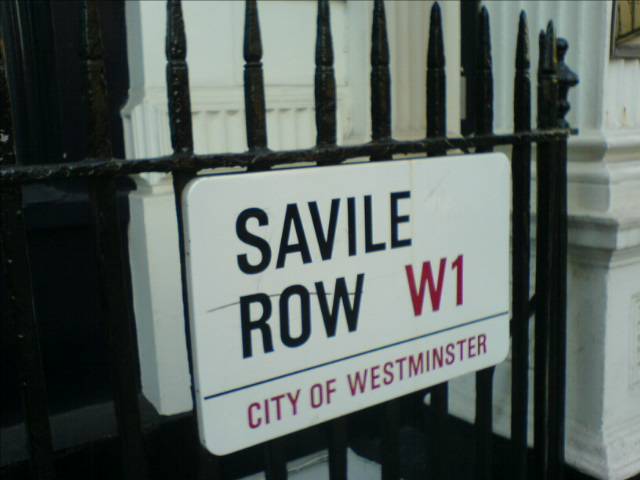
An example; we'd all prefer a made-to-measure, bespoke suit. Not only can we specify it to our taste, it will also be optimised for relevance. In other words it'll fit not just our taste, but our specific shape. To service our bespoke requirement in this regard is costly - particularly when compared with the price of an off-the-peg solution.

Granted suits on pegs are not sold quite at the level of one-size-fits-all, but they are certainly sold against a series of broad 'fitness' points. Very rarely, a buyer's specific taste and shape requirements will be matched by an off-the-peg suit. And on that rare occasion no doubt the rare buyer will rave about the quality of the fit of the suit to all his pals (who no doubt will find buying the same off-the-peg-suit far from satisfactory).

Consider how the networked world could make suits. Let's assume that people are able to accurately measure themselves in all the dimensions a quality bespoke tailor would (and yes, that is quite an assumption, but play along for the thought experiment, please).

Imagine a platform which could gather the meta data of these measurements, associated with their owners (a website, if you like, where people enter the relevant data) where those with excellent matches are introduced to one another - on a global scale.

Now these customers are formed into a group via the meta data of their shared dimensions and taste. Assume thousands of them (remember, we are operating on the global scale of billions of internet users) are a match - and they can all buy together. Now they can get the same order of utility (hand stitching aside, if that is indeed an advantage) as the individual bespoke suit buyer - at the same order of cost as anyone buying a mass-produced off the peg suit.

Imagine the relevance-first model applied to your industry.

The network has the ability to scale fit (relevance) in a way traditional mass production can not. In the complex adaptive system of the economy, those best adapted to the actual fitness landscape are best equipped to survive.

It's another example of how the web reveals the true role of the organisation as a platform - and the web as a place where orgs make things with (others) rather than take things from.
Enhanced by Zemanta

FasterFuture.blogspot.com

The rate of change is so rapid it's difficult for one person to keep up to speed. Let's pool our thoughts, share our reactions and, who knows, even reach some shared conclusions worth arriving at?