Showing posts with label Broadcasting. Show all posts

Monday, September 13, 2010

Apology as a tool of revenge

The humanising of communication; the shift from one-to-many broadcast to many-to-many conversation, raises the opportunity for comms and customer service teams to perform damage limitation faster and with greater effect than ever before.
Research published in Dan Ariely's latest book The Upside of Irrationality reveals there is one very powerful tool in your armoury which is currently deployed far too rarely and warily: the apology.
Dan revealed a basic and very simple formula: one annoyance + one apology = no annoyance.
A basic and intransigent unwillingness to accept blame (for all kinds of legal 'brand' and ego-related reasons gets in the way of this. Yet, if deployed unfettered by these self-regulations, an apology can make the problem those rules are meant to defend against go away. (image courtesy tim ellis)
Social media has revealed the truth of this on many occasions. An apology served early and earnestly is a powerful thing in damage control.

But the multiple success of this strategy seems to have confused some.
They get that there is power in an apology but not that the power resides not in the utterance of the apology but in the allocation of blame.
They say things like 'we are sorry you are sorry' rather than 'we are sorry for doing the thing that has upset you'.
It may be (and I'd love to see Dan examine this) that an apology only serves the purpose of tool of revenge if someone is seen to be taking the bullet - accepting they were wrong.

In the moment of one side admitting guilt we get a kick of vindication which allows us to move on with a feeling - no matter how minor - of justice served/revenge taken.

And as Dan also points out - our desire for revenge is an essential (even useful) part of what we are.
If we don't feel justice is served we'll find other ways to take our revenge (which regularly means doing down the product/service provider to anyone who will listen).

My apologies if I made that a little long-winded... ;-)

Enhanced by Zemanta

Tuesday, June 22, 2010

ITV to 'incorporate social media'? Meh

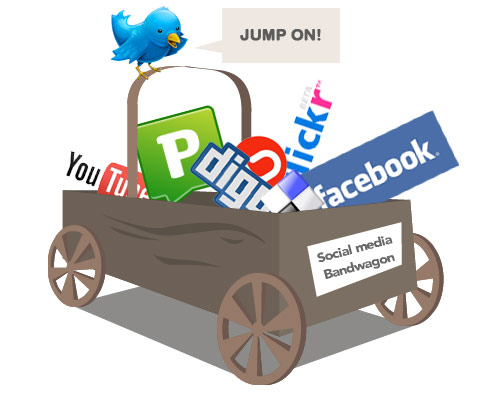
Isn't it time we got over ourselves when it comes to getting excited at yet another traditional business jumping on the social media bandwagon?

The latest 'reason to get excited' is that ITV is going to 'incorporate social media into the news'. Gee.

Meanwhile, the rest of us are busily getting on with sharing what we think about 'the news' (or more potently, that which is relevant to us and our peers) every day via - you guessed it - social media. We've self organised, you see. We aren't waiting for permission to join in from them's that used to be in control. (image courtesy Matt Hamm)

And the more we engage with each other (at the edge) the more we discover we don't need that someone in the centre setting our agenda for us.

But I've banged on about the bankruptcy of the broadcast news model more than once.

We should no longer be excited when yet another company decides its going to use social media. What we should applaud is when one commits to participating in it - understanding that the deal is not all take, and it's not to broadcast through.

What should earn our applause is an organisation participating in social media not as a means of gathering free 'user generated content' and not as a means of getting its messages distributed, but instead as a way of finding people who care about the same things it does inside and outside, and supporting them in shaping better-fit outcomes for all.

There's the return on investment. Make better things, not better messages. Together.

Better things make better messages.
Enhanced by Zemanta

Saturday, March 27, 2010

Publishers should abandon both paid content AND advertising to survive

I'm glad that some Murdoch publications are going back to the failed experiment of paywalls - if only because it will reveal once and for all how far from right they've got their strategy for the networked world.

I understand completely why they are doing it - they've done the math (I've been through it with similar orgs). With only small audiences who pay they can make more money than with vast audiences who don't.

That's because those who advertise online don't pay as much as those who advertise in more traditional mediums. There has been a race to the bottom on advertising pricing which made certain of that.

Mass media publishers have learned that they can't make as much money in the networked world (where everyone is publisher, distributor and creator of their own user journey/experience) as they did in the world of control. So, they are attempting to go back to the world of control (when that genie is well and truly out of the bottle and showing no signs of wanting to return to it).

Information is free. But the way it is packaged - the experience of it - you can add a price to. Music, for example is commoditised. People don't pay Apple for music at iTunes. They pay for the packaging, the user experience, ease of usefulness. If this is what the TimesOnline etc will deliver for news content, they may have a business case. I struggle to imagine the parallel myself.

And if all they are going to do is offer access to information in the way they have done until now - but behind a paywall - then they will lose. They can only ever offer access to limited information with limited sources and processes of verification (and trust creation). The rest of the open web is unlimited in both these key respects. Open wins.

But I think through all this publishers are avoiding the key questions. Why do people pay less to advertise online than they did in traditional media? Online the Times et al can acquire greater audiences, more eyeballs. Why isn't that of higher value than print to those taking the broadcast approach to advertising? More eyeballs = pay me more - surely? Why is an online 'eyeball' worth less than an offline one?

Is it that the many digital innovations in advertising that the internet has enabled has lifted the wool from many eyes? It has shown that an eyeball doesn't equal a sale. Never did. But when you are able to measure the lack of transaction, the lack of interest, the scale of your interruptive spam - as the internet has enabled like no other medium - then the wastage of 'Advertising' becomes ever more clear.

Yet publishers persist with pay-for-my-content/pay-for-adverts-on-my-content as their only experiment - as if the solution can only be one or other, or both. Perhaps it's time for them to try a new experiment rather than repeat a failed one? Perhaps it's time to try not one, or other, or both... but neither.

How can publishers create value if they do not charge for content and do not take adverts?

Micro-contributions? Nah - that's just paying for content by novel means (as was Radiohead's pay what you like for our album) Sponsorship? Nah - that's just placing adverts on my content, by another name. Affiliate deals - just another digital ad innovation.

What can they do? Start with the Because Effect. Don't try to make money with content, try to make it because of it.

Content can be the social object around which communities of purpose form - co-creating communities ready and willing to wikifix solutions with brands and organisations - instead of having them imposed on them and fed to them through advertising.

Publishers can become platform organisations: platforms for creating outcomes with genuine ROI rather than platforms for pumping out things people may find useful attached to ads for things they rarely do.

Pay for content/Place ads on content, worked in a world of mass production and distribution - of mass media. But a new 'neither' model is required in a world of niche, of communities of purpose, of active rather than passive consumers - in a networked world.

Platform could be it.

Reblog this post [with Zemanta]

Monday, February 22, 2010

If advertising didn't exist would you feel the need to invent it?

I'll be in Madrid for the OMEXPO on Feb 24-25. I'll be presenting alongside Jamie Burke (CEO at 90:10) on the, obviously, non-controversial subject of: The Death of Advertising.

This is how our 45 minutes is being sold:

90:10's Jamie Burke and David Cushman confront you with the end of business as usual.

They'll examine how everything you thought you knew about traditional advertising will fail you in the rapidly emerging and increasingly dominant networked world.

They'll explain how the shift from a broadcast world to a network of peers disrupts content creation, distribution and user experience.

And they'll ask what lessons Spain's advertising industry can learn from the peer-powered disruption tearing the UK's media landscape apart.

If you landed in a world without advertising today, would you reinvent it?

And, of course, I'll be making the slides available via slideshare shortly after. Expect some conclusions involving platforms, naturally.

Jamie and I arrive around 1pm on the 24th and leave on the evening of the 25th. If you'd like to meet with us while we're there, please drop either of us a line: david AT ninety10group DOT com or Jamie AT ninety10group DOT com.

Wednesday, January 27, 2010

Why I hate automation in human communication

The Twitter fail whale error message.Image via Wikipedia
Stephen Waddington was kind enough to ask for my thoughts on Bots (and specifically Twitter Bots) for his latest article on Reputation Online.

He's also blogged about his motivation for writing the article.

Stephen has compiled the thoughts of several social thinkers and you can read the aggregation in his article.

But I thought it may be good to share the interview Stephen conducted with me as part of that process, in full.

So, here it is:

Stephen: Is there a real world equivalent to script building in the virtual world? I'm looking for a metaphor?

Me: It's a little like someone who arrives at a university's Freshers' Week and goes about indiscriminately joining each and every club and society. And then they refuse to come to any of the meetings unless they first get appointed to the organising committee. By people they don't yet know and whom don't yet know them.
Or the speed dater who takes everyones number and doesn't call anyone.
Or the boss of a large org who expects everyone to greet him by name each morning but doesn't bother learning the names of his staff to respond with.
In short it's anti-social in the purist form: ie not the way humans expect each other to behave.

Stephen: Is the size of a network as a means of measuring influence/authority appropriate under any circumstances?

Me: If that network is a perfect match for the niche you are interested in. That is a perfect match, and a perfect match Right Now. But the reality is influence flows. It's a real-time web in a real-time world.
Think of a flock. Think of the times you tried to change the direction the flock was moving in. If you succeeded you may claim some influence. If you failed, where was the influence then? Same network - at least the same nodes - in play. But the interactions between the nodes vary on each occasion. And it is in the interactions that change-in-state occurs. Finding nodal start points is important, but the peer to peer mechanic itself is more vital.

Stephen: What is the downside of using a script to build a social network? Technically and socially?

Me: Technically it's likely you will be in breach of many networks' terms and conditions. Check out twitters rules, for an example. But more critically you will mark yourself out as using social networks in a broadcast, one-to-many way. No one wants to talk to someone who doesn't listen.
I have this dream that as us humans spot the bots we block them, refuse to follow them etc to such a degree that the fuzzy edge around our communities hardens against them. And we end up with a walled off Escape From New York scenario where the bots are all following each other, broadcasting welcome messages at each other. Every bot talking but nobody listening.

Stephen: Agencies are flogging bots as a means to build guaranteed follower numbers? How should an agency that deems this inappropriate counter this from a sale perspective?

Me: Well, we have to point out that follower numbers don't equal interaction or desired outcome. Social media means nothing in its own right. We have the best set of tools for connecting people in history. So what are you going to do with them? Harvest eyeballs? Come on! Ditch the spam-tastic waste machine of the 20th century - get efficient. Keep your million eyeballs, I'd rather connect with a small group of people who care sufficiently about the purpose at hand to want to make it better. These people find each other through genuine human interactions, not carpet bombing. Famous for 15 people beats famous for 15 minutes.

Stephen: What should clients/agencies be measuring?

Me: Outcomes.

Stephen: Are there any other points that you'd want to make on this topic?

Me: There is an exception to my anti-auto position. It is to take advantage of the growing Web of Things. Automated reports from devices, buildings etc that I choose to receive status reports from are welcome. I'm also ok with bloggers adding an RSS feed of their posts (and similar) provided that isn't the only or major representation of themselves in any particular network. If the content prompts conversation in the environment in which it is shared, or helps people with shared purpose find each other, that's a good thing.


Reblog this post [with Zemanta]

FasterFuture.blogspot.com

The rate of change is so rapid it's difficult for one person to keep up to speed. Let's pool our thoughts, share our reactions and, who knows, even reach some shared conclusions worth arriving at?