Showing posts with label platform thinking. Show all posts

Tuesday, August 07, 2012

Open Business - Principle 3: The Networked Organisation

 I've just published the third of our 10 Principles of Open Business over at 90:10 Group.

The third Principle is the one that defines the structure of an Open Business. It is that it should be a Networked Organisation.
Networked Organisation (or as McKinsey is labelling them, Networked Enterprises) will be familiar territory to anyone who has read this blog for a number of years. They go by the alternative name of Platform Organisations. An excerpt:
“The organisation functions as a platform connecting internal networks to external ones for a common Purpose.” (see Principle 1: Purpose).
This speaks to and supports our primary definition of an Open Business: One which uses its resources to bring people together to achieve a shared Purpose – designed from the outset to scale through participation making partners of customers.
You can read the full blogpost here.

I've been thinking and writing about the shift from traditional to networked (or platform) organisations since I began this blog. As more tech gets deployed, the clearer the requirement to connect inside and out reveals itself.
And, as I previously discussed, with the arrival of 3D printing the veil lifts on the true role of the organisation - suggesting a platform (or networked) approach has been the natural state to which organisations were always going to return when our view became clear:
When we talk about means of production, we often think about the machinery to produce. But that does not mean the device.
In a mass production world the connection between the machinery and the process is clearer. Traditionally a newspaper owner needed to own a printing press. They also needed to employ a team or writers, photographers, editors etc to produce the content. Which was the means of production? The printing press or the producers of the content? The two were so tightly connected it didn't matter.

On the web the owner of the means of production of content is the person who creates the content. In reality this was always so. In the past the owner of the means or production of content had no access to the printing press. Now they have (or at least to its equivalent in the form of the web - where of course everyone is a publisher).

The same is true of factories; where the production line is the equivalent of the printing press. In a world in which everyone has access to their own production line ( a home 3D printer) the real means of production is revealed as those coming up with the ideas, process and required designs.

What is clear is that 3D printing throws into sharp relief the need for organisations to think of themselves far less as the makers of, and far more the supporters of the makers of, 'their' products.
From 'The Challenge of 3D Printing to the role of the organisation'

Enhanced by Zemanta

Tuesday, November 23, 2010

Revolution requires Government thinking that understands the web

I'm not sure Martha Lane Fox's latest report is calling for anything like a 'revolution' - as the headlines are screaming.

The Government's 'digital champion' is calling on the Government to sharpen up its online processing of our needs. In other words to do better channel management.

That's no revolution. That's what those in Government have been trying to achieve for some long time. They know it costs less to deal with an individual online than it does by phone or - God forbid! - face to face.

It's all about reducing the cost of transacting with the public. In other words, applying old principles of service delivery (one to many; from the centre to the edge) to the network tool set that is the web. Sure. Do it better. But incremental improvement does not a revolution make.

The real revolution would be for the Government to understand the value it can derive by connecting people to make what they need together - like our example for turning digital dole queues into a breeding ground for new businesses.

It's time we adjusted our thinking away from driving people online to deliver services more cheaply and instead use the advantages of online to develop new models in keeping with the network. Ones that make better services with less waste and deliver new services with those who need them. And everyone can join in that revolution.

And with my work hat on; here's my response to Sir Tim Berners-Lee's discussion of the way uber silos are threatening the web and our ability to create value with it: A wake up call for Open business
Enhanced by Zemanta

Wednesday, October 20, 2010

Cuts this deep require model change - and a platform approach

There is much talk within UK Government of using digital means to reduce costs. Reducing costs is what this government does. Or at least attempts to.

When the discussion is about the use of digital means the focus is usually on delivery of existing (or reduced) services or benefits - providing a replacement, lower cost customer interface when compared with bricks and mortar offices. (Image courtesy sjsharktank)

Essentially what they are seeking to do is deliver the same old same old at a lower cost. Efficiencies. Hopefully.

But as those with long expertise and experience in business will tell you, the kind of cuts, the kind of savings our current Government is trying to make don't happen without a significant change to the model, too.

So it's time they stopped looking at driving people online to do what they used to do in offices and instead use the advantages of online to develop new models in keeping with the network.

A great example. Fellow Twitter user @siliconglen and I were discussing 'the cuts' this morning when he suggested there should be some kind of site where the 500,000 public sector people who will be put out of work by these cuts could be helped - where they could pool resources and skills.

This is a very different kind of digital thinking than applied by the Government in its channel management focus. This is platform thinking.

Imagine a site where users register their all important meta data - ie their skills, their interests, their location, their resources - where users pitch ideas to each other, aggregating support, pulling together teams with the right key sets and who, thanks to redundancy payments, may even be able to provide seed funding for the idea. Augtomated cross matching could bring together new groups focused around their shared purpose.

Self-organised, self-starting, highly-motivated businesses launched from the ashes of job cuts - perhaps supported with matching funds by the Government for those ideas reaching a critical level of support. People building things they believe in - and which others believe in, too.

Yes, I appreciate there are elements of this model distributed here and there throughout the web. Places where seed investors are matched with entrepreneurs. Places where ideas are pitched and communities vote. Places where people log their interests and skills. Places where their assets are listed.

What may be necessary is a selection of the essential elements and a distillation into one functioning whole. Hell, some of those cast aside in the spending review could probably do the build. People could share skills and retrain each other through it, too.

With a relatively small investment and a grip on the realities of our self-forming future, the Government could inspire a new self-organising style of entrepreneurial business - contributing to the economy, creating new things and new value - matching real needs. Instead of standing by and keeping fingers crossed that the existing private sector will take up the slack - or even watching helplessly as the unemployed become a long term cost.

Of course this would become valuable not just to the 500,000 public sector folk at risk - but also to all those whose jobs may tumble in the cascade around those public services. In fact, any one could join.

That's Big Society, Dave. Writ large
As I've often said, the future isn't digital - it is self-organised.

Enhanced by Zemanta

Wednesday, September 15, 2010

The challenge of 3D printing to the role of the organisation


RepRap from Adrian Bowyer on Vimeo.
Love this article by Simon Bradshaw, Adrian Bowyer° and Patrick Haufe on the trends among, and impact of, 3D printers. I recommend you go read the lot.
In summary the story goes that 3D printing (ie the ability to copy and fabricate products in the home very simply and cheaply) is likely to have the same impact and reach as the home pc before too long.
So for those of you who thought the disruption delivered by the power of the network was limited to movie making, music production and paid-for content, it's time to take a deep breath and imagine this near future:
"All this may be heading towards a world in which people do not buy consumer goods any more but instead download them from the web and print them themselves. They will be able to customise them at will and may avoid some of the environmental and monetary cost currently entrained by the (often global) physical transport of manufactured goods; indeed, work is in train to make RepRap [a community-owned and very low cost 3D printer] run on home-recycled plastic which would further reduce such costs. In particular, the ability of a 3D printer to, in principle, print a copy of itself, and for both machines to print further copies and so on, suggests that the cost of 3D printing may rapidly fall to the point where it becomes a widely-available technology.
Oh, but what of economies of scale? That's the howl heard railing against anyone touting the accurate serving of microniches (in which users get to shape products to their actual specific fitness landscape, compared against the potentially wasteful ill-fit of the lowest-common-denominators of mass production).
The future is a more widely distributed, less centrally organised place...
"...having many people making few items in the home, instead of few people making many items in factories, is against the idea of economies of scale. But economies of scale are not universal: in the past people took clothes to central laundries to have them washed; now people use their own washing machines. Today electricity is generated in 2 GW power stations tomorrow it may be generated by individual photovoltaics on everyone’s roofs. And industrial printing presses offer far greater economies of scale than the home inkjet printers mentioned in the first paragraph that are – for many types of printing – replacing them."
My caveat is this: our preference, as very social beings, is to always work with others. We are not silos and we will not produce, customise or replicate in silos. The web is not primarily for taking from (ie searching for a product to download and print out). It is for connecting us.
Less for taking from, more for making with (others).

Through it we connect with people aiming to solve the same problem as us in real-time. That's where it delivers real value. Through those relationships our preferences are also shaped.
When we find each other we need effective ways of surfacing our best ways forward - and support in reducing the cost of delivering those solutions/fixes/next steps.

Even a world in which we all have a home factory requires a platform approach. The very process of making together delivers better results for those with shared purpose (none of us is as clever as all of us, after all...)

Platform Organisations can help bring us together and help us discover the more successful collective solution. The expertise organisations contribute will be another value-add. And their ability to bring us together to source raw materials at a collective price, another.

3D printing becomes one of the ways in which the outcome is delivered. It's the new delivery truck. But the web itself - and the relationships it enables - retains its role as means of production (via co-creation - making with).

When we talk about means of production, we often think about the machinery to produce. But that does not mean the device.
In a mass production world the connection between the machinery and the process is clearer. Traditionally a newspaper owner needed to own a printing press. They also needed to employ a team or writers, photographers, editors etc to produce the content. Which was the means of production? The printing press or the producers of the content? The two were so tightly connected it didn't matter.

On the web the owner of the means of production of content is the person who creates the content. In reality this was always so. In the past the owner of the means or production of content had no access to the printing press. Now they have (or at least to its equivalent in the form of the web - where of course everyone is a publisher).

The same is true of factories; where the production line is the equivalent of the printing press. In a world in which everyone has access to their own production line ( a home 3D printer) the real means of production is revealed as those coming up with the ideas, process and required designs.

What is clear is that 3D printing throws into sharp relief the need for organisations to think of themselves far less as the makers of, and far more the supporters of the makers of, 'their' products.

Which is exactly how a platform organisation should be thinking...


One final thought inspired by the article (The Intellectual Property Implications of Low-Cost 3D Printing) - the authors conclude: 'Within the UK at least, personal use of 3D printing technology does not infringe the majority of IP rights.'
Which makes me wonder what planet those politicians who forced through the Digital Economy Act are living on...
Enhanced by Zemanta

Tuesday, September 14, 2010

Beware the survey of the thing they haven't experienced yet

People are notoriously bad at telling you what they want when they haven't yet experienced the thing you think they might like. Apple's Steve Jobs is always banging on about it. It's summed up as 'people don't know what they want.'

Which always sounds, well, insulting and patronising. (image courtesy amydeanne)

This (from December 2007) illustrates the point:
"Am I missing something? The headlines (Consumers Prefer GPS over Mobile Internet/GPS edges out internet as desired mobile feature - study) tell us US mobile phone users would rather have a GPS-enabled phone than a mobile-internet enabled one.

Translation: I'd rather have a sat-nav than be a live, real-time connected node on the network.
What kind of questions resulted in that?
Q"Would you like to know where you are? Or would you like to know any and everything?"
A"Oh, I'll take where I am thanks."
Uh?
But people are exceptionally good at shaping a concept to fit their fitness landscape. In fact, they always place a higher value on something they have had input in creating (which brings oodles of peer-to-peer marketing value).

In order to engage them you have to provide the 'thing' to talk about. That becomes the social object; an integral part of the platform-thinking approach. (discover/bring together/surface/work together to fix).

Give them something that interests them, that engages them. Then they'll help shape it. And if you can give them something to experience - then the 'survey' of their feedback will be all the more effective.

That thing could be a workshop in an interesting location, with physical interaction and decisions made, or a beta site with direct links to the developers, or prototypes to add to and delete from, or....

As long as it's something around which discussion-leading-to-change can happen, the social object will be doing its job. And the discussion is key - the process must be social not silo'd.
Enhanced by Zemanta

Tuesday, June 22, 2010

ITV to 'incorporate social media'? Meh

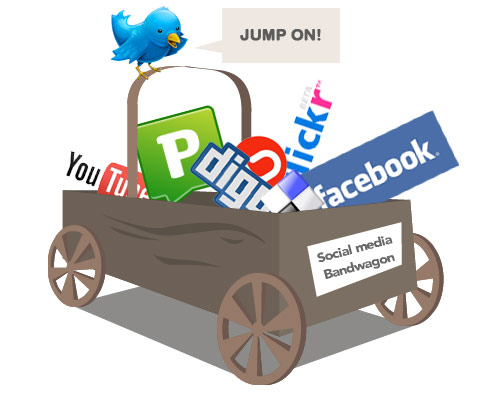
Isn't it time we got over ourselves when it comes to getting excited at yet another traditional business jumping on the social media bandwagon?

The latest 'reason to get excited' is that ITV is going to 'incorporate social media into the news'. Gee.

Meanwhile, the rest of us are busily getting on with sharing what we think about 'the news' (or more potently, that which is relevant to us and our peers) every day via - you guessed it - social media. We've self organised, you see. We aren't waiting for permission to join in from them's that used to be in control. (image courtesy Matt Hamm)

And the more we engage with each other (at the edge) the more we discover we don't need that someone in the centre setting our agenda for us.

But I've banged on about the bankruptcy of the broadcast news model more than once.

We should no longer be excited when yet another company decides its going to use social media. What we should applaud is when one commits to participating in it - understanding that the deal is not all take, and it's not to broadcast through.

What should earn our applause is an organisation participating in social media not as a means of gathering free 'user generated content' and not as a means of getting its messages distributed, but instead as a way of finding people who care about the same things it does inside and outside, and supporting them in shaping better-fit outcomes for all.

There's the return on investment. Make better things, not better messages. Together.

Better things make better messages.
Enhanced by Zemanta

FasterFuture.blogspot.com

The rate of change is so rapid it's difficult for one person to keep up to speed. Let's pool our thoughts, share our reactions and, who knows, even reach some shared conclusions worth arriving at?