People are notoriously bad at telling you what they want when they haven't yet experienced the thing you think they might like. Apple's Steve Jobs is always banging on about it. It's summed up as 'people don't know what they want.'
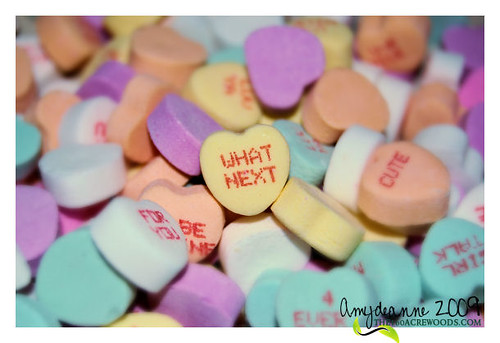
Which always sounds, well, insulting and patronising. (image courtesy amydeanne)
"Am I missing something? The headlines (Consumers Prefer GPS over Mobile Internet/GPS edges out internet as desired mobile feature - study) tell us US mobile phone users would rather have a GPS-enabled phone than a mobile-internet enabled one.
Translation: I'd rather have a sat-nav than be a live, real-time connected node on the network. What kind of questions resulted in that? Q"Would you like to know where you are? Or would you like to know any and everything?" A"Oh, I'll take where I am thanks." Uh?
But people are exceptionally good at shaping a concept to fit their fitness landscape. In fact, they always place a higher value on something they have had input in creating (which brings oodles of peer-to-peer marketing value).
In order to engage them you have to provide the 'thing' to talk about. That becomes the social object; an integral part of the platform-thinking approach. (discover/bring together/surface/work together to fix).
Give them something that interests them, that engages them. Then they'll help shape it. And if you can give them something to experience - then the 'survey' of their feedback will be all the more effective.
That thing could be a workshop in an interesting location, with physical interaction and decisions made, or a beta site with direct links to the developers, or prototypes to add to and delete from, or....
As long as it's something around which discussion-leading-to-change can happen, the social object will be doing its job. And the discussion is key - the process must be social not silo'd.
There are many preparing to put TV back on its pedestal thanks to the perceived influence of the Leader's Debates on tomorrow's (May 6, 2010) UK general election.
But just before we get too excited by a resurging all-powerful broadcast medium, let's pause to think about what's going on here.
The leaders debates have acted as social objects. There are many more people who have been influenced by the conversations of their peers in response to the debates than can possibly have been influenced by watching the debates directly themselves. (Image courtesy Dean Terry)
Influence in isolation is a tough ask. We derive our understanding, our opinion of, our view of - our emotional response to, the leaders debates not through our direct individual experience of them, but through our social interactions with those around us.
The value of a social object is in the interactions it inspires - far beyond that first-generation direct encounter between user and object that we had broadcast at us in our lounges.
Don't believe me? Then why does one group see David Cameron 'winning' a debate while another calls it clearly for Gordon Brown? The content was the same for both sets of observers. The qualities of the social object are not intrinsic in it; they are extrinsic in our response to it (recommendation is in the eye of the receiver). The qualities of the social object are generated by our social interactions.
Which is why the biggest impact on the election result is in the interaction between peers - made so rapid and easy by the social tools at our disposal.
It is not TV wot won it - victory, if it derives from anywhere, is overwhelmingly to be found in social media's ability to connect and amplify our social selves. The ubiquity and simplicity of those tools is what has changed since previous elections.
So it was Twitter wot won it, it was Facebook wot won it. It's your friends wot won it.
I'm glad that some Murdoch publications are going back to the failed experiment of paywalls - if only because it will reveal once and for all how far from right they've got their strategy for the networked world.
I understand completely why they are doing it - they've done the math (I've been through it with similar orgs). With only small audiences who pay they can make more money than with vast audiences who don't.
That's because those who advertise online don't pay as much as those who advertise in more traditional mediums. There has been a race to the bottom on advertising pricing which made certain of that.
Mass media publishers have learned that they can't make as much money in the networked world (where everyone is publisher, distributor and creator of their own user journey/experience) as they did in the world of control. So, they are attempting to go back to the world of control (when that genie is well and truly out of the bottle and showing no signs of wanting to return to it).
Information is free. But the way it is packaged - the experience of it - you can add a price to. Music, for example is commoditised. People don't pay Apple for music at iTunes. They pay for the packaging, the user experience, ease of usefulness. If this is what the TimesOnline etc will deliver for news content, they may have a business case. I struggle to imagine the parallel myself.
And if all they are going to do is offer access to information in the way they have done until now - but behind a paywall - then they will lose. They can only ever offer access to limited information with limited sources and processes of verification (and trust creation). The rest of the open web is unlimited in both these key respects. Open wins.
But I think through all this publishers are avoiding the key questions. Why do people pay less to advertise online than they did in traditional media? Online the Times et al can acquire greater audiences, more eyeballs. Why isn't that of higher value than print to those taking the broadcast approach to advertising? More eyeballs = pay me more - surely? Why is an online 'eyeball' worth less than an offline one?
Is it that the many digital innovations in advertising that the internet has enabled has lifted the wool from many eyes? It has shown that an eyeball doesn't equal a sale. Never did. But when you are able to measure the lack of transaction, the lack of interest, the scale of your interruptive spam - as the internet has enabled like no other medium - then the wastage of 'Advertising' becomes ever more clear.
Yet publishers persist with pay-for-my-content/pay-for-adverts-on-my-content as their only experiment - as if the solution can only be one or other, or both. Perhaps it's time for them to try a new experiment rather than repeat a failed one? Perhaps it's time to try not one, or other, or both... but neither.
How can publishers create value if they do not charge for content and do not take adverts?
Micro-contributions? Nah - that's just paying for content by novel means (as was Radiohead's pay what you like for our album) Sponsorship? Nah - that's just placing adverts on my content, by another name. Affiliate deals - just another digital ad innovation.
What can they do? Start with the Because Effect. Don't try to make money with content, try to make it because of it.
Publishers can become platform organisations: platforms for creating outcomes with genuine ROI rather than platforms for pumping out things people may find useful attached to ads for things they rarely do.
Pay for content/Place ads on content, worked in a world of mass production and distribution - of mass media. But a new 'neither' model is required in a world of niche, of communities of purpose, of active rather than passive consumers - in a networked world.
A group of us will discuss the social side of the mobile tech in a footy context.
If there's anything that qualifies as a Social Object it's a footy team. Yet I'm struggling to find good apps or tools which do more than broadcast information at silo'd individuals. Big opportunity there and one I'm keen to explore in my session.
Both are brilliant and disruptive mobile minds and this represents a rare opportunity for all three of us to be in the same place at the same time. Bit like planets aligning - or buses arriving, depending on your perspective :-)
For my small contribution I get to share a 40% discount code: It is 'speaker-HJRQTSEC' making the ticket cost £180+VAT. To access it go here.
The event starts at 08.30 and the final agenda can be viewed here
I have a lot of time for the guys at One Golden Square Labs as they try to adapt Absolute Radio's broadcast model to the networked world. The latest example is Compare My Radio. Absolute's Dan Thornton pointed me at it (here's his take) - and I want to thank him for making me think a little about radio, music, curation and social objects. Which is what follows.
Anyways, to start at the beginning, Compare My Radio requires a little data from you about musical tastes before attempting to match you with the most appropriate broadcast channel.
Bravely, users get directed to rival properties as well as Absolute's own.
No doubt the payback for Absolute is the data they receive from users which could, for example, be used to hone Absolute's broadcast output: ie they learn more people want more Britpop, so they play more Britpop.
So, I muse, what may the outcomes be if you include not only the output from mainstream broadcast radio in the search returns, but also the narrowcasting shows of podcasts and the likes of Mixcloud (touted as The YouTube of radio). Tough to do. And I'm not criticising that this is not included in CompareMyRadio - I'm simply indulging in the thought experiment of assuming it could and should.
A model like CompareMyRadio could surface the single largest group by revealing the lowest common denominators (ie, the most searched-for artists).
And that is useful for honing broadcast.
And in a broadcast way, it will also point you at the mainstream channel which is the best fit for your expressed tastes.
But that can't be as good a fit as is available from the long tail (think last.fm and spotify for starters).
Imagine if CompareMyRadio could point you at the channel most fit for you? The outcomes would certainly point you at the long tail more often than they would the mainstream broadcasters. That's because your own itunes playlists are a better fit for you than anything Absolute, Capital, Heart or Radio 1-6 etc can come up with. In a long tail world there are bound to be niche shows that are closer to your itunes playlists than the big broadcasters can ever provide. It's a simple matter of too many niches - and those niches being better provided for by narrowcasting (a tautology of course - if it's niche it must be narrow).
Of course, the mainstream broadcasters may still account for the largest single groups (with viable numbers), but that, in a long tail world, is the minority - and significantly so.
Add peer to peer recommendation to the long tail model and you also add discovery - a role previously retained by the broadcast playlist creators.
When I shared CompareMyRadio with peers on Twitter, one point raised was that in a world of spotify etc, access to a best fit of music selection is less of a differentiator than placing value on the human voice content - does the presenter make you laugh/talk about stuff that interests you? Do your peers trust her and her playlists?
Valuing the presenter; their curation of taste and their human voice, is what Mixcloud does. In the podcast world (see blogtalkradio for example) we are all potentially radio show hosts now (just as, through YouTube, we are TV hosts and through blogs and other social media we are publishers). And that means there will always be a show with a list of content which is a great match for you.
But we want that to be more than a playlist. We want the show to be the social object around which the community of purpose gathers.
So where does broadcast play it's part?
For many of us, it acts as The Great Reminder.
Two examples: 1. BBC4 broadcasts Synth Britannia on Friday night, I download Tubeway Army's Replicas. I didn't see the show. But it became a social object around which conversation happened on Twitter. I joined in the conversation on Twitter. It's the conversation, not the show, that inspired the purchase. But the conversation needed the show (the social object).
I also got reminded about Bill Nelson in conversation about the show. He wasn't even featured. But I'll likely be searching iTunes for Art, Empire, Industry later today. Where is the broadcaster's revenue share?
The broadcaster created the social object, inspired the conversation, triggered no end of purchase downloads - but gets nothing.
At the very least, in a YouTube-of-radio model, the creators of the shows (the social objects in this instance) should make one-click iTunes purchases (tickets, dvds, merchandise etc) easy and get a good share of the profit. But that's before the peer to peer interaction has even started - and that's where the greater value for all lays. There's the conundrum - how to track conversations inspired by social objects.
2. I go to see The Pixies with a friend I haven't seen for a while. The Pixies gig is the social object. My friend and I are brought together (again) by our common interest. We talk about (guess what at a gig?) music. He tells me about another gig we should see together (ker-ching) and I end up buying some of the band's work as downloads (ker-ching, ker-ching)
In short social objects and peer-to-peer interactions are fabulous reminders of what you already knew. The 'value' of that knowledge may be enhanced, of course, by the context. And 'the show' is very much about context.
So what about discovery? Well, discovery all depends on silos and silo walls. If the community of purpose surrounding a social object has a hard edge, nothing much new is going to arrive.
But if the community is more like most networks of peers, the edges are fuzzy. More people can be attracted to join by the social object (or by their interactions with their peers) but with a different take on the social object. They bring with them different ideas for content (for example) from their peer to peer interactions in their other communities of purpose.
Provided the show host employs feedback loops which constantly remind her that it's their show, not hers, then the new discoveries can be passed on through the show content. Even without this, the p2p interactions around the show will share (or not) and rate (or score down) the latest collective community discoveries. The most apt will flourish, the least die out.
So, in summary.
Broadcast is The Great Reminder. It has real potential to be the social object around which peer-to-peer interaction happens. And the real magic of this happens in the peer to peer interactions. This is where the purchase reminders and recommendations happen in the main. It is therefore where the greater revenue opportunities lay. Your click-to-buy model (or it's equivalent) therefore has to be portable so peers can take it with them on their journeys.
Narrowcasting serves a greater number of people. All those tiny niches are bigger in total than the largest of your lowest-common-denominator single groups. So if you're really about scale - you know what to do.
Discovery = community created playlists ONLY where communities are fuzzy edged. Bear that in mind when you consider whose communities we are talking about - and where they reside.
Thank you Hugh. Read his post on social objects. It'll help me waste less time. But as I posted on Hugh's blog, the metaphor may not be wholly applicable. What if the dinosaurs are actually collectives of feisty mammals waiting for the opportunity to throw off their dinosaur costume and crack on with evolution. Digging the meteor from the inside?
The rate of change is so rapid it's difficult for one person to keep up to speed. Let's pool our thoughts, share our reactions and, who knows, even reach some shared conclusions worth arriving at?

 People are notoriously bad at telling you what they want when they haven't yet experienced the thing you think they might like. Apple's Steve Jobs is always banging on about it. It's summed up as 'people don't know what they want.'


![Reblog this post [with Zemanta]](http://img.zemanta.com/reblog_e.png?x-id=85cb264d-f98c-4f39-9ed4-e8974f88f557)

![Reblog this post [with Zemanta]](http://img.zemanta.com/reblog_e.png?x-id=ebd4829c-a86c-43bd-83c5-91a408a25eb0)

![Reblog this post [with Zemanta]](http://img.zemanta.com/reblog_e.png?x-id=39d89dba-88de-46d5-a5f1-c60a9a946493)
![Reblog this post [with Zemanta]](http://img.zemanta.com/reblog_e.png?x-id=66e913c6-7512-4cf5-8b0f-42eee9f4c9cd)
