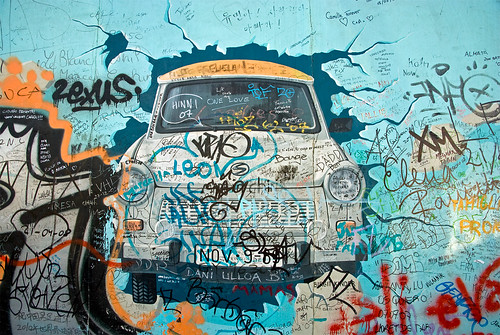
Five things I'm really fed up of:
1. Businesses insisting on massaging (messaging?) the humanity out of their best efforts to communicate with humans. There's a kind of insanity in that which is beyond grotesque.
2. The desparation for certainty. The world has always been adhoc, hard to measure and unwilling to yield to your command and control simplicity. Learn to love the opportunity within the cloud of 'vague'.
3. The allure 'mass' still has despite our niche know-how and why. Twitter trends; 'ooh I'm on the tele', 'I've got more friends/followers than you' - you know it doesn't make sense. Just let go.
4. Those who think they can 'use' us (that's me and you, kid) as a channel.
5. Anyone who thinks the conversation is trivial. They belittle what it is to be human and the value we place on relationships. Their loss.
and... breathe. (image courtesy)
Oh go on then, tell me what you're fed up of.
Showing posts with label command and control. Show all posts
Tuesday, August 18, 2009
Monday, December 08, 2008
ISP censorship reveals fragility of our connections
Looks like a number of UK ISPs have been 'persuaded' to censor your internet.In quick summary, a series of UK ISPs have bowed to pressure from the online watchdog the IWF (a quango) to block access to a wikipedia page about rock band The Scorpions. The row is about an image from one of their album covers - of a naked girl.
From the Beeb: "...the IWF, which warns internet providers about possible images that could be linked to child abuse, said it had consulted the police before making its decision."It's not clear if the ISPs or the IWF had even spoken to wikipedia before taking the action it did. After all wikipedia has (controversially) frozen pages in the past when libel issues have emerged. And surely child abuse is at least as big a concern to all parties as libel?
The ISPs have not just blocked the picture in question, they've blocked text and, wikipedia says, blocked many peoples ability to edit parts of wikipedia. (Image courtesy)
The issue reveals a wider and painful truth we must face:
The internet is created by us, is connected by us. It is ours - but our access to it - our very ability to use it - is not.
While ISPs are run by people who can be threatened with legal action by the centre (Governments and the like) they can be controlled. Mobile operators are already subject to rule after rule about what can and can't be distributed using their infrastructure.
That ISPs have come under so little pressure so far is something of a surprise. The reality is the centre can literally turn off all our access to the web tomorrow. And there's little we could do about it.
While the ISPs retain such power the network is at risk.
Yes, we are the distributors and in the idea of the eighth mass media I claim:
"We are the connections. We are also how the connections are made."
At least, we are when the eighth mass media arrives. What this ISP censorship issue reveals is that it is not yet with us. We don't have as much control over distribution as we'd like to think - as much as we must ultimately demand.
Peer-to-peer distribution requires the means to distribute. And that remains in the hands of the centre.
Only when the distribution itself becomes more distributed itself, a loosely connected network of nodes itself rather than these giant central on/off hubs, only then will the risk to the network be removed.
The eighth mass media requires the free distribution of metadata beyond silos to increase our ability to connect one to another. But one of the biggest silo walls remaining is centralised ownership of ISPs.
I have a feeling we have accepted and tolerated this only as long as the potential power the ISPs holds remains unused.
Examples like today's wikipedia clampdown give us cause for concern and raises questions about how long we'll tolerate this control.
And as we see time after time - people and their connections have a way of finding their way around control.
Friday, August 22, 2008
The more you control, the less you control
I've been thinking about how messages are spread in the networked world, how our connectivity, our group-forming nature, finds ways around control and mediation of all forms. And how going with this flow rather than working against it is more likely to result in 'your' message (it becomes theirs the moment you let go) being passed on.Much of that is illustrated in this post, and in this slidedeck.
This doesn't just apply to messages, of course, but to anything that becomes over processed. Where the intention is control, the result is often the opposite. (image via flickr by Mike McHolm)
Those who feel confined, restricted, halted by those controls and structures simply work around them. There are lessons for companies, government, education and more in this.
Anyone who has adapted to living in the network won't stop doing what they want to do, they just won't do it with you.
Monday, December 17, 2007
Star Trek is wrong
It's that time of year when we start thinking about predicting the future. I've just done a little work on that for the consumer media part of emap (the Bauer-bound bit for those who follow corporate affairs).And before the week is out I'll publish a few thoughts of my own about what'll happen in 2008 (my guesses about 2007: 12 months ago ).
First, I wanted to pause and think about the impact of point of view on predictions. Fairly obviously, It is exceptionally difficult to see beyond that which you are experiencing.
For example. What does the future look like for Gene Roddenberry? Essentially - stick the military in space and give them warp drive. No shock then, that he served with distinction in the US Army Air Corps.
Captain Kirk. Captain? Isn't that a little command and control, hierarchical? Think of most popular science fiction and the visions are the same.
Sometimes they nightmarishly play out what happens when command and control, when the centre, gets too much power and influence over the minutiae of our lives (1984, anyone? Orwell started his working life as a policeman.)
I fell for it myself when I started on my great-unfinished-novel in 1987. If your context is a world of disconnectedness, of centre-out control, this will colour (and generally darken) your view of the future.
The internet (and the web that layered over it) began to emerge in the late 1980s (and became more easily public-facing in the early 90s with the arrival of html - and the joy of documents).
The internet has no hierarchy or central control. No one ordered it built. No one controls who links to who, no one says what can and can't be published, when, where or by whom. No one controls the horizontal, no one controls the vertical...
We haven't had long to digest this networked world, for its influence to seep into your collective consciousness and help us shape the stories of the future we want to tell.
It is a new and all-encompassing context. It changes everything - disrupts everywhere it touches - visions of the future included.
History is our story-telling about the past. Science Fiction is our collective story-telling about the future.
When we do tell new stories about the future, ones inspired by a networked world, it seems likely those stories will be created by the interaction of many people - crowd sourced, co-created if you like. A shared vision of a networked world.
Will they have the blockbuster appeal of a Star Wars? Some will. Some will resonate for many. But even the hits will be wiki-style stubs - a starting point for new stories to grow from.
So, when my predictions for 2008 get slung towards you later this week, expect them to be heavily influenced by the world I live in - and mine is the networked world... and all the brighter for it.
Subscribe to:
Posts (Atom)
FasterFuture.blogspot.com
The rate of change is so rapid it's difficult for one person to keep up to speed. Let's pool our thoughts, share our reactions and, who knows, even reach some shared conclusions worth arriving at?

![Reblog this post [with Zemanta]](http://img.zemanta.com/reblog_e.png?x-id=c9a3f12d-8a6f-4542-b80b-0f7fa0bd9188)