Showing posts with label government. Show all posts

Thursday, July 21, 2011

The march to open business is inevitable - so why aren't you acting?

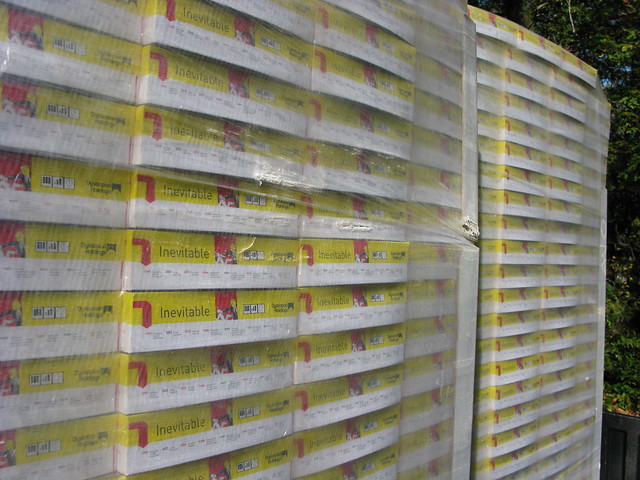
A shipload of Inevitable being delivered right now...
One of the first questions we should ask ourselves when considering any strategy is the one about inevitability.

If a thing becomes inevitable – even at some distance in the future – it’s kind of dumb not to start planning for it – preparing to adapt to it.

It’s part of the risk assessment phase. There it becomes ‘how inevitable is this?
If you score its inevitability at even 50% then there is significant risk that this outcome is going to have a huge impact on the way you conduct your business, where and who with.

One macro example: Is it inevitable that Greece or a.n.other Eurozone country defaults? What percentage score are you going to give that? What level of risk does that then level at your org? What do you need to prepare to change as a result?

Ok.

Now ask yourself what score you are going to give the inevitability of the voice of your customers impacting your marketplace – just as it has taken down Governments in the Arab Spring and killed Britain’s biggest-selling newspaper? Is the social media genie going back in the bottle - or is it going to continue to spread its game-changing impact through more of the media, through all kinds of government, through education, the law - and every kind of business? How inevitable is this march towards the need to be open, to engage, to make productive partners of customers and clients?

How inevitable? 50%?

It’s more isn’t it?

What level of risk does that then level at your org? What do you need to prepare to change as a result?

And isn’t it time you started?
Enhanced by Zemanta

Friday, July 08, 2011

The end of The Age of Being Told What To Do

Image via Flickr - and free to share anywhere!
The end of one of Britain's oldest newspapers marks the end of the Age of Being Told What To Do.
British politician's must be privately sighing with relief (or more likely laughing themselves dizzy). Because this spells out if not the end of the power of press barons, a very significant reduction in it.
The News of the World is one of NewsCorps. Part of the vast Murdoch media empire. It is an empire which has given the Murdochs huge power. They have used it to threaten, cajole, instal and topple Governments. They backed one party or another - and went on witch hunts and mud-slinging exercises to attack those who they did not annoint. Through this they have seeked to control how we are governed.
Successive generations of Britain's leaders have cow-towed to this power. It's been embarrassing to see them cringe before Rupert and Co.
Now politicians are waking to the realisation that Murdoch's media power has gone - and that learning has to impact every press baron remaining on the planet.
The rapid and angry response of the people took down the News of the World - destroying the brand. And that response was only able to grow, aggregate and self-organise to impressive effect because of the social tools now at our disposal - the social media. We didn't need to be told how to think, or what to do.
A community of purpose organised and created change, fast. The web lowers the cost of group forming. But the important bit is that these aren't any old groups. These are groups of people with shared purposes: Communities.
And communities lower the cost of getting things done.
No longer is the power at the centre - it is at the edge.
We, the edge, the self-organised, have achieved what Governments could not - we have brought the press barons to heel.
Of course there will be emergent clusters and clumps of influence, flocks to be turned in the peer to peer world where influence now resides. We don't all have equal influence - power if you like - all of the time. But it is us, the edge that will do the flock turning.
Messages are no longer done to us, but done by us - or at the very least with our considered consent. We will share what we choose to share - and that is the only way in which information will flow in this space. We will no longer be told what to think by a huge source of power at the centre - we will influence each other.
But before the politicians raise a glass of champagne to the demise of the media baron, they must also note that their fate remains in the hands of exactly the same forces. They may believe they are the power at the centre but unless they take rapid steps to open up to the people they represent - and relinquish the control that dominates the current model - they will go the way of the News of the World and of the press barons.

Enhanced by Zemanta

Wednesday, April 28, 2010

Platform Government cuts costs AND improves services

Who ever wins, loses (or draws) the UK's General Election next month, we are in for a world of pain.

But that may equate to the single biggest opportunity we've ever had for fundamental, structural, governmental change (not the small c 'change' you may have heard the politicians tell you they want - theirs is the kind of change which leaves them in both command and control).

The leaders can tell you they will cut a smidgeon here to invest a little there but the reality of the burden of the UK's record breaking deficit and debt is that we must expect both a reduction in services AND an increase in the amount we all have to contribute for them.
If you had a contract between you and UK plc you would be quite within your rights to tear it up and take your business elsewhere.

Unfortunately we don't have that option (yet... the when of that 'yet' is quite another story which we must leave for another day. Suffice to say the networked world doesn't recognise geo-political borders).

Government, does however have an option which can both better target resources AND engage voluntary effort which will have the net effect of both cutting costs AND improving services.
And just as businesses require crisis to change (excellent performers, or flat-line ones like the Ad Industry tend toward head-in-the-sandism) so perhaps our crisis of cuts and tax rises will provoke just the kind of strategic shift in how we govern ourselves that we so clearly need.

I'm talking about Platform Government of course.
To reiterate: an organisation should use its available resources to discover people who care about the same issues they do, bring them together, surface what they think needs fixing and work with them (enable and join with them) to fix it.

Government - or 'resource allocation against the needs of the people' to give it its full name (ok, that's my definition) has:
  • Never had a better set of tools to discover the real time needs of people.
  • Never had a better set of tools to engage with people.
  • Never had a better set of tools to enable people. I'm talking about social networks, technologies and tools of course.
Government must be redesigned to meet the needs of, and take advantage of, this networked world.

Our current process of Government, like mass media, has been built to serve the lowest common denominator needs of a mass production world. It's resulted in one-size-fits-all policies, resource allocation (and, incidentally, political parties).

That world is ending.

Now we can all find people who care about the same stuff we do in real time. We can come together to discuss an issue. We can surface what needs fixing. And in engaging in the conversation we discover that we care enough about this thing that we are prepared to act to make it better (at least enough of us to make change). The Government can be a platform for exactly this kind of collaborative innovation.

Apply this to things such as policy development: Instead of a small group of Government appointed experts beavering away; share the aim.
A platform government approach would open its doors to that freely given expertise and insight.


And how about that issue of resource allocation? Ongoing online listening will not only reveal where the people who care about each issue are (so you can invite them to participate), it'll also reveal what the issues that matter are, where, and in real time. And it'll reveal this in a long-tail, rather than lowest common denominator, way - ie it will reveal all the niche interests that need serving, rather than the single biggest need.

The result of this is a wikifixing approach to resource allocation - to make Government services a better fit with actual, real-time need. That equals less waste and more effective services for more of the people they are meant to serve. Real efficiency.

The flipside (other upside of this remarkable win-win) is that in engaging people in the change they want, you get an army of volunteers to make the change happen. More people willing to take responsibility instead of leaving it to 'the government' to sort out. More people willing to put their action where their conversation is.

And that means better services can be delivered at lower cost because more of us get involved in making, sharing and delivering them.

We could maintain taxes at current rates, provide better services at lower cost, and pay off that deficit.

Oh, and we'd also end up with a Government people felt part of - which is kind of a good thing, since it was meant to be ours all along.

Who knows, we may even start trusting politicians again? Ok, maybe that's an ask too far...

Monday, March 22, 2010

Landing a man on the networked moon

Gordon Brown's plans to 'create innovation and personisation (is that customer-centric for the public sector?) in the delivery of public services will require rather more than faster broadband and a centre to understand and exploit the semantic web.
"Companies that use technology to interact with their users are positioning themselves for the future, and government must do likewise. Mygov marks the end of the one-size-fits-all, man-from-the-ministry-knows-best approach to public services.
"Mygov will constitute a radical new model for how public services will be delivered and for how citizens engage with government - making interaction with government as easy as internet banking or online shopping. This open, personalised platform will allow us to deliver universal services that are also tailored to the needs of each individual; to move from top-down, monolithic websites broadcasting public service information in the hope that the people who need help will find it - to government on demand."
Gordon Brown, PM. read full transcript

For Government,this is truly a mission on the scale of landing a man on the moon.

Not because it seems almost impossible to do, but because the scale of change, the number of barriers to overcome are so large, that essentially the UK system of government, the control from the centre model that matched the industrial age, must be utterly transformed to match the demands of the networked age.

I fear the announcement Brown made today in London is fundamentally too focused on the technology, too little on the organisational changes required to deliver the vision.

The UK Government, like every other government, like every other business, like every other organisation, must be redesigned on the principles of a networked business to deliver its purpose through a platform approach.

In this way they reduce the transaction costs of making things happen; turning a shared idea into an efficient 'fit' through the bringing together of communities of purpose.

There are no hard edges to networked organisations. There can't be. To scale and to enable they have to go beyond traditional boundaries. And they are not made by technology.

The fact that the technology enables transparency and connectedness like never before IS critical. But the desire for, and organisational design for, transparency and connectedness (for sharing; for scale through participation; for search to discover and help us organise through connecting us and our data; and for enabling the always on/not-always-available nature of the web (asychronous/synchronous) is the critical part - not the technology enabling it.

So Government - and all organisations aiming for longevity in this networked world of ours - must adapt (funny how my diagram below looks a little like rocket... perhaps it could land a man on the networked moon...):


Reblog this post [with Zemanta]

Tuesday, March 02, 2010

Angry of Percy Street

I'm fuming.

I've just wasted more than an hour on a call which could have lasted 30 seconds. If the caller had been upfront and honest.

An organisation called me because they had been 'given my name' in association with my work with NinetyTen and CitizensOnline (at least that's what they said). They felt we should be introduced to senior people in the UK Government to help effect change after the next election.

They asked questions about what I/we do. They listened carefully as I outlined the impact of the network on every aspect of our lives - and how what we do focuses on creating new efficiencies through social technologies.

They asked how we could see ourselves and our services fitting in with local government and national government requirements and processes.

And when I asked what they needed from us they said a 650-word document about what we do, to place in front of Public Sector commissioners (the people with the purse strings).

It would be part of a book (a page in fact) guiding these commissioners in what needs to change.

Oh - and that'll cost me £3995.

Stunned.

I'm angry (image by darrenhester) for a number of reasons:

1. I feel like a fool. I feel fooled. I was (mis)led on to believe there was genuine interest among senior government officials in trying to make sense of the power of collaboration, of wikifixing, of a platform approach to the organisation. In fact I was being asked to buy an advertorial. A 650-word listing. The whole approach was disingenuous and as far from transparent as I ever want to try to see through.
2. This is no way to serve the community of commissioners this content is intended for. Serving the community FIRST is a guiding principle in media for me. To do this you get the best, most relevant content you can get from all sources, rivals included. Certainly NOT JUST FROM THOSE WHO WILL PAY.
3. As a UK taxpayer, I'm concerned at the implication from the vendors of this listing that commissioners will spend public money based on a company's appearance (or otherwise) on a paid-for listing (you say 'book', I say ad listing.) Any UK public sector commissioners that does should be shown the door for both negligence and incompetence.

For the record, those of you with an interest in public sector (particularly commissioners), a number of 90:10 consultants have deep experience of working with UK Governments at both national and local level.

We use listening technologies to discover people who care about issues and use social tools to bring them together and surface their concerns to enable improved efficiencies in the production, marketing and delivery of products and services.

We don't need to appear on a paid-for list to tell you that. If you'd like to know how we can help you, give us a call, drop us an email, let's meet face to face. Ninety Ten awaits.

Just don't expect us to show up in a book sent to you free any time soon.

Tip for everyone else on planet earth: If you are expecting me to pay to create your content say so right up front. It'll save us both a lot of time.

Reblog this post [with Zemanta]

Wednesday, June 10, 2009

Digital access is about discovering value - not Mbs

The big idea at the heart of the Digital Britain interim report is 2mb broadband access for every home in the UK.

I've been thinking about the issues of access a lot recently - mostly prompted by my work as a Trustee at CitizensOnline.org (which I, of course, recommend to you :-). (I should make clear before I go on, the following are my views - not necessarily those of Citizens Online.)

For a start 2mb isn't very much these days. If it was a real (rather than 'as advertised') 2mb that would be a start. My 8mb home connection rarely actually delivers half its claim. (thanks BT).

But that is very much only half of the story. (image courtesy)

Speed of access to the internet is not the same as speed at which something can be broadcast at you via broadband.

Speed of access is - just like all the best things about the internet - about a two-way flow.

The internet is created by us, with us. You are a participant and contributor to it. To access it is therefore to have an equal ability to contribute to it as it is to draw down from it: So 2mb download and upload speed, please.

But the story of access is about more even than this. It is one thing to have connection to the pipe - and a nice fat two-way one at that - it is quite another to get your share of the value.

It's a little like Victorian Government sending a free set of encylopaedias to every home, only to discover only the rich kids benefit - because they know how to read.

It's time to think about the equivalent of teaching people how to read and write. on the web - making their ability to participate and share a core foundation of how the UK as a whole benefits from the digital revolution.

Let me give you a real and personal example. If the very nice people at the Government decide in their wisdom to provide free wifi in the road my dear old mum lives in it she'll get precisely zero value from it. Zip, nada, until such time as someone either gives her an interface to access participatory sites with such ease it's like popping the kettle on. Or until such time as someone invests the time and trouble to show through demonstration the value she could join in.

Access to the value creating power of the network is little to do with access to a particular terminal at a particular speed.

How many people got real value from the early internet; from the dial-up modem internet; from the not-always-available internet - from the bloody-hard-to-use internet? Lots.

Those pioneers didn't need 2mb downloads to join in the value.

We wouldn't have today's internet if they had. They found value inspite of the limitations.

And they told their friends. Their friends joined in and made it bigger and better.

Their friends got value, told their friends etc etc ad infinitum.

Helping others discover the value available through the tools on offer is the crucial and critical thing here.

It's the part the Government should be focusing on with its reports and big ideas.

But it's also the part ALL of us can commit to doing something about.

Sure, you can lobby your MP to put pressure on for the Government to spend more cash on ever fatter pipes.

Or you can just coach one more person in the value you get from being online.

The more of us who make it to the edges - the less those in the centre have control over the big decisions anyway...

Reblog this post [with Zemanta]

Monday, June 08, 2009

Little bits of politics

The euro election results coming in today reveal yet another inconvenient truth for the old world of mass: a record low turn-out.

Roughly 6/10* elligable Europeans care so little about the policies and the messages of ALL political parties that they decided not to vote at all.

I wonder how many may have made the journey to the polling booths if they had known there would be an alternative box to tick? One that read:
The current system sucks. I want a new one - one that's relevant to me.
Those elected today can hardly claim a mandate. We're starting to ask what constitutes legitimate government? How low must a turn-out be before the result is considered void?

And yet everyone has an opinion about how they would like the world about them to be. The turn-out for that all-day every-day election is pretty much 100%. Current models aren't capturing how much we care.

The old mass broadcast model of democracy is being challenged just as all forms of mediation are, by the power of the network.

Our electoral system is devised to match a world of mass; of lowest common denominator; focus on the hit end of the long tail.

The Us Now movie raises some of the issues. But it doesn't challenge the basic assumption that we should be governed by massing us into geographic groupings.

Perhaps we choose not to be grouped in that way any more? Perhaps the global communities of purpose that emerge, when we get our hands on the tools of digital self-organisation, change politics and the concept of nation states as much as they challenge traditional media and traditional business models?

Perhaps self forming, adhoc, communities of purpose will become the new way in which groups are gathered to be governed and to govern themselves?

If you had to start from scratch with an electoral system today, knowing what we know now about the power of the network - and the power it gives us all, would we start from where traditional politics has delivered us?

Do you trust the judgement of everyone who gets to vote?

If our lords and masters at the centre don't deign to consider the impact of the network, I have a funny feeling we'll just end up working around them...

*Updated at 10:35am on official turn-out figures.


Reblog this post [with Zemanta]

Thursday, June 04, 2009

Come on out the land is lovely - part II

Missed this myself when it came out (May 22 copy of PR Week didn't make it to my desk). Colleague has now sent me this snap. So I'll share it with you.
It contains my thoughts on the appointment of the Government's Director of Digital Engagement.
You might have to click on the image to enlarge it to read it.
The eagle-eyed among you will realise my title is slightly squiffy - I'm Director of Social Media at Brando Social (important distinction around these parts...).
It's the result of the questions that made me write this.
Reblog this post [with Zemanta]

Thursday, May 14, 2009

Us Now: Democratizing democracy

I had the good fortune to be invited to the online launch of the Us Now documentary this week. Here's a clip:


It's a film about what the web reveals about ourselves - that co-operate is what we do - and what that means for government.

You can watch the whole thing (it's an hour) below. Or by clicking this link.

A particular highlight for me is one very high profile member of the uk government cabinet lost for words at the idea that the democratisation of publishing, distributing, creating, marketing (and critically, organising) could be deployed to democratize er... Democracy.

I won't spoil that treat for you because I'd love for you to see it yourself. Ideally I'd love for you to share it with someone who NEEDS to see it rather than someone who wants to. But do a bit of both. That way we'll get to more of the 'needy' through the 'wants!'

The film features lots of Clay Shirky (my personal favourite communicator on group forming network theory and the co-operative web) and Don 'wikinomics' Tapscott. (If you like your Clay Shirky talking heads bits, here's an interview I did with Clay last Autumn).

Us Now offers many examples of successful co-created businesses, such as zopa and ebbsfleet, challenges many traditional ideas but, for me, stops short of going beyond extending the empowered-shareholder model of co-created businesses.

But that's ok. This film is for those who need it. Slowly slowly catchy monkey.
But there was another jungle creature in the room. And the elephant on the impact of the globalising social web on politics is a mammoth:

Each nation's party system is a construct of the mass production age and the broadcast of one-size fits all ideology (who needs a lowest common denominator party in a world of self-organising adhoc communities of purpose?)

But of even greater challenge to our legislators is how self-organising cuts across state, national and religious boundaries.

The network disrupts where-ever it touches. And its reach is global.

Us Now was shown simultaneously in Harvard and at The Curzon in London. I was in London at the event staged courtesy of The British Council and thanks to an invite from Dominic Campbell. Chris Thorpe has been responsible for getting the entire hour-long film online.


Us Now from Banyak Films on Vimeo.

Reblog this post [with Zemanta]

Friday, March 14, 2008

Disaggregated Government, here we come

I saw Alex Butler speak yesterday; the Director of Transformational Strategy at the UK Government's Cabinet Office (cool title, btw)

She's facing an uphill battle - as anyone who is attempting to tackle the silo'd mentality of any organisation will attest. Her gig is to try to put the 'citizen' (read consumer for the rest of us) first - not the producers of the information (familiar difficulties in media, too).

Her problem is that each Government department wants to dissemminate its 'information' from its centre, out to the edge that is the citizenry. The result is something like (and it appears very hard to audit) 1500 government web sites.

And famously you may need to contact something like 40 government offices if you suffer a sudden bereavement. Not really putting the citizen first.

So the Directgov.co.uk site is an attempt to address this.

Alex says she understands the need for two-way flows of conversation, says government is learning from the success of e-petitions (that people actually want to take part in the legislative process) and is even considering the thorny issue of letting go of control - by offering government stuff as widgets and sources for mash-ups. Alex referred to NetMums (not a government site), revealing an understanding that local mums know best about services locally. Edge is best.

And at the end of this process you might conclude there will be no need for directgov.co.uk.
For example, if you want to go abroad; sure you need to know about passports and visas and whether or not your dog can come with you etc etc etc - all those government agency things... but you also need to know where you can book flights, hotels, car hire etc.

That government information is best deployed where it is of most use - eg when we're going through the 'consumer journey' of booking our travel.

So allowing government 'information' to be set free to be re-used by other relevant widgets/sites will mean the distribution is no longer controlled by the centre. And in citing NetMums Alex seems to understand that even the control of content is not always best performed from the centre.

Heartening. Makes me wonder what changes will be wrought to the machinery of government as a result. Disaggregated government here we come.

FasterFuture.blogspot.com

The rate of change is so rapid it's difficult for one person to keep up to speed. Let's pool our thoughts, share our reactions and, who knows, even reach some shared conclusions worth arriving at?