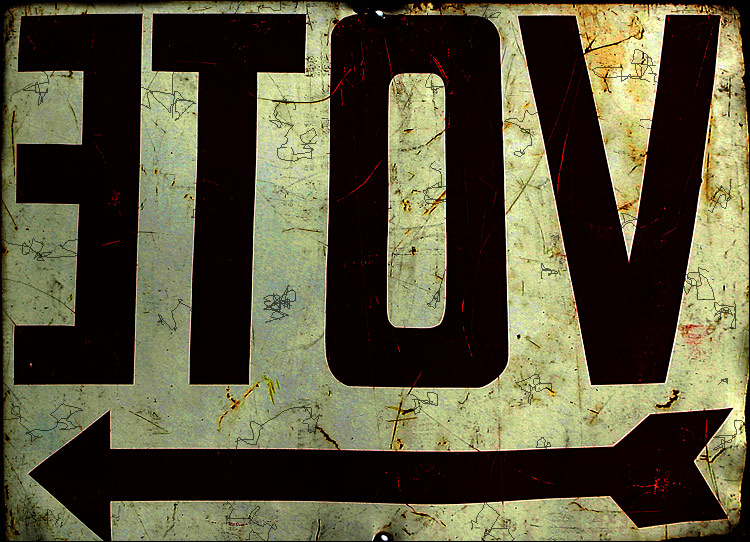
There are many preparing to put TV back on its pedestal thanks to the perceived influence of the Leader's Debates on tomorrow's (May 6, 2010) UK general election.
But just before we get too excited by a resurging all-powerful broadcast medium, let's pause to think about what's going on here.
The leaders debates have acted as social objects. There are many more people who have been influenced by the conversations of their peers in response to the debates than can possibly have been influenced by watching the debates directly themselves. (Image courtesy Dean Terry)
Influence in isolation is a tough ask. We derive our understanding, our opinion of, our view of - our emotional response to, the leaders debates not through our direct individual experience of them, but through our social interactions with those around us.
The value of a social object is in the interactions it inspires - far beyond that first-generation direct encounter between user and object that we had broadcast at us in our lounges.
Don't believe me? Then why does one group see David Cameron 'winning' a debate while another calls it clearly for Gordon Brown? The content was the same for both sets of observers. The qualities of the social object are not intrinsic in it; they are extrinsic in our response to it (recommendation is in the eye of the receiver). The qualities of the social object are generated by our social interactions.
Which is why the biggest impact on the election result is in the interaction between peers - made so rapid and easy by the social tools at our disposal.
It is not TV wot won it - victory, if it derives from anywhere, is overwhelmingly to be found in social media's ability to connect and amplify our social selves. The ubiquity and simplicity of those tools is what has changed since previous elections.
So it was Twitter wot won it, it was Facebook wot won it. It's your friends wot won it.
We're all publishers now, My Sun.
Showing posts with label Gordon Brown. Show all posts
Wednesday, May 05, 2010
Monday, March 22, 2010
Landing a man on the networked moon
Gordon Brown's plans to 'create innovation and personisation (is that customer-centric for the public sector?) in the delivery of public services will require rather more than faster broadband and a centre to understand and exploit the semantic web.
For Government,this is truly a mission on the scale of landing a man on the moon.
Not because it seems almost impossible to do, but because the scale of change, the number of barriers to overcome are so large, that essentially the UK system of government, the control from the centre model that matched the industrial age, must be utterly transformed to match the demands of the networked age.
I fear the announcement Brown made today in London is fundamentally too focused on the technology, too little on the organisational changes required to deliver the vision.
The UK Government, like every other government, like every other business, like every other organisation, must be redesigned on the principles of a networked business to deliver its purpose through a platform approach.
In this way they reduce the transaction costs of making things happen; turning a shared idea into an efficient 'fit' through the bringing together of communities of purpose.
There are no hard edges to networked organisations. There can't be. To scale and to enable they have to go beyond traditional boundaries. And they are not made by technology.
The fact that the technology enables transparency and connectedness like never before IS critical. But the desire for, and organisational design for, transparency and connectedness (for sharing; for scale through participation; for search to discover and help us organise through connecting us and our data; and for enabling the always on/not-always-available nature of the web (asychronous/synchronous) is the critical part - not the technology enabling it.
So Government - and all organisations aiming for longevity in this networked world of ours - must adapt (funny how my diagram below looks a little like rocket... perhaps it could land a man on the networked moon...):
"Companies that use technology to interact with their users are positioning themselves for the future, and government must do likewise. Mygov marks the end of the one-size-fits-all, man-from-the-ministry-knows-best approach to public services.Gordon Brown, PM. read full transcript
"Mygov will constitute a radical new model for how public services will be delivered and for how citizens engage with government - making interaction with government as easy as internet banking or online shopping. This open, personalised platform will allow us to deliver universal services that are also tailored to the needs of each individual; to move from top-down, monolithic websites broadcasting public service information in the hope that the people who need help will find it - to government on demand."
For Government,this is truly a mission on the scale of landing a man on the moon.
Not because it seems almost impossible to do, but because the scale of change, the number of barriers to overcome are so large, that essentially the UK system of government, the control from the centre model that matched the industrial age, must be utterly transformed to match the demands of the networked age.
I fear the announcement Brown made today in London is fundamentally too focused on the technology, too little on the organisational changes required to deliver the vision.
The UK Government, like every other government, like every other business, like every other organisation, must be redesigned on the principles of a networked business to deliver its purpose through a platform approach.
In this way they reduce the transaction costs of making things happen; turning a shared idea into an efficient 'fit' through the bringing together of communities of purpose.
There are no hard edges to networked organisations. There can't be. To scale and to enable they have to go beyond traditional boundaries. And they are not made by technology.
The fact that the technology enables transparency and connectedness like never before IS critical. But the desire for, and organisational design for, transparency and connectedness (for sharing; for scale through participation; for search to discover and help us organise through connecting us and our data; and for enabling the always on/not-always-available nature of the web (asychronous/synchronous) is the critical part - not the technology enabling it.
So Government - and all organisations aiming for longevity in this networked world of ours - must adapt (funny how my diagram below looks a little like rocket... perhaps it could land a man on the networked moon...):
Related articles by Zemanta
- Every British Citizen To Have a Personal Webpage (yro.slashdot.org)
- Brown to hail superfast broadband programme (guardian.co.uk)
- Berners-Lee Calls For Government Data Transparency (yro.slashdot.org)
Tuesday, February 23, 2010
No 10 Bullying row: The unintended victim
The whole National Bullying Hotline mess of the last couple of days (links below will fill you in on the row surrounding British PM Gordon Brown) has had one unintended victim: BullyingUK.
This genuine and effective charity has been tarred with a very nasty and impactful brush. Some of its would-be clients - many of them vulnerable school kids - have been put off by the fear that their confidentiality will be breached - in the same way (very much allegedly) that No10 staff reportedly had theirs breached by The National Bullying Helpline.
So let's be very clear BullyUK has absolutely nothing to do with the self-proclaimed National Bullying Helpline.
And if the national press, and the Conservative Party care as much about bullying as the screaming headlines suggest, then perhaps they will join me in donating to BullyingUK right here and now.
They have a lot of damage to repair.
Perhaps you will join in too?
I should make clear, BullyingUK have been very careful not to solicit donations during this sensitive period for fear of accusations of cashing in. And I think that's very wise.
But (and in line with the platform approach I advocate all organisations take) I'm equipped with the belief and the tools to play my part in righting this wrong. And now, so are you.
So let's do what they can't. Together. You'll find them on twitter, too.
Donate, by all means - but ask others to, blog about this, tweet about it. Thank you.
This genuine and effective charity has been tarred with a very nasty and impactful brush. Some of its would-be clients - many of them vulnerable school kids - have been put off by the fear that their confidentiality will be breached - in the same way (very much allegedly) that No10 staff reportedly had theirs breached by The National Bullying Helpline.
So let's be very clear BullyUK has absolutely nothing to do with the self-proclaimed National Bullying Helpline.
And if the national press, and the Conservative Party care as much about bullying as the screaming headlines suggest, then perhaps they will join me in donating to BullyingUK right here and now.
They have a lot of damage to repair.
Perhaps you will join in too?
I should make clear, BullyingUK have been very careful not to solicit donations during this sensitive period for fear of accusations of cashing in. And I think that's very wise.
But (and in line with the platform approach I advocate all organisations take) I'm equipped with the belief and the tools to play my part in righting this wrong. And now, so are you.
So let's do what they can't. Together. You'll find them on twitter, too.
Donate, by all means - but ask others to, blog about this, tweet about it. Thank you.
Friday, August 14, 2009
The NHS: A case of viral love, belief and the enemy
And that's ok. Really useful things - things that are a really good fit, are a fit for long-tail-like-low numbers by virtue of their true relevance to those who find them useful.
But many a marketing director still dreams of the kind of mass numbers of mass broadcast.
They want their mass cake and eat their niche one too.
The envious eyes hungrily watched the growth of #welovethenhs on Twitter.
They saw it grow so fast it crashed Twitter, attracted Prime Minister Gordon Brown to join in (and his PR savvy wife Sarah) and... finally the mainstream press ran another story about Twitter. Lots.
(By the way, how did the BBC arrive at the claim 'The Twitter campaign has attracted more than a million followers ' - that's not a stat that's publicly available as far as I know.)
An aside on that: This very regular transfer of twittered tales to mainstream media is all a little odd.Anyway. Back to the matter in hand. Why did #welovethenhs grow so fast and wide?
1. It seems wise enough of the press to report on how people are talking about stuff. Before social media journalists did vox pops or listened in pubs. We (us people, not them journos) always were the content. But back then we weren't publishers or distributors. Social media allows us to fulfill all three roles now. Which I guess is why the press reporting what we had already thought, published and distributed makes them seem a little like the proverbial spare apendage at a house of ill-repute...
2. Reporting that people are organising to show how much they are prepared to fight to defend the NHS is a huge story politically. Yet the press continues to report on the tools (Twitter) rather than the action. Like I keep saying, we're trying to change the world - not report on it.
Here are my best guesses. Feel free to add your own to the comments.
1. It was NOT directed from the centre.
This is no Government-organised PR stunt. As far as I can work out some graduates in Edinburgh started the ball rolling (update: Dan at Twibbon, started the twibbon - which is going wildy well - comment from him below. He also tells me the instigator of the hashtag is Graham Linehan, best known as the writer of Father Ted.
2. It is a belief which people can share, rally to and advocate.
3. It is a belief that was there already. The #welovethenhs became a tool those who shared the belief could use to find one another.
4. It's emotional. So are we. One tweet I saw summed it up. 'everyone has someone in their family who owes their life to the NHS'.
5. Someone threatened the thing we all believe in. Hello Sarah Palin and the American right. Her description of the NHS as evil not only revealed how slippery her grasp on reality must be, it got our backs up - making us more ready to act.
6. The tools were easy to use and perfectly adapted for peer to peer transmission in the wonderfully viral conditions of Twitter. ie twitter's hashtags and trends.
7. Influencers got a simple way of wearing a badge to support the campaign in every conversation they had - the simple but effective twibbon.
Labels:
belief,
Gordon Brown,
mass media,
NHS,
purpose,
Sarah Palin,
twitter,
viral
Subscribe to:
Posts (Atom)
FasterFuture.blogspot.com
The rate of change is so rapid it's difficult for one person to keep up to speed. Let's pool our thoughts, share our reactions and, who knows, even reach some shared conclusions worth arriving at?

![Reblog this post [with Zemanta]](http://img.zemanta.com/reblog_e.png?x-id=85cb264d-f98c-4f39-9ed4-e8974f88f557)

![Reblog this post [with Zemanta]](http://img.zemanta.com/reblog_e.png?x-id=96b7e785-1a93-419b-9cc0-528f810b0e67)

![Reblog this post [with Zemanta]](http://img.zemanta.com/reblog_e.png?x-id=5ac6f368-7ab2-4a5e-bbcb-bcc7abd44bac)
![Reblog this post [with Zemanta]](http://img.zemanta.com/reblog_e.png?x-id=b8e6a146-0948-448d-966a-4f78022caeaf)