Showing posts with label social business. Show all posts

Wednesday, January 09, 2013

Welcome to the Open Business mission

I was delighted to discover that Luis Suarez (@elsua on twitter) long time social blogger, famed for his attempts to banish email and for his KM work with IBM, has committed 100% to the Open Business cause.
His blogpost yesterday comes at the end of a series on social business/enterprise and concludes that it's time to move on, to lose the 'social' and to celebrate the Open.
Luis Suarez: Inspiring Open Business
I remember when back in the day, nearly 10 years ago, when I first started blogging, both internally and externally (Nearly 8 years ago for the latter), one of the themes I decided to go for as its own category was Social Computing, then Social Networking. From there onwards Enterprise 2.0, followed by the Social Enterprise and, lately, Social Business. That was all part of what I felt was the evolution of social networking in a corporate environment. Well, as of today, and while I move on shifting my focus into that where to next … I have created a couple of new categories. One of them is just a renaming activity from a previous one. The other is an entirely new category that I will be using to post articles on that particular topic from here onwards. It will also mean how, after 6 years, I’m starting to sense it’s time to move on from those fully loaded monikers of Social Enterprise or Social Business, since, you know, they eventually mean something completely different altogether and it’s probably a good thing to move on anyway.
That’s why Social Enterprise / Social Business from here onwards, for yours truly, are going to beOpen Business, following further up the superb piece of work that David Cushman did in setting up the stage of what Open Business is all about during the course of last few months. You may want to go ahead and start reading “The 10 Principles of Open Business“, or “Introducing Open Business“, or perhaps check out the Open Business Council to find out more about it and you will see how for a good number of years this blog has been permeating through plenty of the vision David shared across with that new concept of how businesses should operate. I know it’s not new, for sure, I mean, openness has been there all along, but if you read further into the principles that David shared across about this topic you would see how we still need to do plenty of work about it. And that’s essentially what I am planning on doing from here onwards.
I'm flattered that my work on Open Business (with Jamie Burke) has inspired you Luis. Inspiring Open is core to how I work.

If anyone would like to catch up on the 10 Principles of Open Business (a book on which is coming soon), start here.

But please also go and take a look at Luis' blogpost, and those leading up to it - join in shaping what Open Business can become.

I wonder if he can inspire IBM to make the leap from social to open business, too...

Monday, August 06, 2012

Introducing the Open Business Program

Here's how I'm thinking right now...

Organisations must adapt to the needs of a rapidly changing world; one which demands ever greater connectedness, openness and meaningful relationships with customers. 

Too often the seismic shift we are experiencing is being dealt with on an issue-by-issue basis. Reactive piece-meal tactics create a permanent state of panic-ridden catch-up. Learnings are lost in silos, failures are swept under carpets. 

I believe there is an holistic strategic solution which provides a framework for change, leap-frogging the tick-box exercise of simple implementation of social technologies. It makes organisations future-ready like never before. That solution is Open Business. 


Enhanced by Zemanta

Tuesday, July 24, 2012

Open Business: Principle 1 - Purpose

I've just published the second in the series of blog posts on the Principles of Open Business over on 9010group.com.
Here's an excerpt:

Most organisations are good at ‘What’ they do and ‘How’ they do it. But ask them Why? And things get trickier...
Most when asked about Purpose will point to Mission Statements.  Unfortunately in the majority of cases a Mission Statement begs a further question: Why?
Many are written along the lines of “To be No1 in our chosen markets and sectors returning maximum value to shareholders”.
Why?
That Why is important. It is what brings people together, motivates them, inspires them to support your cause. In a connected world in which the organisation’s role is to act as a platform to help others achieve a collective shared Purpose, it is essential. It is how you succeed.
Read the full post on 9010group.com
Enhanced by Zemanta

Wednesday, January 04, 2012

IBM's evolution of business - expert views

Here's the fifth in the series of videos provided by IBM on the future of 'Social Business'. I'm delighted that this time around they've included at least some reference to OPEN business and to my role not only as a 'thought leader' (ie blogger) but also as a practitioner (Co-Founder of the Ninety10 Group)

You can see the previously released versions here, at least those featuring my contributions.

Just to reiterate - I'm very keen on making the distinction betweeen 'Social' Business and 'Open' Business for positive reasons. This from a previous post on the subject:
"There's little wrong with social business and much that is good. But it rarely inspires business leaders. In fact I know a very senior business journalist who has never even heard the term.
And when I was invited in to IBM to talk about Social Business in London... I made the point that few CEOs will feel comfortable with turning their business into a social one. The term creates unhelpful mental blocks. IBM folk reported similar concerns.
Why make life more difficult when what we all want is change for the better?
"So what's the difference between Social and Open Business?
Here's three distinctions I see:

1. It's not about the tools - it is about Behaviours:

Often social business conversations focus on implementing software. Open Business urges you to think Behaviours first. What are people doing, what can and will they do? If you are starting with tools you'll likely starting in the wrong place.

2. Think less about messages and more about products.
Open Business urges you to consider ways of making things with the people for whom they are intended; for the best possible fit with real need; for efficiency; for results people care about. Messages are an outcome of this process - not its purpose. Talk 'social' and all roads will lead you back to messages.

3. Ditch the customer.

No, really. Stop thinking about customers. Customers are people you intend to do things to. Open Business urges you to think about the long-suffering customer as partners to work with instead. It pushes those people deep into the production process - right to the start, to join with and be supported by the org in delivering the things all parties want - all partners want.

"Tools/Behaviours

Messages/Products
Customers/Partners

"There are differences: Critical ones in transforming how business is done. "

Enhanced by Zemanta

Thursday, December 22, 2011

Top 5 Posts of 2011

I've written more than 50 blogposts this year. But 5 have stood out for the attention they have received.
In case you missed them, or would like a reminder. Here's the top 5: in reverse order of popularity (as measured by views).

5. We Don't Connect To Be Marketed To:
In which I posit the outrageous suggestion that we don't form groups to be, er, marketed to. And we might be wise to try to figure out why groups do form in order to engage in a process that values all parties. More.

4. Ditch The Customer If You Want To Transform Business:
An appeal to think differently about your relationship with the people you intend to serve. Open rather the Social Business; Behaviours rather than Tools, Products rather than Messages, Partners rather than Customers. More

3. How Riots Spread - Expressed Through the Medium of Dance
My attempt to explain what was really going on when London's rioters hit the streets in the summer - and the real threat their self-organising abilities pose to traditional Government. Plus a great video. More.

2. The Two Kinds of Social Media Strategy
There are two kinds of social media 'strategy'. And they service two kinds of orgs; the ones which see social media as a channel through which to sell stuff and the ones who realise that social media offers a bigger opportunity to become an Open Business - with all the benefits that apply. There's a simpler way of putting that: There are the orgs that are prepared to change, and those who are not. More

1. 'Top Stories' Reveal Facebook's Broken Strategy
What Facebook's focus on lowest common denominator news among friends (Top Stories) reveals about their strategy - and what that's headed in the wrong direction. More 

Friday, November 25, 2011

Perspectives on Social Business... can we be open?

A few weeks back I got asked in to IBM to share my thinking on 'social business'. Of course I made it very clear that I thought the term somewhat unhelpful - and that I would prefer we talk about Open Business.

I also attended in not only my capacity as a thought leader (blogger) but also as a practitioner (MD Ninety10 Ltd UK and Co-Founder Ninety10 Group.com).

I'm hoping we'll get a bit more of both those things in the final edit we're still due to get from the day - on the Future of Social Business.

In the meantime, take a look at the videos below. Contributions from me on both.


Enhanced by Zemanta

Thursday, November 10, 2011

Ditch the customer if you want to transform business

At FT Innovate in Londom this week much of the conversation was about the role of social media in innovation.
Martha Lane Fox advocated business leaders get themselves involved in social media in her keynote.
But it was clear that for most the best this means is the opportunity to get an ever-better understanding of the customer.
Which sounds on the face of it a very excellent thing - a step up from social as 'earned media' or attempting to use people as your choice of broadcast channel.
But there's something missing. And the missing bit is one of the three quick indicators of the difference between what gets referred to as 'social business' and what I urge you to consider instead, Open Business.
Open Businesses are purpose-led platform-thinking organisations. They use their available resources to discover people who care about the same things the org does, bringing them together to surface their concerns and working with them to support them in resolving those concerns. It means outcomes which are a better fit with the real needs of those for whom they are intended.
There's little wrong with social business and much that is good. But it rarely inspires business leaders. In fact I know a very senior business journalist who has never even heard the term.
And when I was invited in to IBM to talk about Social Business in London last week I made the point that few CEOs will feel comfortable with turning their business into a social one. The term creates unhelpful mental blocks. IBM folk reported similar concerns.
Why make life more difficult when what we all want is change for the better?
So what's the difference between Social and Open Business?
Here's three distinctions I see:

1. It's not about the tools - it is about Behaviours:
Often social business conversations focus on implementing software. Open Business urges you to think Behaviours first. What are people doing, what can and will they do? If you are starting with tools you'll likely starting in the wrong place.

2. Think less about messages and more about products. Open Business urges you to consider ways of making things with the people for whom they are intended; for the best possible fit with real need; for efficiency; for results people care about. Messages are an outcome of this process - not its purpose. Talk 'social' and all roads will lead you back to messages.

3. Ditch the customer.
No, really. Stop thinking about customers. Customers are people you intend to do things to. Open Business urges you to think about the long-suffering customer as partners to work with instead. It pushes those people deep into the production process - right to the start, to join with and be supported by the org in delivering the things all parties want - all partners want.

Tools/Behaviours
Messages/Products
Customers/Partners

There are differences: Critical ones in transforming how business is done.


- Posted using BlogPress from my iPad
Enhanced by Zemanta

Thursday, March 25, 2010

Plug collaboration into your business


Bringing communities together, co-creating, collaboration, open source... open ended?

The whole notion of businesses without walls can be very difficult for those embedded in traditional organisations to imagine. Where to start? Where does it end?

So at (disclosure, I work there) 90:10 we have been working on a whole series of products to help those organisations benefit from the value created by co-creation in a rapid, outcome-oriented way. First, clear, effective action-oriented steps.

They each have deliverables and outcomes, fixed and short timescales (from 1 week to 3 months) and fixed prices to go with them.

The following slidedeck reveals our approach. If you're interested in the products themselves and how they can create value for your organisation - let me know.

Reblog this post [with Zemanta]

Wednesday, March 03, 2010

Can you help design the future?

I've been lucky enough to bag myself a place at the SOMESSO / Headshift Social Business Summit in London on March 18.
Places are limited to 100 and keynote speakers include Jeff Dachis and JP Rangaswami. It's very much not just a passive consumption event though. Attendees are expected to help design the future.
If you'd like to join us, I do have a limited number of discount codes available to distribute.
To get one, drop me an email (davidpcushman AT gmail DOT com) and - if you don't feel I know you already - outline why you think you should be there.
See you on March 18.

If you're US-based, can I point you at an event which Ninety Ten (the company I work for) is supporting in New York on April 19: Social Business Edge. It's run by 90:10 collaborator Stowe Boyd.

And if you've got your social biz thinking cap on, please consider submitting a nominee for the latest round of the Social Business Innovation Awards. Thanks.

Tuesday, March 02, 2010

Angry of Percy Street

I'm fuming.

I've just wasted more than an hour on a call which could have lasted 30 seconds. If the caller had been upfront and honest.

An organisation called me because they had been 'given my name' in association with my work with NinetyTen and CitizensOnline (at least that's what they said). They felt we should be introduced to senior people in the UK Government to help effect change after the next election.

They asked questions about what I/we do. They listened carefully as I outlined the impact of the network on every aspect of our lives - and how what we do focuses on creating new efficiencies through social technologies.

They asked how we could see ourselves and our services fitting in with local government and national government requirements and processes.

And when I asked what they needed from us they said a 650-word document about what we do, to place in front of Public Sector commissioners (the people with the purse strings).

It would be part of a book (a page in fact) guiding these commissioners in what needs to change.

Oh - and that'll cost me £3995.

Stunned.

I'm angry (image by darrenhester) for a number of reasons:

1. I feel like a fool. I feel fooled. I was (mis)led on to believe there was genuine interest among senior government officials in trying to make sense of the power of collaboration, of wikifixing, of a platform approach to the organisation. In fact I was being asked to buy an advertorial. A 650-word listing. The whole approach was disingenuous and as far from transparent as I ever want to try to see through.
2. This is no way to serve the community of commissioners this content is intended for. Serving the community FIRST is a guiding principle in media for me. To do this you get the best, most relevant content you can get from all sources, rivals included. Certainly NOT JUST FROM THOSE WHO WILL PAY.
3. As a UK taxpayer, I'm concerned at the implication from the vendors of this listing that commissioners will spend public money based on a company's appearance (or otherwise) on a paid-for listing (you say 'book', I say ad listing.) Any UK public sector commissioners that does should be shown the door for both negligence and incompetence.

For the record, those of you with an interest in public sector (particularly commissioners), a number of 90:10 consultants have deep experience of working with UK Governments at both national and local level.

We use listening technologies to discover people who care about issues and use social tools to bring them together and surface their concerns to enable improved efficiencies in the production, marketing and delivery of products and services.

We don't need to appear on a paid-for list to tell you that. If you'd like to know how we can help you, give us a call, drop us an email, let's meet face to face. Ninety Ten awaits.

Just don't expect us to show up in a book sent to you free any time soon.

Tip for everyone else on planet earth: If you are expecting me to pay to create your content say so right up front. It'll save us both a lot of time.

Reblog this post [with Zemanta]

Monday, February 15, 2010

Social Business Innovation Awards: Jan 2010 winner

We have a winner in the first Social Business Innovation Awards: January 2010. Securing 62% of the vote, the winner is...

Image representing BusinessCard2 as depicted i...Image via CrunchBase


BusinessCard2.

I haven't used it myself but... in a nutshell: LinkedIn taken beyond the silo.

It beat off better known (at least to me) challengers Twelpforce (2nd with 14%) and Local Motors (with 10%).

Check out all the January 2010 nominations here (along with the purpose of the awards).

If nothing else, January's vote has served to surface something new to me - and likely new to you too. We're discovering stuff we didn't know we needed to know about.

So BusinessCard2 becomes the first to enter our Social Business Innovation Hall of Fame. The process of selecting the next to join it will be started when we open nominations later this month for the February 2010 award. Please join in.

Here's BusinessCard2 co-founder Lief C Larson (of Workface Inc) on what makes BusinessCard2 a good example of social business innovation:

How our model works:
"Individual-level transparency is a major opportunity in the future of social business. We have created BusinessCard2, a service that helps professionals network and exchange business cards online without face to face interaction.
"Tens of thousands of users have created a card with us. The card acts as a web container that holds all the information that makes us digitally distinct: a utility to inform and educate. Customers and prospects use it to peer deeper into the great people behind the company. Fundamentally we believe business is about two people forming new connections.
"To help BusinessCard2 users reach more customers and prospects, we built unique technology that makes the card portable. For instance, those with a card can visit BusinessCard2-enabled websites and drop their card. BusinessCard2 was built to most closely mimic the process of sharing business cards in the real world, but as a process on the internet.

How social tools are used to innovate:
"BusinessCard2 is itself a social tool. It has been designed to provide portability beyond any singular walled garden social network. However, we have also implemented ways that BusinessCard2 can be shared in existing social networks, such as Facebook and Twitter.
"From my perspective, business isn't just about those you all ready know (the current social network), but also about reaching out to those you don't yet know (the network potential). Our technology road map is focused on using the social infrastructure to build visibility within specific markets and help give our users the tools to form new connections.

Case study:
We are not focused on specific user case studies at this time. There are so many different use cases for BusinessCard2 that calling out specific instances does a disservice to it's potential. Rather, we are focused on how BusinessCard2 is incorporated into many different social situations: from social networks like Facebook, to high-traffic websites, to CMS (such as blogs, wordpress, etc.). I have a three minute video here that shows how to integrate BusinessCard2:


"I also have a brief video here that helps you understand what BusinessCard2 looks like.

BusinessCard2 on Social Business:
One of our core beliefs is that business is not just about companies, products, and services - but about meaningful connections between two people. At the organizational level, a company is defined as the sum of its parts.
"The parts are the people. We seek individual-level freedom and transparency at the professional level. We aspire to help power the autonomy of any person engaged in business to take their identity with them across the web. We hope to help help encourage social business by giving the public open access to the millions of incredible people behind the companies, products, and services we use every day.
"Each person who creates a BusinessCard2 has formed a social compact where they have complete control over their identity, and agree to expose that identity openly across the web. You do not need to log in to BusinessCard2 to view a person's card. Anyone with a BusinessCard can take their card anywhere they wish and share it freely."


Reblog this post [with Zemanta]

Friday, February 05, 2010

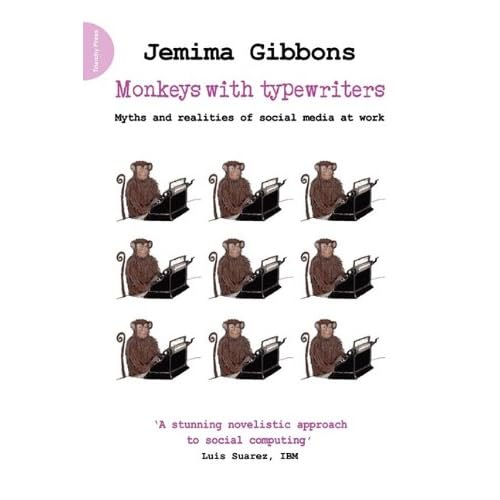
Book review: Monkeys With Typewriters:

I went to Essex University with Jemima Gibbons. In fact, we were both elected to serve on the same small editorial committee of Vulture, the student union rag. I’d tell you what year that was. But I'm too much of a gentleman…

We found each other again less than a year ago. Via Twitter, naturally. She came along to a hastily arranged tweet-up in Camden Town – which was where she told me about the book she was completing. Had we stumbled upon each other earlier Jemmia says I'd likely have played a cameo in Monkeys With Typewriters myself (insert your own gags here).

Jemima’s book is “a novelistic approach to social computing” according to Luis Suarez.
It certainly has a story-telling quality – scenes described, images evoked.

I’ll admit it wasn’t an approach I was comfortable with at first, but it grew on me – and I found myself drawn in attracted by the page-turning storyness of it.

It’s a story in which I happen to know a great many of the characters. ‘Social’ is a relatively small world – particularly in London where the majority of the plot unfolds. Perhaps that added to the fascination… I kept reading on looking out for the next friend to get a mention…

Sometimes there is more story-telling description than actual insight – but that’s not altogether a bad thing.

Many, when faced with creating a mass media portrayal of the interwebs (book, magazine article, latest BBC4 TV series…) default to a way of describing aA Big Thing that it is out to do and who is out to do this big thing and to whom – very centre-out notions and essentially a broadcast approach.

The reality is the web is what it is. It is all of us. It is what each of us makes it. It is what emerges from our interactions. There is no grand plan, there is no editorial committee…

Jemima’s approach (and the clue is in the title, Monkeys With Typewriters… brave when your surname is Gibbons) is much closer to the latter ‘reality’.

It’s a guide book for those in organisations coming to terms with the shifting sands beneath their feet (as hierarchy and central control are swept away and improved upon by adhoc self-forming communities of purpose).

And it’s a guide book that is more practical than most, coming complete with buzzword demystification and a 30-step guide to ‘getting social’ thrown in.

If you’ve spent a lot of time thinking about the impact of group forming network theory then this is probably not the book for you. But if you’re just starting to understand that everything the network touches it will disrupt, then Monkey’s With Typewriters will set you on the right path without making your brain bleed. And we all know someone who could do with that.


Reblog this post [with Zemanta]

FasterFuture.blogspot.com

The rate of change is so rapid it's difficult for one person to keep up to speed. Let's pool our thoughts, share our reactions and, who knows, even reach some shared conclusions worth arriving at?