Showing posts with label social media strategy. Show all posts

Tuesday, July 22, 2014

The strategic role of content in proving brand promise

Click the image to see at full size
Social Media has confused many marketers for many years. Mostly because it isn’t a media. It’s an exercise in relationship building.

It tends to be thought of as a channel of amplification – “hey social guys, here’s my great idea/piece of content (ah hem, advert) go do magic to make it famous”.

It is, of course, a channel of advocacy.

In many ways social has more in common with the promise proving role of CRM and loyalty than it does with promise making role of brand strategy - not least because social is and always has been the single most effective way to have an open door to your customers at scale.

Whether you open that door to gather data (information about the needs and wants of customers and potential customers) or to build relationships (with customers, and potential customers) what is clear is that you don’t throw that door open and try shouting through a megaphone through it.

So, to help clarify the role and effectiveness of social content – and that of other content, I’ve developed this simple model (see diagram above).

You’ll note that I’ve annotated each of the bands with ‘Awareness, Consideration, Conversion’. This is something of a simplification (evaluation is, for example also taking place in social – and there are cross-overs, social can also deliver awareness and consideration, and it’s not unheard of for ATL (above the line) to trigger an immediate sale) but they do, I believe, focus on what each of Brand/Content/Social strategy is best at delivering – and therefore a guide to where the focus of each should be.

Social is a conversion channel because it is the truth medium. It is where we report the truth of  experiences – and it is where we turn (to each other, to our friends) to discover the truth behind the promises. This is where the proof of the promise a brand strategy makes and a content strategy brings to life is either made or has its bubble burst in spectacular fashion.

Google’s ZMOT (Zero Moment of Truth) - the point at which the purchase decision is made (a conversion is delivered) is therefore the point at which we discover a friend’s positive report of the truth of the brand’s promise. So social’s focus is on building advocacy in small audiences (right down to one to one) through rich relationships in modes of content where the user has the control.

Content that has value in this is that which inspires, discovers, aggregates and/or amplifies reports of the proof of the promise. Why? Because that’s what drives conversion. The more easily a potential customer can discover a positive user-generated report of the brand’s promise being true – at the right time in their own decision making process, the more likely a customer is to buy.

A test for this comes when the shiny content guys come to call. “Hey social guys, here’s my shiny thing, make it famous for me!” To which the answer should be:

Sure. So long as you can give me positive answers to the following:
        Will it build advocacy?        Will it build trust/relationships?        Is it in the user’s control?

If so feel free to ‘amplify’ through the relationships social has built. If not, stick to the channels most appropriate for building awareness…


Thursday, December 22, 2011

Top 5 Posts of 2011

I've written more than 50 blogposts this year. But 5 have stood out for the attention they have received.
In case you missed them, or would like a reminder. Here's the top 5: in reverse order of popularity (as measured by views).

5. We Don't Connect To Be Marketed To:
In which I posit the outrageous suggestion that we don't form groups to be, er, marketed to. And we might be wise to try to figure out why groups do form in order to engage in a process that values all parties. More.

4. Ditch The Customer If You Want To Transform Business:
An appeal to think differently about your relationship with the people you intend to serve. Open rather the Social Business; Behaviours rather than Tools, Products rather than Messages, Partners rather than Customers. More

3. How Riots Spread - Expressed Through the Medium of Dance
My attempt to explain what was really going on when London's rioters hit the streets in the summer - and the real threat their self-organising abilities pose to traditional Government. Plus a great video. More.

2. The Two Kinds of Social Media Strategy
There are two kinds of social media 'strategy'. And they service two kinds of orgs; the ones which see social media as a channel through which to sell stuff and the ones who realise that social media offers a bigger opportunity to become an Open Business - with all the benefits that apply. There's a simpler way of putting that: There are the orgs that are prepared to change, and those who are not. More

1. 'Top Stories' Reveal Facebook's Broken Strategy
What Facebook's focus on lowest common denominator news among friends (Top Stories) reveals about their strategy - and what that's headed in the wrong direction. More 

Friday, July 29, 2011

The two kinds of social media 'strategy'

There are two kinds of social media 'strategy'. And they service two kinds of orgs; the ones which see social media as a channel through which to sell stuff and the ones who realise that social media offers a bigger opportunity to become an Open Business - with all the benefits that apply.

There's a simpler way of putting that: There are the orgs that are prepared to change, and those who are not.

Social Media Strategy 1. 
This requires the gathering of evidence from which to derive org/brand-specific insights. The evidence is gathered in a structured way, from all stakeholders, across operational axis - creating a living and live strategic framework for best-fit delivery of not just discovery and engagement of relevant customers and potential customers, but also of methods with which to deliver products and services with those for whom they are intended. It is the framework which keeps on giving - a platform for social media excellence to apply across the org now and into the long run.
This first kind of strategic approach is the one taken by organisations who, 'get strategy'. They appreciate that any project is far likelier to fail than succeed if the evidence and insight phases are absent. They have learned that much energy, time and cash is wasted in wild goose chases driven by ego or gut instinct.
They seek to remove risk by increasing knowledge.

Social Media 'Strategy' 2:
And then there's the other kind of 'strategy'.
These are the orgs that ask for 'a social media strategy' but mean - 'please, let's go straight to tactics'. They rely on the experience of an expert - the gut of their judgement. And as the small print always says - past performance is no guarantee of future results. The only possible outcome is a generic 'strategy' since no evidence has been gathered and no insight derived to make it an org-specific plan. And one thing I'm damn sure of in the world of the web - one size most certainly does not fit all.

Those who tend to select this approach are likely to see social media as just another channel through which to sell stuff to people. And they want to know how where and when.
This approach delivers short-term campaign-style results. It's cheaper. But, of necessity, more prone to failure.
It's quite quick and easy to get to that 'know the channel' stuff. What's harder is making the org ready to connect with its consumers in this open way. The two-way flow is typically not something they have been used to.

They have yet to establish what is required of them from their customers, what needs to change within the guidelines, governance, roles, job descriptions and so much more to make the most of the participation coming their way.
And when their rush-to-tactics delivers poor results who and what will they blame?

I'm counting the days until we collectively wise up enough not to describe that second kind as 'strategy' at all.
That's going to require some honesty from both sides.

Enhanced by Zemanta

Wednesday, March 09, 2011

The fool walks into the swamp with eyes shut

The fool walks into the swamp with eyes shut. The wise man takes a map - and a stick.

So stop. Stand still. Pause. Every organisation and business engaged in any form of social media activity... halt! The swamp is undiscovered territory. Fraught with risk for the ill-prepared. Stand still for a moment.

There are few areas of business life where we go to tactics - plunge headlong into the swamp - without knowing the strategic landscape.

Fewer still where we buy a map only to find we don't understand what it tells us - and carry on buying the updates without complaint.

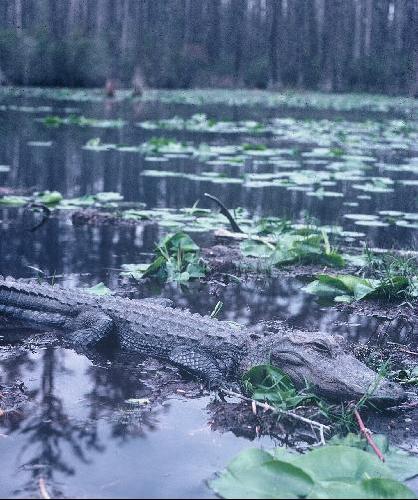
Yet when it comes to social media it seems firms are happy to go tactical before they think strategic. And it's costing them millions and casting a shadow of fail over the social landscape. (Image courtesy jstephenconn )
"I stepped into the swamp and sank/got bit". Really? Who's surprised here?

They may conclude the swamp is somewhere they should never go again: Which is a little like giving up on attempts to find The New World because a fishing boat went down off the coast of Portugal - to mix my exploration metaphors.

Worse still, there are those who provide (and charge for) heaps and heaps of social monitoring data - without insight. It's the equivalent of the surveying guys with the theodolites giving you their scribbled latitude and longitude notes but failing to draw you a map.

"Ah - so this bit here is 29°16' N, 94°49' W. Er. Ok. So where do I go next?" you may well ask.

It's time the approach to social media strategy grew up.

And that means mapping the community landscape as it applies to you (understanding who is talking about what's relevant to you, where, how, who is influencing who in those conversations, where they sit in your purchase cycle even). That gives you the strategic landscape on which to deploy tactics.

And it also means auditing for and understanding the opportunities and blockages presented by your own organisation, your customers and other key stakeholders. From this you will develop a strategy and tactical plan for creating best value from social.

Do all this and I guarantee your action plan won't start and end at Start a Facebook Page.

It will deliver the transformational improvements required to make the org and its products and services the best (read most efficient and effective) fit with the networked world - with its customers and their needs.

Friday, December 19, 2008

A shared model of social media strategy

Tom Nixon (he of Nixon McInness) has been working up a diagram to act as a model for social media strategy. It's going to be a creative commons project and Tom has already reached out to myself (at Brando-Digital.com - site going live any moment now!) and others to sense-check his initial proposals. The outcome of this initial tinkering is seen below.

What I've seen so far has been a remarkably detailed and deep reaching description of the Power of the Network and one I have very few quibbles with.

It has started life on the Nixon-McInness blog but, as we discussed off camera (you'll see a video below) we feel it's going to be wise to widgetise - and make the ideas and concept as portable as possible.

I'm already thinking about how we could create a truly interactive version of the diagram Tom has started us all off with. Something the team at Brando-Digital.com (my lot) could contribute, I'm thinking.


And I wonder if Dave Armano might consider throwing his considerable talents into the co-creation mix on this one? And with purpose core in the model, we're going to need Mark Earls, too. How about it fellas?

Tom and I met on Tuesday to talk about the project. And I shot this quick video of him elaborating on it.

I hope you will take up his offer to join in.

I'll be sharing this at the P2PR community, too.


Enjoy the street sounds :-)

Reblog this post [with Zemanta]

FasterFuture.blogspot.com

The rate of change is so rapid it's difficult for one person to keep up to speed. Let's pool our thoughts, share our reactions and, who knows, even reach some shared conclusions worth arriving at?