Some more stuff you need to know about 'influence'. (via @DarrenBBC)
Less rational (Homo Sapiens) - more Homo Mimicus.
Now, go back and think about the flock again.

The further ahead you look - the faster you go | davidpcushman AT gmail.com | These are my views and my views only.
Monday, February 08, 2010


Friday, February 05, 2010
Book review: Monkeys With Typewriters:
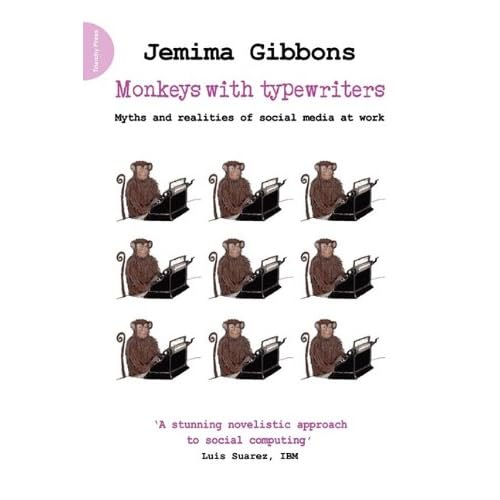
We found each other again less than a year ago. Via Twitter, naturally. She came along to a hastily arranged tweet-up in Camden Town – which was where she told me about the book she was completing. Had we stumbled upon each other earlier Jemmia says I'd likely have played a cameo in Monkeys With Typewriters myself (insert your own gags here).
Jemima’s book is “a novelistic approach to social computing” according to Luis Suarez.
It certainly has a story-telling quality – scenes described, images evoked.
I’ll admit it wasn’t an approach I was comfortable with at first, but it grew on me – and I found myself drawn in attracted by the page-turning storyness of it.
It’s a story in which I happen to know a great many of the characters. ‘Social’ is a relatively small world – particularly in London where the majority of the plot unfolds. Perhaps that added to the fascination… I kept reading on looking out for the next friend to get a mention…
Sometimes there is more story-telling description than actual insight – but that’s not altogether a bad thing.
Many, when faced with creating a mass media portrayal of the interwebs (book, magazine article, latest BBC4 TV series…) default to a way of describing aA Big Thing that it is out to do and who is out to do this big thing and to whom – very centre-out notions and essentially a broadcast approach.
The reality is the web is what it is. It is all of us. It is what each of us makes it. It is what emerges from our interactions. There is no grand plan, there is no editorial committee…
Jemima’s approach (and the clue is in the title, Monkeys With Typewriters… brave when your surname is Gibbons) is much closer to the latter ‘reality’.
It’s a guide book for those in organisations coming to terms with the shifting sands beneath their feet (as hierarchy and central control are swept away and improved upon by adhoc self-forming communities of purpose).
And it’s a guide book that is more practical than most, coming complete with buzzword demystification and a 30-step guide to ‘getting social’ thrown in.
If you’ve spent a lot of time thinking about the impact of group forming network theory then this is probably not the book for you. But if you’re just starting to understand that everything the network touches it will disrupt, then Monkey’s With Typewriters will set you on the right path without making your brain bleed. And we all know someone who could do with that.
![Reblog this post [with Zemanta]](http://img.zemanta.com/reblog_e.png?x-id=f81060ec-e7d4-4d3a-84c6-69863b404a16)
Thursday, February 04, 2010
It'll be a sad day when we finally understand influence
 A fascinating post by fellow 90:10er Stowe Boyd (... The Dark Matter of influence) has been rolling around my head since I read it yesterday.
Stowe discusses this Arvix Post, titled Best Connected Individuals Are Not the Most Influential Spreaders in Social Networks.
To summarise; influence is derived from how close you are to other influencers in a network - how low and short the number of links from you to how many other influencers (not the number of your connections, as often assumed).
Which validates why network analysis is such a crucial element when trying to 'identify influencers'. (image via Beth Harte)
Stowe concludes:
The subtle, dark-matter mystery of social networks is that influence is oblique, and not easily determined by the sorts of tools we have today.Influence is fluid. It resides less in the node and more in the interactions between the nodes. It is the interactions which change the state of the group, not a change in the condition of the nodes (think water H2O molecules and ice, water, steam - an example Mark Earls (another 90:10 collaborator) refers to in his book Herd. (Update, Mark has now posted his own response)
It is not your follower count, or who you follow, per se. But, instead, do you have short paths into other social scenes, both incoming and outgoing? That is the deep structure of being truly connected: bridging over different social scenes, acting as a conduit, a vector, a filter and amplifier for ideas good and bad, the best insights, and deadly viruses.
This means that giving interesting things to people to do together - bringing them together around things they care about (through shared purpose), to act on those things, has more value than spotting the influencer and giving them some sort of message you expect them to go off and influence others with.
Influence has a certain value: in crisis management, identifying those with the likelihood of having their voice heard by a greater number and in giving likely start points for the real job of peer to peer distribution. If you're going to try to turn the flock, you're bound to think it best to start off by working with the big birds.
And to Stowe's point about the tools, influence is complex, but not complicated. It can be deconstructed nuance by nuance; function by function.
One day - and perhaps quite soon - we will have the tools to fully understand it in real time. And that concerns me. Because at the point we can truly understand influence we're but a tiny step from using that power for ill. Manipulation, springs to mind. It could all become very 'broadcast'.
People influence each other. They change the state they are in. Help them find each other, support their conversation, help them act on it. That will always generate more value (for ALL parties) than an influential voice.
Be the platform.
![Reblog this post [with Zemanta]](http://img.zemanta.com/reblog_e.png?x-id=f9edf5c7-ec70-409c-8d28-3c6cdd78f8af)
Tuesday, February 02, 2010
The 3 Reasons People Join Groups

The success or failure of any groups that form, via pretty much any tools, comes down to the same thing - how well are you enabling those involved to achieve the three things they join groups to do? (image courtesy Kbaird.)
Three Reasons People Join Groups:
1. Express themselves: Usually this is support for or antipathy toward something. It's how people know that group X is one that cares about the same stuff they do.
2. Discuss what needs fixing about it.
3. Fix itFacebook has the tools for peer-to-peer comms - but pages and groups veer towards broadcasting at an audience without extreme caution. Success depends on what the community is given and in how much they talk to each other. Communities talk to each other, audiences are broadcast at.
One way 'founders' of groups can encourage more interaction is by appointing interested folk to roles in which they can take more ownership of the group. Obviously ongoing support for the group through tools, content and interaction is critical , too.
Few groups get past point 1.
To point 3, make clear in the group how people joining can help and what they can actually do to manifest that.
Peer-to-peer interaction is always less about the viral marketing of a message, more about bringing people together who care, to talk - and then act.
![Reblog this post [with Zemanta]](http://img.zemanta.com/reblog_e.png?x-id=531c073c-8601-4d1e-b203-6168c868a994)
Monday, February 01, 2010
Vote in the first social business innovation awards
 The nominations are now closed and the voting is now open in the first ever Social Business Innovation Awards. Don't worry if your favourites aren't on the list, we all get the chance to nominate again for the next month's when the voting closes on this round on Feb 11.
For those who missed the nomination phase, to reiterate, this is what it's all about:
Social business innovation: Efficiency and tranformation through the use of social tools.The winner will enter a Hall of Fame where we can collectively gawp upon fine thinking, share opinions and get inspired.
We have the best set of tools in history for people to find each other and act together to create and improve on the things that matter to them.
What are we doing with them?
Some businesses and organisations are grasping them to wikifix their products and services, to deliver best-fit R&D and NPD and join in waste-free people-powered communications and marketing. The wikifixing of the world has begun.
Those engaging in the process reach new levels of efficiency thanks to an ever-better fit with the needs of their partners - those formerly known as the customer. (By way of disclosure, that's what we at 90:10 Group help organisations with).
I hope you will join with me to celebrate the best of them - and through this find a path to the communities-of-purpose-driven future of the organisation.
So each month this blog will host a Social Business Innovation of The Month award, nominated by you and voted on by you. The format is very much inspired by Neil Perkin's ThinkTank.
The awards are to recognise great work in open/social business/organisational design/innovation/tranformation/efficiency using social technologies.
The winners will enter a case-study Hall of Fame to be shared with all - and in which the winners can revel in the glory of their peers' admiration ;-). More importantly, we can all get inspiration and guidance.
So, here are this month's nominees (note they do not have to be from the last month (at least initially), the monthly cycle is just to keep this rolling and keep us collectively scouring.
The Nominations are:
1. The City Square Project
VOTING CLOSES ON February 11, 2010. Nominations for the next (February 2010) award will open shortly after.
![Reblog this post [with Zemanta]](http://img.zemanta.com/reblog_e.png?x-id=cb9c72e4-a2c5-4e13-b25f-e9d0f9174126)
Subscribe to:
Posts (Atom)
FasterFuture.blogspot.com
The rate of change is so rapid it's difficult for one person to keep up to speed. Let's pool our thoughts, share our reactions and, who knows, even reach some shared conclusions worth arriving at?
