Showing posts with label yahoo. Show all posts

Tuesday, March 16, 2010

Twitter's Anywhere can change the game, the web and your life

Wow. Twitter made an announcement at SXSW (I'm not there, for the record) which, according to reports, got overshadowed by other events.

I don't want to go into that. I do want to make sure you don't miss the real story here. Something that is potentially beyond game-changing - it is life changing. And it is called @anywhere.

From Twitter's blog:
"When we designed Twitter, we took a different approach—we didn’t require a relationship model like that of a social network. Keeping things open meant you could browse our site to read tweets from friends, celebrities, companies, media outlets, fictional characters, and more. You could follow any account and be followed by any account. As a result, companies started interacting with customers, celebrities connected with fans, governments became more transparent, and people started discovering and sharing information in a new, participatory manner.

"We’ve developed a new set of frameworks for adding this Twitter experience anywhere on the web. Soon, sites... will be able to recreate these open, engaging interactions providing a new layer of value for visitors without sending them to Twitter.com. Our open technology platform is well known and Twitter APIs are already widely implemented but this is a different approach because we’ve created something incredibly simple. Rather than implementing APIs, site owners need only drop in a few lines of javascript. This new set of frameworks is called @anywhere."
It took hypertext to create the open, unsilo'd web of documents we see today.

We are waiting for something similar to do for the web of people what hypertext does for the web of documents. (image courtesy Erica Marshall)

And @anywhere sounds like it could be a judicious punt in the right direction.

Imagine if @anywhere could become a standard protocol for people's real-time meta data in the way hypertext has proved to be for documents?

That's potentially web changing - and therefore life changing. For all of us.

In its present iteration the @anywhere platform twitterises sites. Launch partners include eBay and The New York Times, Amazon and (watch out Google) Yahoo!

But surely the end game isn't about serving individual sites? Just as hypertext isn't about better internal navigation within a website. No, @anywhere is all about connecting people through the real-time expression of their meta data. So @anywhere is the building blocks of the twitterisation of the web - taking the real-time adhoc fuzzy-edged community-of-purpose forming that Twitter delivers beyond the silo of Twitter itself - and across the entire internet..

Imagine if all sites used it. And it all connected us from site to site. Beyond the silos.

Forget the 140character thing, that's just clever interaction design. It's the framework and standardising of a protocol emerging here which excites me.

Facebook Connect connects. But to me the way it connects people is in a hypertext, node-to-node way. The potential for @anywhere is to connect via interaction between nodes. And that's a much richer space with far greater opportunities to connect with people who share your real-time expression of need, a much greater opportunity to find each other when you need each other.

The value is in the interactions, not in the nodes. Twitter may just have identified that - and found a way to extract it.

And the great thing about value in interactions is that it is value in which we can all share. An even better way to find those who care about the same issue we do right now, come together and act to fix it.

Efficiency beyond the dreams of the broadcast world.

Reblog this post [with Zemanta]

Thursday, April 30, 2009

Your content at risk: A credit crisis for the co-created web

There are reports that flickr may be in trouble. Well, it is owned by Yahoo, so maybe we shouldn't be too surprised.

When loic le meur (he of Seesmic fame) heard this he wondered outloud (on twitter) if he should start backing up his years of images.

This is the social web's equivalent of a failing bank scenario.

We have invested our content in it and now we're fearful that we might have been better off stashing it under our mattresses. We're worried if the bank fails, our investment disappears. (Image courtesy Travis Truman)

When we contribute content that we value, in the joint creation of a site such as blogger or flickr, we not only insist on retaining ownership of our content (traditional media companies really struggle with that bit), we need confidence that this content will be stored safely and not evaporate over night. Just as we do when we hand our cash to a bank.

In both cases we hope to create a little extra interest for ourselves along the way and recognise that our service provider has to find a way of making a return on their investment (the platform or bank) in return.

If Flickr were to fail, how would that change your online generosity?

Of course, Flickr would not be the first to disappear, taking our treasured content with it. But it would be the first co-created giant of the social media age to tank.

Imagine the holes it's sudden desctruction would leave across millions of websites and blogs... there would be one on this blogpost, for a start.

Is Flickr is too big to fail? Given the interconnectivity of the web, can anything which stores and shares be allowed to fail?

Perhaps it is time for a bail out strategy - time for a global institution to guarantee our content investments are protected, the assets safely transferred and made accessible to us in the event of failure - so we can reinvest them elsewhere if we choose.

There are some regulation issues opened up by this, such as, do you have to comply with T&Cs of the bail-out guardians in order to have your web service covered? Who gets to set the rules? etc

But without some kind of guarantor does the web face a credit crunch all of its own where we as investors of our content start becoming more wary about who we will lend it to.

Let's not underplay this. These loans are the very reason businesses from twitter to facebook, wikipedia to google can exist at all.

The web has grown through peer-to-peer content creation and distribution. We contribute on the understanding we can always get it back (which at least means access it online and share it with others).

As we increasingly rely on the cloud for our storage requirements, the providers of those clouds will have to come up with protection for lenders which include exit/bail-out strategies whether lightning strikes or financial storms come.

What kind of terms and conditions would restore your confidence as a contributor? What terms and conditions would you find acceptable as a platform creator?

Reblog this post [with Zemanta]

Monday, March 31, 2008

Day one at Mobile Internet, Berlin

I've heard loads of interesting and challenging stuff today at Mobile Internet in Berlin (see 'speaking at' links, left). I've met some interesting people too.

I was twittering live throughout, as I will be on April 1 and 2. That means those that follow www.twitter.com/davidcushman get to ask questions, too.
Was great to hear from Antonio Vince Staybl, CEO at GoFresh/Itsmy.com from the stage and to have a conversation with him in a round table. I'm a big fan of itsmy's focus on community first and mobile first. They have an incumbent- rocking model. As Antonio points out a new media leads to new leaders; before cars there was no BMW. Before the internet, there was no google... before mobile there was no itsmy!
I also like the itsmy ad model. Users don't get a share of the revenues they create. BUT they do get to choose if their ugc carries adverts - and if it does, what sort of adverts. The users are allowed the power to treat the ads as content (the content as ads).
Interesting itsmy stats: The first pic of the recent UK earthquake was uploaded to itsmy within 30seconds (only content created on a mobile can be uploaded to mobile). Each user looks at 60pages per visit. 42% had never used a social network before using the mobile-only itsmy!

Cyworld's Christian-Peter Heimbach revealed the South Korean MoSocialNetwork is retreating to asia after a failed european experiment. Christian himself will crop up working in Brighton soon. Brighton types - give me a shout so you can welcome him in, he's a nice chap.

The Cyworld back-track was clarified after Jonathan Macdonald (following via twitter) asked Christian, via me, what the plans for a launch in the UK were. Answer, er none just yet. It's back to rebuild the aging tech with a view to returning someday soon.

Yahoo's Alex Romero had some nice things to say about my presentation (I was on before him, and before lunch!) and talked about new products such as oneconnect, among other things. It allows you to bring together all your social networks merging all your contacts. To which www.twitter.com/stoweboyd asked if yahoo thought this was something we actually want.

I caught up with Alex later and he explained the idea is more about a user gathering their routes to networks in one place - not sharing your digital identities and each identity's connnections. Need to investigate this a little more before drawing a conclusion, I feel.

Alex was fascinated by my eeepc. A few more sales coming Asus' way. Wonder when I'll get my commission...

I was also interested in Tim Hyland's youtube stats eg: every minute of every day 10 hours of video is uploaded to youtube. youtube uses more bandwidth today than the entire internet did in 2000.

Spent some time chatting to Luke Brynley-Jones of Trutap. Aim to catch up with him some more over the next few days. Luke revealed one user had sent 1200 messages in a day. Who knew thumbs could do that? And two Finlands a month are going on to contract in India each month at the moment. Now that's a growing market!

Finally (and apologies to those I haven't mentioned here, I may have reported previously via www.twitter.com/davidcushman) Martin Duval of orange gave us an interesting insight into the orange start-up programme which has orange working with vcs to develop and help new businesses take shape. He's creating a value web in the best traditions.

More from conference tomorrow, Follow it live at twitter.com/davidcushman and look out for opportunities to ask questions.

Starts again at 8am UK time.

Friday, February 01, 2008

Big deal

On a day on which the company I work for gets officially renamed under new ownership, here's a bit of perspective.
emap went under the hammer (in two separate bits) for around about £2bn (ok, give or take, but that's the ballpark). More for the detail hungry, here.
Microsoft is offering to buy Yahoo - got to be the most interesting deal of the year - for £22bn.
And just so we're all clear - that's Microsoft valuing Google's main rival at a little over 25% more than ONE social networking site - Facebook.
Is the value in the pointing (the links you get in your search return), or the people doing the pointing? (the people linking to each other).

Back to the intro... the company I now work for is Bauer Consumer Media. Expect me to be updating linkedin et al momentarily.

However, please note, all my contact details, role etc remain exactly as they were.

Tuesday, December 11, 2007

Video and thoughts from Widgety Goodness 07

So finally, I get a chance to share with you some stuff about Widgety Goodness. And it's all good.
I even shot (badly) some video on my Nokia N73, so you can get a sample of some (not all) of the speakers.
Here's some stand-outs for me:
1. Yahoo's Susan Mernit (coiner of the phrase Widgety Goodness) via video. What's next for widgets? Your ID/own data being migrated and embedded in widgets. She reminded us that web2.0 really means "we are the operating system".
2. Freewebs Chris Cunningham: "Widgets teach those who try them about engagement marketing, they require new engagement metrics - not CTR or PI.
"Widgets are pull, display ads are push. Widgets are about brand advocacy."
Chris (who I shared a cab with, and thanks for the lift!) says widgets need both a value utility AND and personal outcome.
And he points out that the widget is simply the lastest version of the increasing dominance of personal voice as we've moved from CRM, through corporate blogs to widgets today - and who knows tomorrow?
3. Open Intelligence Agency's Russell Davies: His presentation was more performance than lecture - and a fine illustration of adding value with imagery/sound/humour which is kind of his point. I have video of Russell. I don't wholly agree with his perspective. For example, he discusses (just before the video clip starts) the idea of the uncanny valley - the notion that as robotics become more and more human they start off kind of cute and end up kind of freaking us out. And he takes this idea and applies it to advertising messages. When they have the nirvana of complete knowledge about us what they serve us freaks us out. It makes us feel uncomfortable - cue nightmare visions of the Minority Report kind.
But I think you only end up there if the world remains a command and control, centre-out one. If you apply edge-in, community-focused approaches to the same dilemma I believe you end up less freaked out, more helped out. Russell gets 10 mins or so to state his case on video - so I thought it fair enough to make a counter-case?
The other thing I didn't get was his belief that ads that add value to products (eg the soft porn of perfume ads which transform a £3 bottle of liquid into a £50 fantasy fulfilled) were irreplaceable. I think this plays to the world as it is.
But when we're all involved in the conversation, when we're all involved in the co-creation, is anyone going to pay £47 for an image constructed for them and broadcast at them? So while I get his 'right now' point - and his premise that a widget can't do the job of fooling someone that a £3 bottle is worth £50, I don't think its a sustainable long-run position as the networked world disrupts. The networked world reveals the huckster.
Anyway - enjoy his presentation - I certainly did.


4. The widgetizers panel: Steve Bowbrick stuck an enduring image in our heads - The Darwinian Disco (not really sure why it's a disco, other than the alliteration...). Anyway, the notion is that the website building universe is Newtonian - massive, relatively slow-moving giants. The widgety world is more like little animals (warning - mixed metaphor ahead!) scurrying about in the undergrowth, swinging from tree to tree, adapting fast - or dieing. Websites are lumbering dinosaurs. (mixed metaphor over now... and relax).
5. Google's Matthew Trewhella: If only from an insight into the Gadgety Goodness of Google - and OpenSocial. See video.


6. Techlightenment's Ankur Shah on what Facebook teaches us about viral widgets. Watch the video, but the big take-away from me came in the q&as (and I'd put the camera down by then).
Ankur was challenged about the 'ownership' of data implied by how some of his widgets worked. But he calmly explained the data is only used when it is functional for the user. ie it only knows who and what you are while you are interacting with it. The data is not farmed/owned/kept/stored. This is a model of data usage (ie permission to use when the user allows) which I expect to become the norm.


Interesting stats:
Facebook accounts for 80% of widget consumption right now. The top 20% of Facebook widgets account for 80% for usage.

I went down to Brighton the night before the event to catch up with organiser Ivan Pope - and ended up joining in the co-creation of the conference in a tiny way - by stuffing T-shirts into goody bags into the evening! By the way Ivan - if you've got a spare medium...

Ivan's vision was to pull together some brilliant thinkers and case studies on the explosion that is widgets to try to work out what the uses of widgets are to real businesses.

His team pulled it off in double-quick time, too, and its success means Ivan is busily putting together the next Widgety Goodness, this time in New York in the summer of 08 (disclosure: Ivan has asked me to be part of the advisory panel for that event and to speak at it - so I hope to be playing a larger part in the co-creation of the next one).

Thursday, May 03, 2007

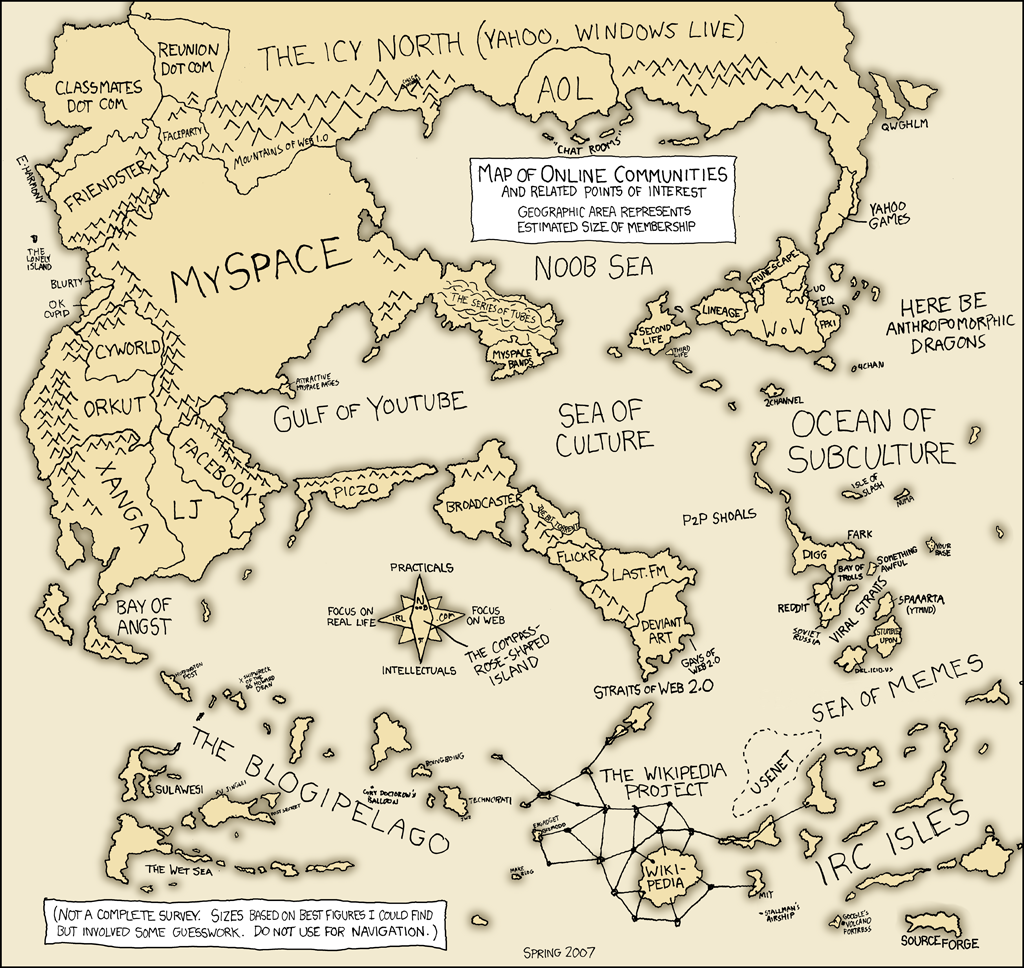
The Map of Online Communities


As found on XKCD.com
It's a map of online communities.
See it larger here
Amused me!

Microsoft buys ScreenTonic, Yahoo launches onesearch

A couple of fairly heavyweight mobile internet moments happened today, and this post is simply to log them.
Microsoft has bought ScreenTonic, the Paris-based mobile-internet advertising company. The firm felt it missed out on the disruption opportunity of the fixed-line internet (hello adsense!) and is 'positioning itself better' for this second internet disruption.
It'll be interesting to see how much they paid.
The second biggy today is Yahoo's launch of OneSearch - a locally biased mobile-focused search. It claims to be radical and new. Not sure how different it is to google's mobile search?

Tuesday, April 10, 2007

Yahoo launches its mobile internet advertising model

Yahoo weighs in. More here
This is interesting, particulary given yahoo's relationships with operators (eg 3).
Makes it easy for the mobile internet publishers to get their content funded. And look what that (google adsense) did for the amount of content on the fixed line internet.
Sounds like a similar approach to that taken by Nokia with its AdService.
But the great thing is this is global and will work with any mobile internet device. It's offered across the world and to a range of publishers (there is a sub 1 million page impressions a month level to select).
Yahoo says: "The Yahoo! Mobile Ad network lets you leverage Yahoo!’s scale and expertise as a global media powerhouse. Joining the network gives you access to Yahoo!’s worldwide sales force and its relationships with top advertisers across 19 countries. In addition to these advertisers, Yahoo! welcomes those of all sizes who have relevant offers for the mobile audience – increasing further the relevancy and volume of ad inventory available to you."
And more are coming. I hear google's mobile adsense is in test mode.

Friday, December 22, 2006

Digital media predictions for 2007

This will be my last day in the office before the New Year. I will attempt to resist updating this blog until then (about as likely as resisting the temptation of more Christmas chocs, to be honest...). However, I thought it would be a good time to make some predictions about 2007 - all of which you are very welcome to contend, add to or dismiss via the comments below.

So, I say, 2007 will be the year in which:

1) Access to the internet via mobile will surpass 40% of all internet use (globally).
2) A UK national newspaper will close its print operation. And a series of one-time print only magazine brands will become digital only (pick a number between 25 and 100).
3) Broadcast TV on your mobile will become commonplace. Sky will offer it as a bolt-on upgrade to your home services.
4) Microsoft/Google/Yahoo (one or all) will launch a mobile phone.
5) All mobile operators in the UK will follow 3 and offer fixed price mobile internet access.
6) A mobile operator will seek the edge by launching a fixed price for all services (ie £40 a month for all-you-can-eat internet, voice, text, mms...TV(?)
7) More than 10% of internet users will blog.
8) A citizen-journalism TV channel made up entirely of video shot on and uploaded from mobile phones will launch.
9) TV on demand will revolutionise how you consume TV and send advertisers into a blind panic.
10) A slow-burn campaign for users to claim back their digital identities will turn to a riot of noise by the end of the year...

Monday, December 04, 2006

Yahoo/Reuters embrace phone photo journalism

The NY Times and GigaOm are both reporting that Reuters and Yahoo will start incorporating UGC pictures and video in their reportage.
Cameraphone users will be able to go to You Witness News from Dec 5 to upload. The pictures will be curated by editors from both Yahoo and Reuters. Interestingly, Yahoo will not pay contributors, whereas Reuters say they will pay for anything that goes out via its' commercial services - it's just not sure how it will work.

The timing is certainly right. Following the oft-cited examples of the tsunami or London train bombings, just look for 'Michael Richards' on google or youtube. Even those not familar with Kramer or Seinfeld couldn't help stumbling across the footage of his racist outburst in a comedy club.

The real interest lies in which brands users will run to with their scoops. If you've captured a video of a newsworthy event, would you instantly want to upload it to Reuters or a Daily newspaper? Or would you rather upload it to Youtube, or your own blog?

Tuesday, November 21, 2006

Optimising for mobile: The time is NOW!

It occurs to me that optimising your website for mobile NOW has to offer significant strategic advantage.

Since mobile will become the primary access point for the internet within two years (probably less post 3's announcement of fixed-price 3G internet access last week) then it follows that those users arriving on the mobile web will prefer (and fall in long term love with) the first sites they find on the subjects they are interested in AND which are best optimised for the mobile user experience.

Brand will give you a head start - but if you offer a poor user experience (by not being optimised for mobile) then bye bye! Your user is off to find someone offering what you've got - on a mobile-optimised site.

We are in an internet ground zero situation.

Imagine being able to be at the start of the internet revolution knowing all that you know now. You are in that position now - if you recognise the mobile internet opportunity and move fast.

The alternative is to repeat the mistakes of sitting, watching, and following too late. The alternative is unthinkable.

eBay is already there, google is already there, yahoo is already there, microsoft is already there.

Where are you?

Monday, November 20, 2006

Yahoo goes shopping...

Yahoo has been on a multi-million spending spree, investing in MyBlogLog, a social netowrking site and tracking site for bloggers, and Bix, a site which lets anyone set up their own online content (see previous post on this blog HERE).
More on the buying spree, here.

And just to keep David happy here's Movidity.....who plan to launch movy.tv in January, allowing users to upload audio or video content, which gets converted in formats for most smartphones and PCs...but like the report writer, I'm not sure that a new start up will get people using the service, rather than waiting for youtube....unless an opportunistic Mobile operator gets involved, of course.

FasterFuture.blogspot.com

The rate of change is so rapid it's difficult for one person to keep up to speed. Let's pool our thoughts, share our reactions and, who knows, even reach some shared conclusions worth arriving at?